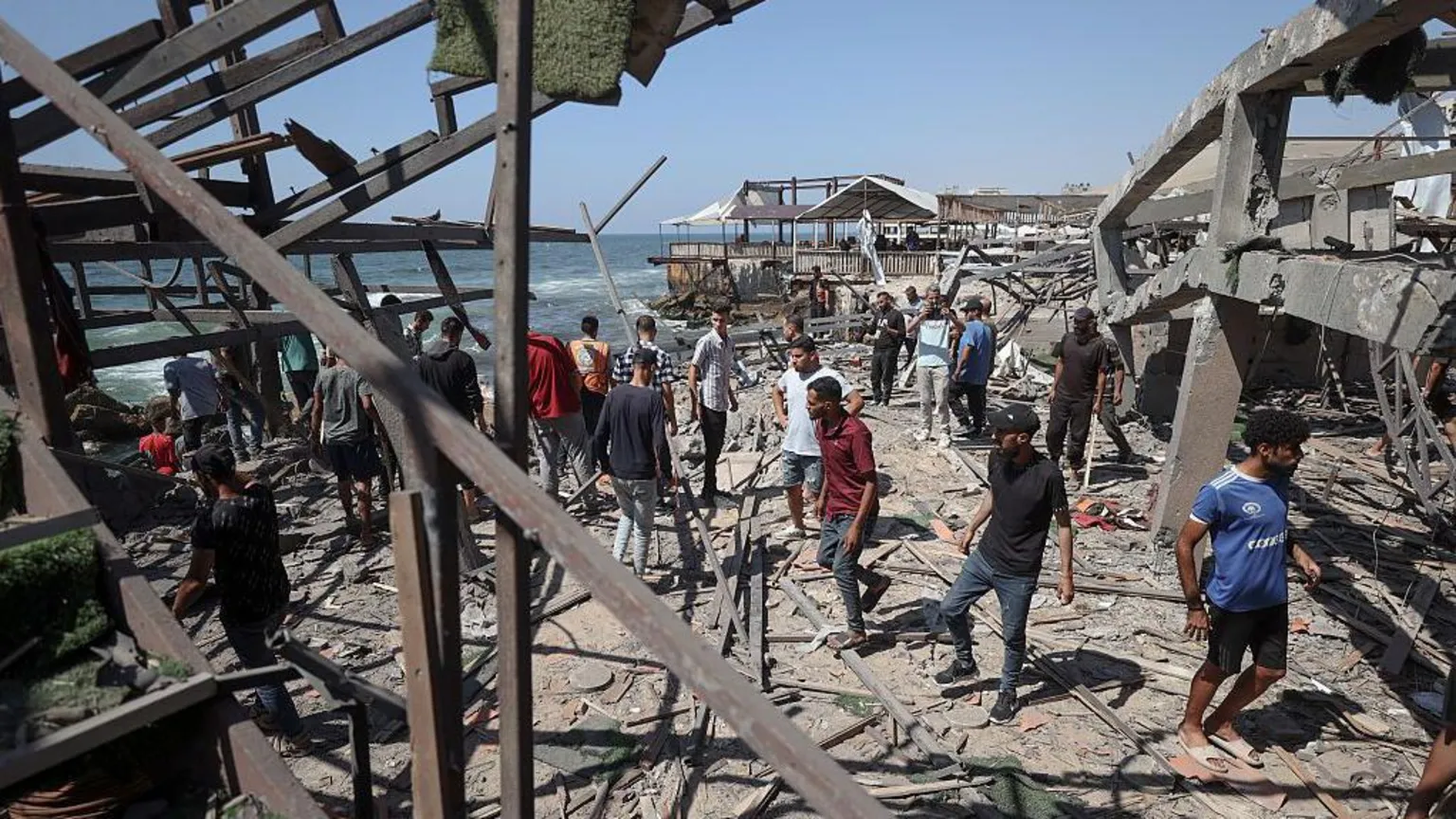
What began as an ordinary day by the sea ended in unspeakable tragedy when an Israeli airstrike flattened a popular Gaza beachfront café, killing at least 20 people and wounding many more, according to local rescuers and eyewitnesses.
The strike hit Al-Baqa Cafeteria, a well-known outdoor venue built from tents and wooden frames along Gaza’s western shoreline. More than just a café, it had become a refuge for journalists, remote workers, and young activists searching for a moment of normalcy amid chaos. On Monday, that sanctuary was reduced to rubble.
“I was just meters away, heading there to use the internet,” said local cameraman Aziz Al-Afifi. “Then the explosion came. It was hell. I saw the bodies of my friends, the people I speak with every day. Blood, fire, and screams everywhere.”
Emergency crews dug through a crater left by the blast, pulling out lifeless bodies and injured survivors. The images shared online show scenes of devastation — broken chairs, crushed laptops, and stunned civilians combing through the debris.
There has been no immediate comment from the Israeli military, though social media footage points to a missile strike likely launched from a warplane.
An Escalating Humanitarian Nightmare
The beach café attack came as part of a wider wave of Israeli airstrikes across the Gaza Strip. Residents described a night of terror, with dozens of air raids raining down on densely populated areas like Shujaiya, Tuffah, and Zeitoun. In some cases, the very schools sheltering displaced families became targets.
“It felt like the sky was falling,” said 60-year-old Salah from Gaza City. “We hear that a ceasefire is near — but all we see is death.”
The Israeli military had earlier issued evacuation orders to civilians in northern Gaza, pushing them further west into already overwhelmed areas. Yet most residents, having fled multiple times, say they are left with nowhere safe to go.
“This is the seventh time we’ve been forced to flee,” said Abeer Talba, a mother of seven. “No food, no water. We sleep in the street. My children are starving. At this point, death feels kinder than this.”
Ceasefire Promises vs. Ground Reality
While diplomatic chatter intensifies — with former U.S. President Donald Trump claiming Israeli Prime Minister Benjamin Netanyahu is “working on a deal” — people in Gaza say they have heard it all before.
The last ceasefire attempt collapsed in March. Since then, humanitarian aid has been severely restricted, and the controversial U.S.- and Israeli-backed Gaza Humanitarian Foundation (GHF) has come under criticism for failing to ensure safe aid distribution. Incidents of Palestinians being injured or killed while trying to access aid have become tragically routine.
The latest wave of violence has left more than 56,000 people dead in Gaza, according to the Hamas-run health ministry. Critics warn that without a real ceasefire and sustained humanitarian access, the situation will only worsen.
A President Under Pressure, A People Under Siege
As the civilian death toll rises, pressure on Israeli leadership is mounting. Netanyahu is being squeezed both by hardliners demanding a military victory and global allies urging him to negotiate a truce.
Meanwhile, in Gaza, a new generation of grief is growing up fast — children robbed of shelter, students of classrooms, and workers of the spaces where they once tried to find dignity in the digital world.
A café where ideas, news, and laughter once flowed now lies in ashes. And in its place is a crater — not just in the sand, but in the collective soul of a battered, bleeding city.
About the Author