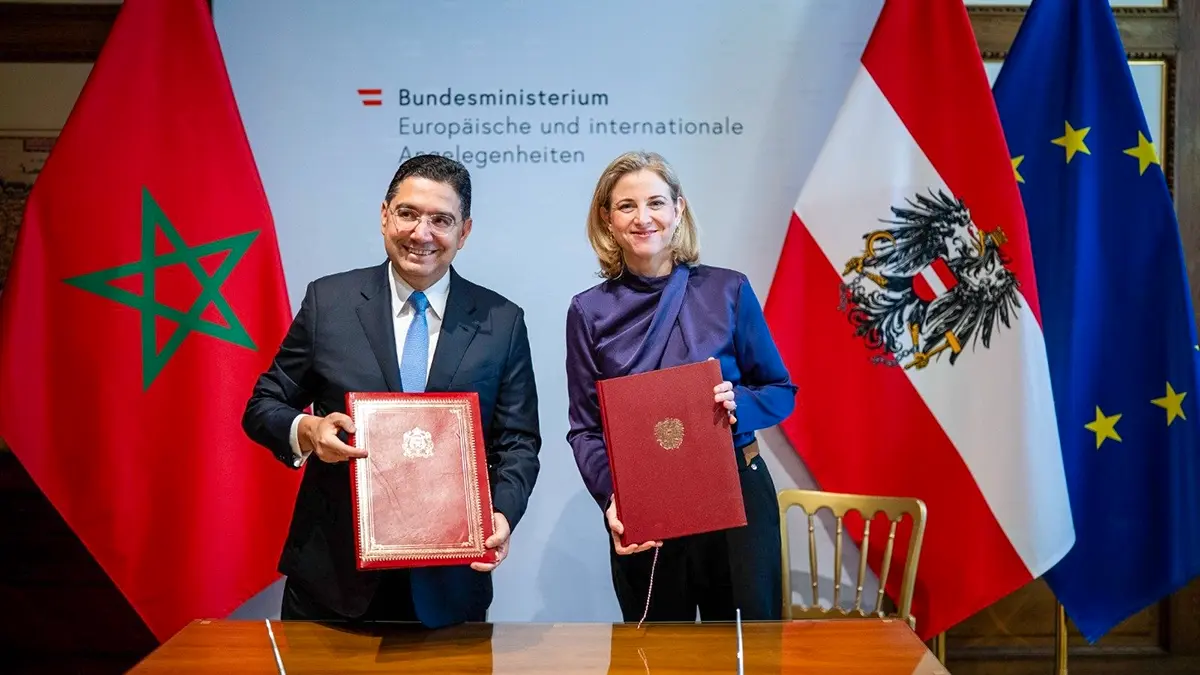
Vienna – April 22, 2026
The Austria has reiterated its support for United Nations Security Council Resolution 2797 (2025), emphasizing that a system of genuine autonomy under Moroccan sovereignty could represent one of the most practical solutions to the long-standing dispute over the Moroccan Sahara.
The position was outlined in a joint communiqué issued after talks in Vienna between Austrian Federal Minister for European and International Affairs Beate Meinl-Reisinger and Morocco’s Minister of Foreign Affairs, African Cooperation and Moroccan Expatriates Nasser Bourita, who is currently on a working visit to the European country.
In the communiqué, Austria welcomed the adoption of Resolution 2797, which endorses ongoing diplomatic efforts led by the United Nations Secretary-General and his Personal Envoy. The resolution calls for negotiations aimed at achieving a just, lasting, and mutually acceptable political solution, taking Morocco’s autonomy proposal as a key reference point in the process.
Austria also expressed appreciation for Morocco’s openness in explaining how such an autonomy framework would function under Moroccan sovereignty. According to the statement, Vienna views this approach as a constructive basis for dialogue and progress in resolving the regional dispute.
The Austrian position contributes to what Moroccan officials describe as a growing international consensus supporting the autonomy initiative proposed by Morocco in 2007. The diplomatic momentum behind the proposal has intensified in recent years, particularly following the adoption of Resolution 2797 by the Security Council on October 31, 2025.
Morocco maintains that the autonomy plan offers a realistic and pragmatic path toward stability and development in the Sahara region while preserving the Kingdom’s territorial integrity.
The initiative continues to gain international backing as part of broader diplomatic efforts led by King Mohammed VI, aimed at consolidating global support for the Moroccan position and advancing a peaceful resolution to the regional issue.
About the Author