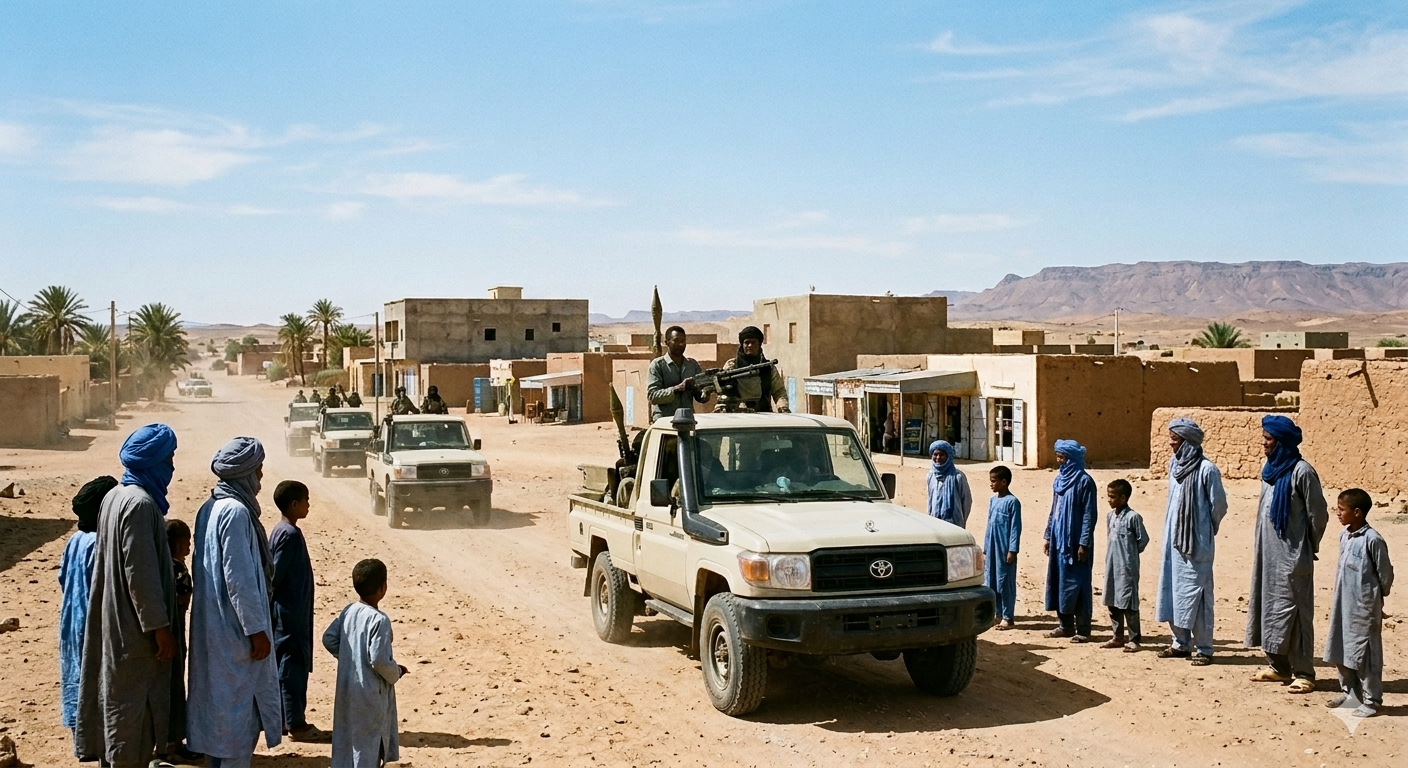
Recent footage reportedly filmed in Bordj Badji Mokhtar, southern Algeria, has sparked renewed debate about Algeria’s regional policies and its relationship with armed and separatist movements operating across the Sahel.
The video appears to show members of the Azawad Liberation Front (FLA) parading openly with vehicles and flags on Algerian territory. If authentic, the footage would represent one of the most visible public displays of the group’s presence inside Algeria to date. The images have prompted observers to ask whether such activities could occur without at least a degree of tolerance from local authorities.
The development is particularly noteworthy given Algeria’s long-standing position on self-determination movements in North Africa. For decades, Algeria has been one of the principal political and diplomatic backers of the Sahrawi cause and has hosted and supported the institutions of the self-proclaimed Sahrawi Arab Democratic Republic (RASD). Critics of Algerian policy argue that this support goes beyond diplomacy and constitutes direct involvement in the Western Sahara dispute, while Algerian officials maintain that their position is based on support for the principle of self-determination and international law.
Against this backdrop, the reported presence of FLA fighters on Algerian soil raises questions about consistency in regional policy. Some analysts argue that Algeria’s tolerance of armed actors operating near its borders may be viewed by neighboring states as indirect support, particularly when such groups advocate political autonomy or separatist objectives. Others caution that the mere presence of a group inside a country’s territory does not necessarily prove official backing or sponsorship.
The issue also highlights broader tensions across the Sahel, where security challenges, insurgencies, and cross-border movements have complicated relations among regional governments. Any perception that states are selectively supporting certain movements while opposing others is likely to fuel further diplomatic disputes.
Ultimately, the footage alone does not establish official Algerian support for the FLA. However, it does raise legitimate questions about how authorities are responding to the group’s activities and whether regional actors apply the same standards to all separatist movements. As more information emerges, transparency from all parties involved will be essential to understanding the full implications of these developments for regional stability and the ongoing debate surrounding Western Sahara and the RASD.
About the Author