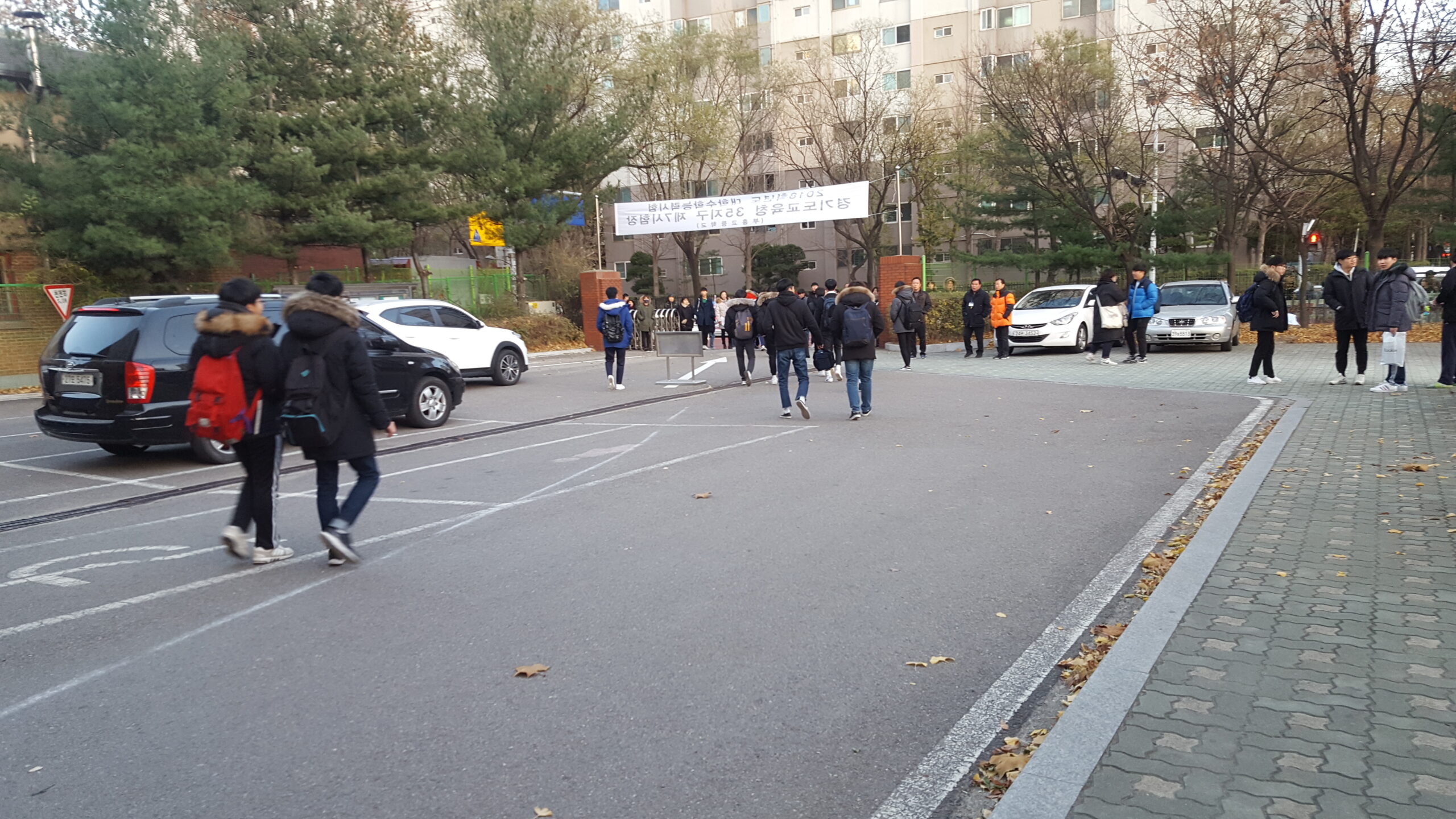
Students leave an examination site after South Korea's College Scholastic Ability Test in November 2017. Archival photograph by 고려, licensed under CC BY 4.0 via Wikimedia Commons; not a photograph of the November 2026 exam.
South Korea’s government is preparing a broad overhaul of its national examination system after artificial intelligence and concealed electronic devices exposed weaknesses in the safeguards used for high-stakes tests. President Lee Jae Myung ordered officials on November 20 to investigate suspected cheating and develop reforms that keep pace with rapidly changing technology.
The move followed the country’s November 19 College Scholastic Ability Test, commonly known as the Suneung, which was held under unusually tight security. More than 550,000 candidates registered for the examination, administered at 1,312 testing centers nationwide.
More than 110 candidates found with prohibited devices
South Korean officials said 111 test-takers were caught possessing prohibited electronic devices during the examination, including AI-enabled glasses. The figure refers to candidates found with banned devices; it does not establish that every individual used the equipment to obtain answers or successfully cheated.
Authorities had deployed approximately 75,000 proctors and 8,400 additional personnel. Security measures included inspections of glasses and clothing, restrictions on personal belongings, monitoring of wireless signals and nationwide emergency phone alerts intended to expose devices that had been brought into examination rooms.
A separate confession triggered the crisis
The heightened security followed a separate scandal involving a candidate in a national tax-accountant examination. According to South Korean reporting, the candidate admitted using a concealed camera, a smartphone and generative AI to photograph test questions and obtain answers. The case raised questions about whether other professional and public examinations could be vulnerable to similar methods.
Reuters reported before the Suneung that authorities were preparing to inspect glasses, clothing and other items after the confession. The government also sought cooperation from technology companies as investigators examined whether images of exam questions had been sent to AI services.
Lee calls for an overhaul beyond the college entrance test
President Lee said conventional safeguards may no longer be sufficient against cheating that uses AI and advanced devices. He directed officials to investigate suspected violations in the latest examination and examine possible misconduct in earlier tests. His call for reform extends beyond the university entrance examination to state-administered tests and other assessments where results affect access to jobs, qualifications and opportunities.
The Prime Minister’s Office said an interagency task force had begun coordinating the government’s response. The official plan includes investigations, enforcement and measures intended to prevent repeat violations. Authorities have also discussed tougher penalties for candidates found to have cheated.
The wider challenge for education systems
South Korea’s experience highlights a problem confronting education systems worldwide: tools that can interpret images, answer complex questions and communicate wirelessly are becoming smaller and harder to detect. Traditional examination controls were designed around phones, notes and conventional electronic devices, not discreet systems that can connect a test-taker to powerful AI services.
But stronger surveillance also raises questions about privacy, proportionality and the treatment of students who rely on ordinary glasses or medical devices. South Korean officials have acknowledged the need to prevent cheating without unfairly disadvantaging candidates who have legitimate reasons to wear assistive equipment.
The challenge for policymakers is therefore not simply to ban more devices. It is to protect the credibility of examinations while setting clear procedures for evidence, investigations, appeals and the responsible use of AI in education.
What happens next
The government’s proposed overhaul is still being developed. The November 20 presidential directive sets a policy direction; it is not itself a completed replacement for the country’s examination rules. Investigations will need to determine which candidates violated the rules, what evidence supports individual cases and whether any results were affected.
For South Korea, the stakes extend beyond one examination cycle. The Suneung is a major gateway to university admission, while professional and public-sector tests can shape careers and access to regulated occupations. Maintaining public confidence will depend on whether the government can adapt its safeguards without undermining fairness in the process.
Sources: Yonhap News Agency; KBS World; South Korean Prime Minister’s Office; Reuters; Associated Press.
Editorial note: WMF distinguishes possession of prohibited devices from proven cheating. The reported figure of 111 refers to candidates found with banned electronic equipment, and individual violations remain subject to investigation. The featured photograph is an archival image from a previous Suneung examination and does not depict the November 2026 test.
About the Author