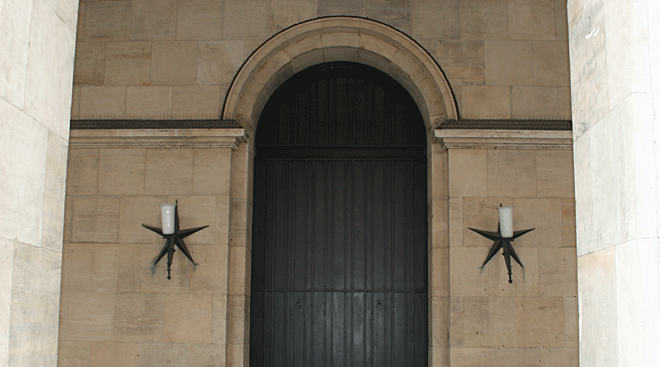
Copenhagen Police Headquarters, Politigården. Archival location photograph; not a scene from the investigation. Photo: Rikke Hyldsberg Søgaard / Wonderful Copenhagen.
By World Media Feed Editorial Team
Denmark has accused Russian intelligence services of planning an assassination attempt against a Ukrainian-American citizen at a public concert north of Copenhagen, saying the operation was stopped shortly before it could be carried out. The case has triggered a diplomatic expulsion and a new push by Copenhagen for tougher European restrictions on Russian travel.
The Danish Security and Intelligence Service (PET) said on November 20 that it assessed the operation was planned and initiated by Russian intelligence and that people linked to the banned Danish gang Loyal to Familia were expected to carry it out. Danish authorities have not publicly named the intended target in their own statement. International media have identified him as the Ukrainian-American rapper Kyivstoner.
The allegations are serious, but the distinction between intelligence assessments and criminal proof is important. PET’s assessment concerns the overall operation and its implications for Denmark’s security. The police and prosecution service must establish what each suspect did and knew, while courts determine criminal liability.
Police intervention came minutes before the concert
The alleged operation was set for September 25, 2026, during a concert at a venue north of Copenhagen. PET said the attempt was already underway and imminent when authorities intervened in cooperation with North Zealand Police.
According to PET, three people travelling in a car near the venue were stopped and firearms and knives were found. Reuters, citing police and court documents, reported that two Danish men were charged with attempted murder and assisting a foreign intelligence service. Prosecutors said the suspects were travelling toward the venue with two loaded pistols and two knives; one had purchased a ticket to the concert.
The concert was cancelled. Reuters reported that the two men denied wrongdoing. The charges have not been proven in court.
Why Danish intelligence sees a wider threat
PET Director General Rasmus Kieffer-Kristensen described the case as unprecedented in Denmark and said the service viewed it as evidence that Russian intelligence was willing and able to initiate a physical attack on Danish soil, including at a public event and through people connected to criminal networks.
The intelligence service also made an important qualification: it does not assess the case as indicating a general threat of assassination against Danish citizens or other people living in the country. Its concern is the specific capability demonstrated by the alleged use of local criminal intermediaries for a foreign-directed operation.
The suspected involvement of Loyal to Familia adds a domestic security dimension. Denmark’s Supreme Court declared the gang illegal in 2021. PET says the use of criminal networks can give foreign intelligence services access to people and capabilities that can be used to carry out violent operations.
Denmark expels Russia’s defence attaché
Foreign Minister Lars Løkke Rasmussen said Russia’s defence attaché had been ordered to leave Denmark within seven days. Copenhagen said it wanted to send a strong signal without severing diplomatic relations with Moscow.
Russia’s embassy in Copenhagen rejected the accusations, telling Reuters that Denmark had not provided evidence of Russian involvement. Moscow has repeatedly denied accusations of conducting hybrid operations in Europe.
The expulsion is a diplomatic response, not a judicial finding about the suspects or proof that the Russian state will face further legal consequences. The investigation and any prosecution remain separate processes.
Copenhagen seeks a coordinated EU response
On November 21, Denmark urged fellow European Union governments to adopt a more unified approach to Russian nationals’ access to the Schengen travel area. Reuters reported that a Danish message circulated to EU governments proposed suspending tourist visas for Russian citizens, refusing Russian non-biometric passports across the Schengen zone, making greater use of visas limited to individual countries and imposing tougher entry restrictions on current and former Russian combatants.
Denmark is expected to present the proposals to EU ambassadors in Brussels. They are proposals, not rules already adopted across the bloc. Any EU-wide change would require agreement through the relevant European decision-making process.
European Commission President Ursula von der Leyen expressed solidarity with Denmark and said the Commission would soon propose a new European Security Strategy focused on preparedness and deterrence. The statement signals political support, but does not itself establish new visa restrictions or sanctions in this case.
A case with implications beyond Denmark
The alleged plot highlights a security challenge facing European governments: the possibility that foreign intelligence services may seek to use criminal intermediaries rather than state personnel to carry out operations abroad. Such cases can blur the boundary between organised crime, espionage and national security.
For investigators, the central questions are the suspects’ individual roles, their knowledge of the alleged plan and the evidence connecting the operation to any foreign intelligence service. For governments, the case raises a separate question about how to deter hostile activity without weakening legal safeguards or treating allegations as established guilt.
Denmark’s next steps will therefore unfold on two tracks: the criminal investigation and the diplomatic effort to persuade European partners to adopt a common response. Neither the court process nor the EU policy debate has been concluded.
World Media Feed will continue to follow the investigation, Denmark’s diplomatic measures and any decisions by EU governments on the proposed travel restrictions.
Sources and reporting
- Danish Security and Intelligence Service (PET) — Russia uses Danish criminal networks in assassination attempt on Danish soil, November 20, 2026.
- Reuters — Denmark says it thwarted Russian plot to assassinate US-Ukrainian rapper, November 20, 2026.
- Reuters — Denmark pushes EU to tighten curbs on Russians after foiled plot, November 21, 2026.
- Associated Press — Denmark accuses Russian intelligence of plotting to kill American Ukrainian on its soil, November 20, 2026.
Editorial note: The attribution to Russian intelligence reflects PET’s official assessment, which Moscow disputes. The criminal charges remain allegations, and the defendants are presumed innocent unless proven guilty in court. Denmark’s proposed EU travel restrictions have not been adopted as bloc-wide policy.
Featured image: Copenhagen Police Headquarters, Politigården. Archival location photograph, not a scene from the investigation. Photo: Rikke Hyldsberg Søgaard / Wonderful Copenhagen.
About the Author