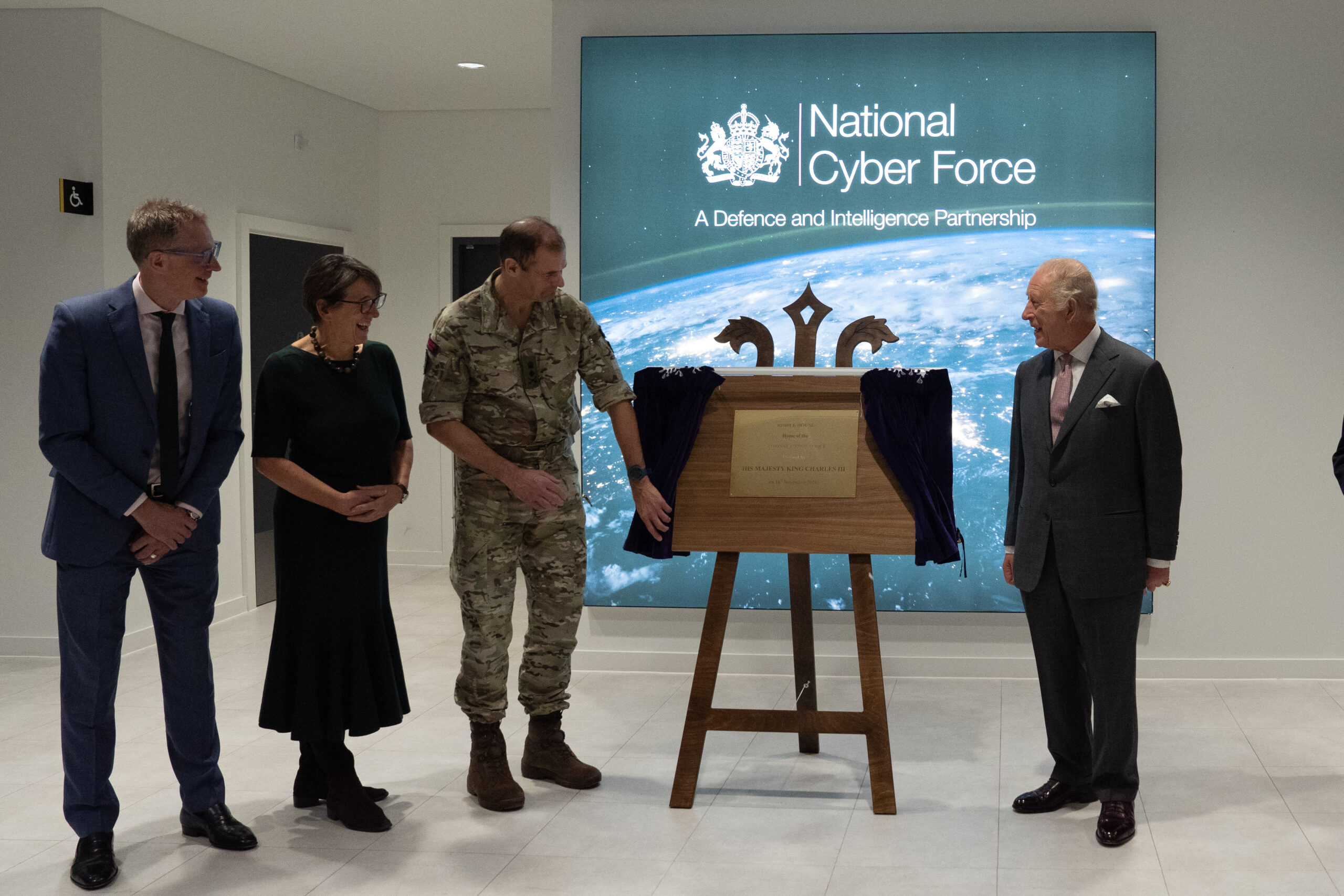
King Charles III unveils a plaque at the opening of Ribble House, the National Cyber Force headquarters, in Samlesbury, Lancashire. Crown Copyright / GCHQ.
By World Media Feed Editorial Team
Britain is conducting offensive cyber operations against Russia, China, Iran and North Korea, the head of its military cyber command has publicly confirmed, offering an unusually direct account of a capability that is normally discussed in broad and guarded terms.
General Sir Rob Magowan, commander of the UK’s Cyber and Specialist Operations Command, told Sky News that the National Cyber Force was carrying out operations against the four countries. He said the cyber threat facing Britain was significant and warned hostile actors that their activity would carry a cost.
The remarks are notable because senior British officials rarely describe the targets of the country’s covert offensive cyber activity so explicitly. They do not, however, disclose which networks have been penetrated, what operations have been conducted or what effects those operations have achieved.
A rare public description of offensive cyber missions
Asked directly whether the National Cyber Force was conducting offensive operations, Magowan answered that it was. He named Russia, China, Iran and North Korea as states whose cyber activity Britain regards as a threat, according to the interview published by Sky News on November 20.
Magowan also said the force’s work extends beyond state adversaries to organised crime groups and individuals involved in harmful online activity, including crimes targeting children. That broader remit reflects the organisation’s stated mission to support military operations, counter state threats and disrupt criminal and terrorist activity online.
The interview did not provide operational examples. That limitation matters: a public statement that offensive operations are under way is not the same as evidence of a particular cyberattack, a confirmed disruption or a disclosed intelligence success.
What the National Cyber Force does
The National Cyber Force was established in 2020 as a partnership bringing together the Government Communications Headquarters (GCHQ), the Ministry of Defence, the Secret Intelligence Service (MI6) and the Defence Science and Technology Laboratory.
According to GCHQ, the force develops and conducts cyber operations to support military activity, confront state threats and disrupt criminals and terrorists. Its work is deliberately secretive; the agency says routinely disclosing operational details could reduce effectiveness and help adversaries strengthen their defences.
Offensive cyber operations can involve gaining access to hostile computer systems, disrupting or degrading digital capabilities, or creating effects that support wider military and national-security objectives. The precise legal authority, target selection and oversight arrangements for individual operations are not set out in Magowan’s interview.
New headquarters brings intelligence and defence teams together
The public remarks came shortly after King Charles III officially opened Ribble House, the National Cyber Force’s new headquarters in Samlesbury, Lancashire, on November 16.
The site brings together personnel from the defence and intelligence partnership and is intended to strengthen the UK’s cyber capabilities. GCHQ said the opening also represented a long-term investment in specialist skills, local employment and the North West’s technology sector.
The King met senior leaders from the partnership, including GCHQ Director Anne Keast-Butler and Magowan. The government described the headquarters as a significant milestone in Britain’s ability to confront threats in cyberspace.
Four named adversaries, different kinds of risk
Magowan’s list brings together countries whose cyber capabilities and strategic aims differ substantially. British officials have repeatedly identified Russia as a source of hostile cyber activity and wider hybrid threats. China is a major cyber-intelligence and technology competitor. Iran and North Korea have also been associated by Western governments with cyber operations targeting state institutions, companies and financial systems.
Grouping the four countries in one public statement does not mean that Britain treats them as identical threats or that the same tools are used against each. The general’s comments describe the range of adversaries targeted by the force, not a single coordinated campaign.
The broader context is an increasingly contested digital environment in which governments use cyber capabilities for espionage, disruption, influence and military advantage. Cyber operations can take place below the threshold of armed conflict, making attribution, proportionality and the risk of escalation central concerns.
Britain and the EU also seek closer cyber coordination
The remarks came as Britain and the European Union announced closer cooperation against hybrid and cyber threats at their November 20 summit. In a joint declaration, both sides said they would improve awareness of threats, strengthen preparedness through exercises, coordinate responses and work together to impose costs on hostile actors.
The declaration also addressed foreign information manipulation and interference, democratic resilience and cooperation on cybersecurity. It establishes a framework for closer coordination, rather than announcing a new joint offensive cyber operation.
Transparency and accountability remain central questions
Magowan’s comments make Britain’s offensive cyber posture more visible, but the most consequential details remain classified. Public scrutiny will depend on how the government explains the legal basis for operations, the safeguards against unintended harm and the mechanisms through which elected representatives and independent bodies oversee sensitive activity.
There are also strategic risks. Cyber operations can expose capabilities, provoke retaliation or affect systems beyond the intended target. Governments often argue that secrecy protects operational effectiveness, while critics say secrecy makes it harder for the public to assess proportionality and accountability.
For now, the clearest new information is the explicit public confirmation that Britain’s National Cyber Force is conducting offensive operations against Russia, China, Iran and North Korea. The scope, frequency and results of those operations remain undisclosed.
World Media Feed will continue to follow official statements and policy developments concerning Britain’s cyber strategy and international cooperation on digital security.
Sources and reporting
- Sky News — UK conducting offensive cyber ops against Russia, China, Iran and North Korea, November 20, 2026.
- GCHQ — King Charles III opens new National Cyber Force Headquarters, November 16, 2026.
- UK Ministry of Defence / GOV.UK — King opens new National Cyber Force HQ boosting North West growth, November 16, 2026.
- European Union and United Kingdom — Joint Statement following the EU–UK Summit, November 20, 2026.
Editorial note: The confirmation of offensive operations and the naming of the four countries are attributed to General Sir Rob Magowan in his interview with Sky News. No operational details or independent assessment of the effects of specific missions were made public in the cited material.
Featured image: King Charles III unveils a plaque at the opening of Ribble House, the National Cyber Force headquarters, in Samlesbury, Lancashire. Crown Copyright / GCHQ.
About the Author