By World Media Feed Editorial Team
For farmers operating agricultural irrigation engines, the cost of fuel is only part of the challenge. Knowing how much fuel is being consumed, whether an engine is operating normally, when a problem begins, and where equipment is located can be just as important.
A Moroccan inventor is attempting to bring several of those functions together in a single system.
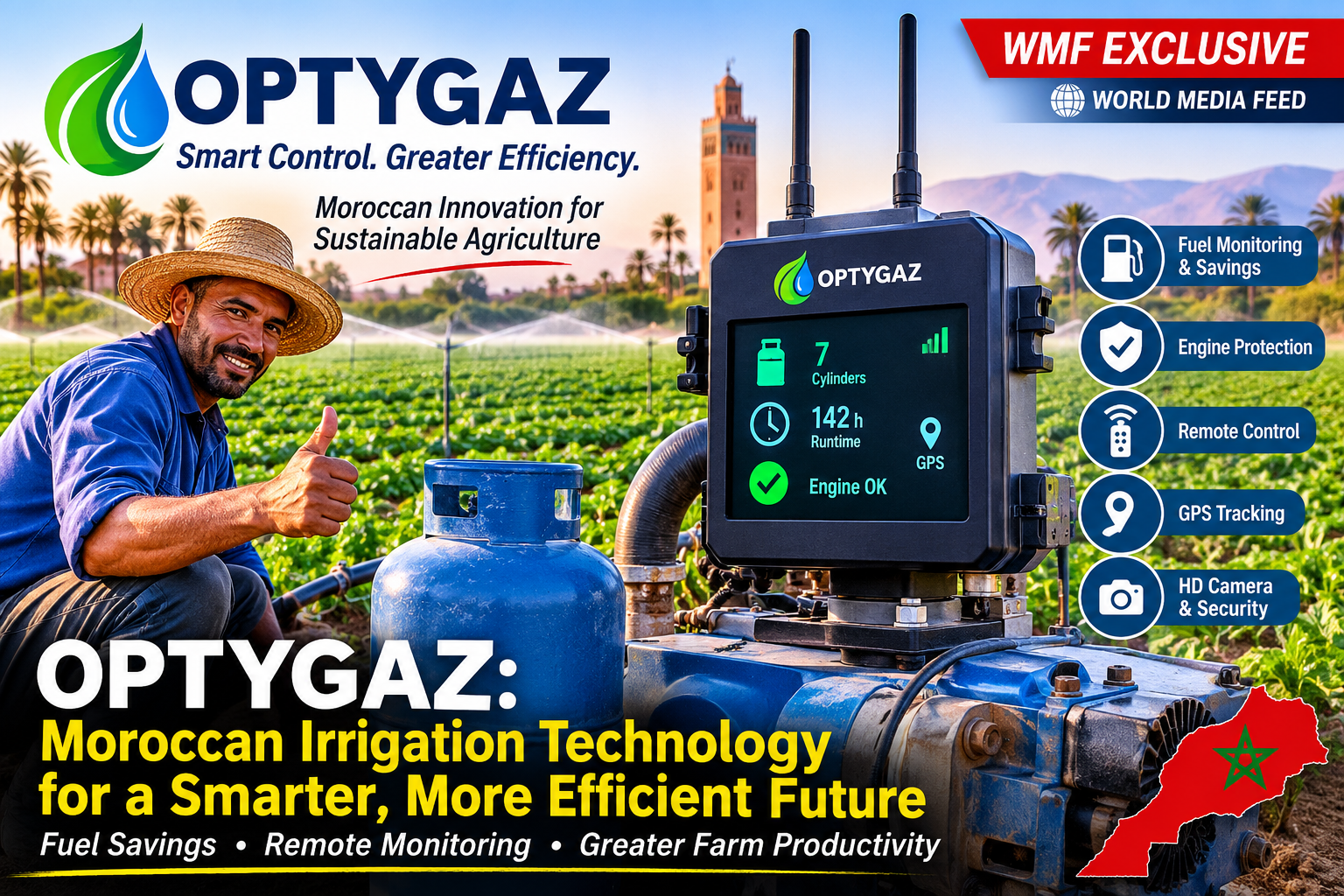
OPTYGAZ, developed by Moroccan inventor and founder Noureddine Ben Elouali, is designed for agricultural irrigation engines powered by butane cylinders. The system combines fuel-consumption monitoring with remote engine management, fault alerts, equipment protection, cameras and GPS, according to technical material provided to World Media Feed by the inventor.
The project is particularly notable because it appears to have moved beyond a laboratory concept into field applications. OPTYGAZ has provided WMF with a collection of 25 videos showing the system installed on and operating with agricultural irrigation engines, including a farmer testimonial. The company has also provided documentation relating to an intellectual-property filing in Morocco.
But the most interesting question is not simply whether the technology exists.
It is whether the results claimed by its developer can be independently demonstrated in real agricultural conditions.
From a fuel problem to a broader management system
According to OPTYGAZ, the system was developed in response to problems faced by farmers using butane-powered irrigation engines.
The inventor identifies several challenges: rising fuel costs, difficulty keeping track of cylinder consumption, limited information about engine operating hours and start-and-stop activity, and the possibility that mechanical problems may go unnoticed until they cause significant damage.
OPTYGAZ is intended to address those issues through a combination of monitoring and control technologies.
The system reportedly records butane-cylinder consumption automatically and tracks engine operating hours as well as start-and-stop activity. Depending on the configuration, it can also allow the user to start or stop the irrigation engine remotely.
That changes the concept from a device focused only on fuel savings into something closer to a remote management system for irrigation equipment.
The fuel-saving claim
One of the strongest claims made by OPTYGAZ concerns butane consumption.
The inventor says field testing has shown the potential to reduce consumption by more than 50 percent under certain operating conditions, while acknowledging that results vary according to the engine, operating conditions and usage patterns.
One example supplied by the project involves an irrigation engine that reportedly consumed 17 butane cylinders during a particular operating period before installation of OPTYGAZ and seven cylinders afterward.
Based on those figures, the reduction would be approximately 58.8 percent.
That is a significant figure if independently reproduced.
It is also the kind of figure that deserves scrutiny before being presented as a generalized performance result.
The available material establishes that OPTYGAZ is making the claim and has supplied supporting field material. It does not, by itself, establish that a 58.8 percent reduction can be expected across irrigation engines generally.
That distinction matters.
Beyond fuel: watching the engine itself
Fuel management is only one component of the system.
OPTYGAZ says its technology monitors engine conditions and can issue warnings when abnormalities are detected. The system reportedly uses indicator lights to identify certain faults and can send SMS notifications to the user’s mobile phone.
The inventor identifies examples including engine overheating, low engine-oil levels, certain engine-component faults and interruptions in battery charging.
For specified critical conditions, OPTYGAZ says the system can automatically shut down the engine to help prevent additional damage.
If these functions perform as described, the potential value extends beyond fuel savings. A system capable of identifying abnormal conditions before they become major failures could help farmers reduce downtime and protect expensive equipment.
Cameras, GPS and an independent power system
The system also incorporates security and monitoring functions.
According to the technical description provided to WMF, OPTYGAZ integrates cameras intended to operate continuously, along with GPS positioning to help users locate their irrigation equipment. The system also includes two 100-watt lighting units intended to provide nighttime illumination around the equipment.
Another unusual feature is that the device has its own power supply and backup battery rather than depending entirely on the irrigation engine’s battery.
The inventor says that independent power arrangement allows the monitoring and protection functions to continue operating separately from the engine battery. OPTYGAZ also describes an emergency function intended to assist with starting an engine when its battery is weak or discharged, as well as a mobile-phone charging function.
Taken together, those features suggest that the inventor is attempting to solve several problems around a single piece of agricultural infrastructure rather than focusing exclusively on fuel consumption.
A Moroccan intellectual-property filing
There is also an intellectual-property component to the project.
The material supplied to WMF includes an OMPIC filing receipt for application No. 73152, dated October 13, 2025. The receipt documents the submission of patent-application materials, including an invention description, claims and technical abstract.
There is an important distinction here: the documentation provided is evidence of a filing, not evidence that a patent has already been granted.
OPTYGAZ itself makes that distinction clear.
For an emerging technology project, that is an important detail because intellectual-property protection and technological performance are separate questions.
What makes the project worth watching
Morocco has invested heavily in expanding its technological and industrial capabilities, but innovation does not always begin inside large technology companies or research laboratories.
Sometimes it begins with a practical problem encountered repeatedly in the field.
That appears to be the story OPTYGAZ is trying to tell.
Its development began around the everyday challenges of farmers using butane-powered irrigation engines. The resulting system combines fuel monitoring, engine surveillance, remote management and equipment protection in an effort to make irrigation operations more visible and controllable.
The inventor has now supplied WMF with 25 videos documenting demonstrations and field applications. The collection includes a farmer testimonial, giving the project an opportunity to move the discussion beyond the inventor’s own description of the technology.
The verification question
For WMF, however, the most important part of the story may be what happens next.
The inventor has offered to provide further technical explanations and, with the farmer’s consent, potentially connect WMF with a farmer who can independently discuss a reported field example.
That would allow the central claims surrounding OPTYGAZ to be examined from another perspective.
How much fuel was actually consumed before and after installation?
Over what period?
Was the same irrigation engine used under comparable conditions?
How were the cylinders counted?
What independent measurements exist?
And do the system’s monitoring and protection functions operate consistently outside demonstration conditions?
Those questions do not diminish the significance of the invention. They are precisely the questions that become important when a technology moves from an inventor’s prototype toward broader agricultural use.
From Moroccan idea to potential agricultural technology
At this stage, OPTYGAZ should be viewed as an emerging Moroccan technology project with documented development activity, field demonstrations and an intellectual-property filing—not as a technology whose performance has already been independently established across the agricultural sector.
That distinction is important.
The project has presented a concrete technological response to a real problem, and its developers have provided WMF with material that can be examined rather than simply asking readers to take a claim at face value.
The next step is verification.
If independent field evidence confirms the reported results, OPTYGAZ could become more than an interesting Moroccan invention. It could represent a practical example of how locally developed technology can address the operating costs, maintenance challenges and security concerns faced by farmers.
For now, the technology is worth watching—and the evidence is worth examining.
World Media Feed will continue to follow the OPTYGAZ project as additional technical and independent field information becomes available.
About the Author