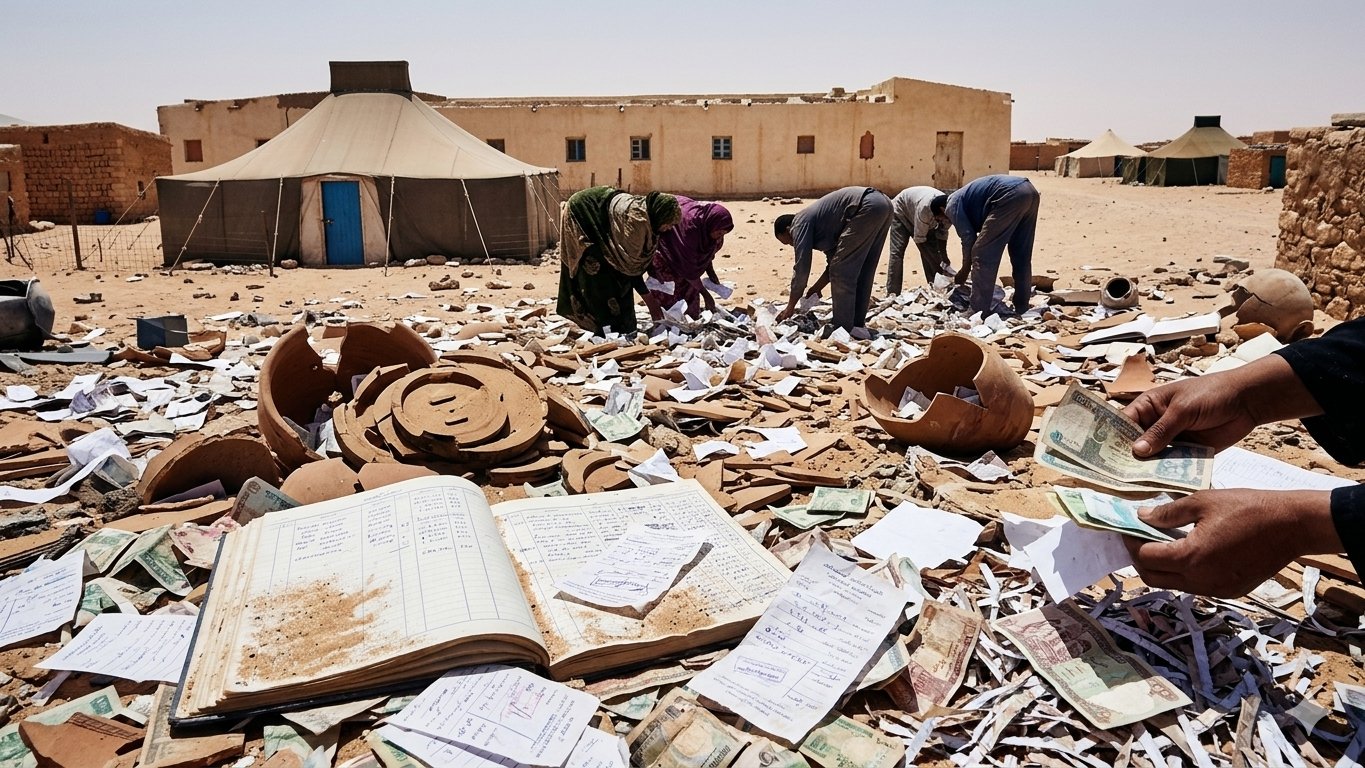
Rabouni, mid-September. Dozens of families gather outside the offices of a company that, just days earlier, had passed for one of the rare economic success stories in the camps. Now its director is gone, the cash box with him, and hundreds of Sahrawi savers are left demanding money they may never see again.
The Infravest affair isn’t just a financial footnote lost in the Algerian desert. It’s a symptom of something bigger — a system in which the population of the Tindouf camps keeps paying the price for a leadership that answers to almost no one.
A Pyramid Collapses
Everything changed on September 13. Infravest for Contracting and Investment, active in Rabouni since 2022 under director Sallamou Abba Ali, put out a brief statement citing “technical and organizational difficulties.” The vague wording fooled no one. Within hours, word had spread across the Chahid El Hafed camp — the director had vanished.
Behind the front of a respectable construction firm, one that sponsored cultural projects and visible building sites to earn residents’ trust, Infravest was reportedly running something far more familiar: a Ponzi scheme, promising investors returns of up to 70%, funded not by real economic activity but by a constant stream of new deposits from newly recruited savers. It was a model that was never sustainable — and when it finally gave out, it took the savings of thousands of already-vulnerable Sahrawi families down with it.
The full scale of the damage still isn’t clear. No official investigation has been opened to establish the exact number of victims or the total amount lost, and early estimates circulating among residents put the losses in the millions of dollars, spread across Algerian dinars and Mauritanian ouguiyas. What’s more troubling than the numbers is how a scheme like this was allowed to run for years, completely unchecked, inside a closed, militarized zone where almost nothing is supposed to escape the Polisario’s own security apparatus.
According to a Sahrawi blogger who documented the case in detail, Infravest built its credibility in part by publicizing its director’s international connections and enlisting journalists and well-known figures in the camps to help promote the company’s image. A Sahrawi source also said the director’s tribal background — his family includes members who were among the Polisario’s founders — likely helped the operation grow to the scale it did, something the same source said would have been unthinkable for someone without connections or protection inside the movement.
A Deeper, Older Anger
The Infravest collapse has acted as a spark, reigniting older and deeper frustration over how humanitarian aid is managed in the camps. Since as far back as 2015, the European Anti-Fraud Office (OLAF) has documented suspicions of food and supply shipments meant for refugees being siphoned off, with some of that aid, according to former movement members cited in the press, ending up resold on regional black markets instead of reaching the people it was intended for.
In Italy, that distrust has escalated further. Sahrawi activists and dissident voices have publicly criticized the management of Fatima Mahfoud, the Polisario’s representative in Italy, accusing her of a lack of transparency around humanitarian projects for children from the camps — allegations reported by the outlet Mediterranews, among others. It’s worth being clear about where this stands: these accusations have not, at this point, been the subject of any judicial investigation or independent confirmation, and Mahfoud has not publicly responded to them as far as could be determined. Still, they reflect a growing rift between part of the Sahrawi base and its representatives abroad, a rift that each new scandal seems to widen further.
The Spanish Paradox
What makes the timing especially bitter is the contrast with what’s happening thousands of miles away. Spain’s Congress of Deputies has just approved a bill that would grant Spanish nationality — and with it, EU citizenship — to tens of thousands of Sahrawis born under Spain’s former colonial administration, along with their descendants.
On one side, an unprecedented legal path out opens up for part of the Sahrawi population. On the other, those still living in Tindouf are watching their modest savings disappear inside a system their own leaders are accused of failing, or refusing, to properly oversee. It’s a gap that’s hard to look past.
What the International Community Can No Longer Ignore
Funding humanitarian aid to Tindouf without demanding an independent census of the population or a rigorous audit of distribution channels means turning a blind eye to risks that organizations as credible as OLAF have documented for years. This isn’t an abstract concern — it’s European public money, and the trust of well-intentioned donors, that’s on the line.
At a moment when Spain is opening a legal path forward for thousands of Sahrawis, it would be reasonable for European parliaments — Italy’s in particular, given the accusations circulating there — to demand clear accountability for how allocated funds are actually used. As for the population trapped in the camps, they deserve better than a system where basic economic survival depends on the unpredictable integrity of a handful of men in positions of power.
The Infravest affair may well pass, like others before it, without anyone being held accountable. But every scandal like this leaves a deeper mark on the relationship between the Sahrawi base and a leadership increasingly seen as disconnected from the people it claims to represent.
About the Author