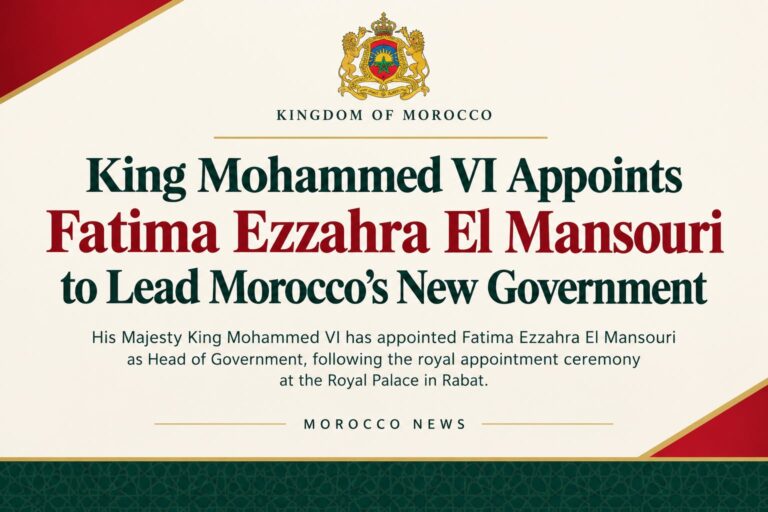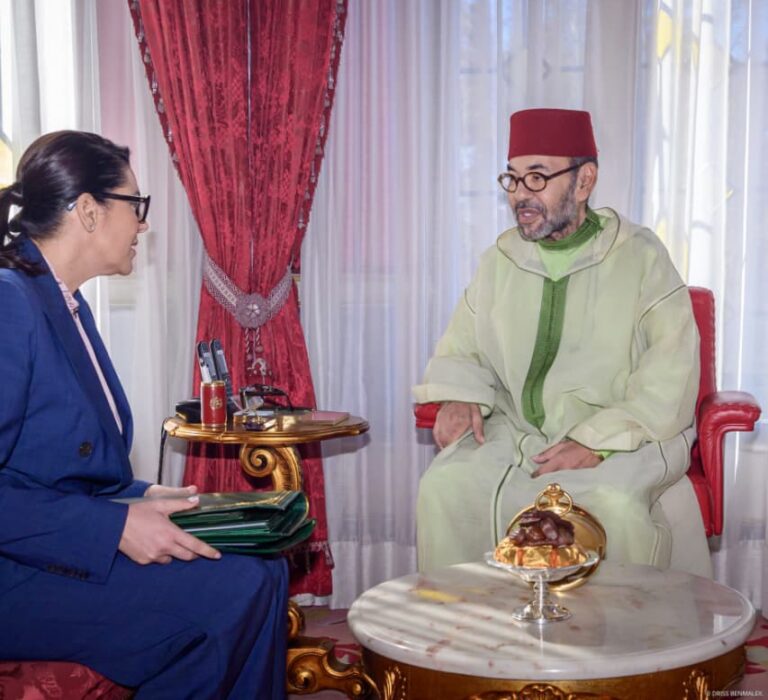
Rabat just changed its political history in a single afternoon. According to World Media Feed, King Mohammed VI received Fatima Ezzahra El Mansouri at the Royal Palace on Tuesday and formally named her Head of Government, making her the first woman ever entrusted with leading Morocco’s executive branch and tasking her with building the country’s next cabinet.
The Appointment
The announcement came from the Ministry of the Royal Household, Protocol and Chancellery, which confirmed that the King received El Mansouri — coordinator of the collective leadership of the Authenticity and Modernity Party (PAM) — at the Royal Palace on September 29, corresponding to 17 Rabi’ al-Thani 1448 in the Hijri calendar. Acting under Article 47 of the Constitution, the King appointed her to the post and charged her with forming the government going forward.
The move followed directly from the ballot box. PAM finished first in the legislative elections held on September 23, 2026, positioning El Mansouri, as the party’s leading figure, as the natural pick to head the next government under Morocco’s constitutional framework, which calls for the head of government to come from the party with the strongest electoral showing.
“A Historic Moment for Our Country”
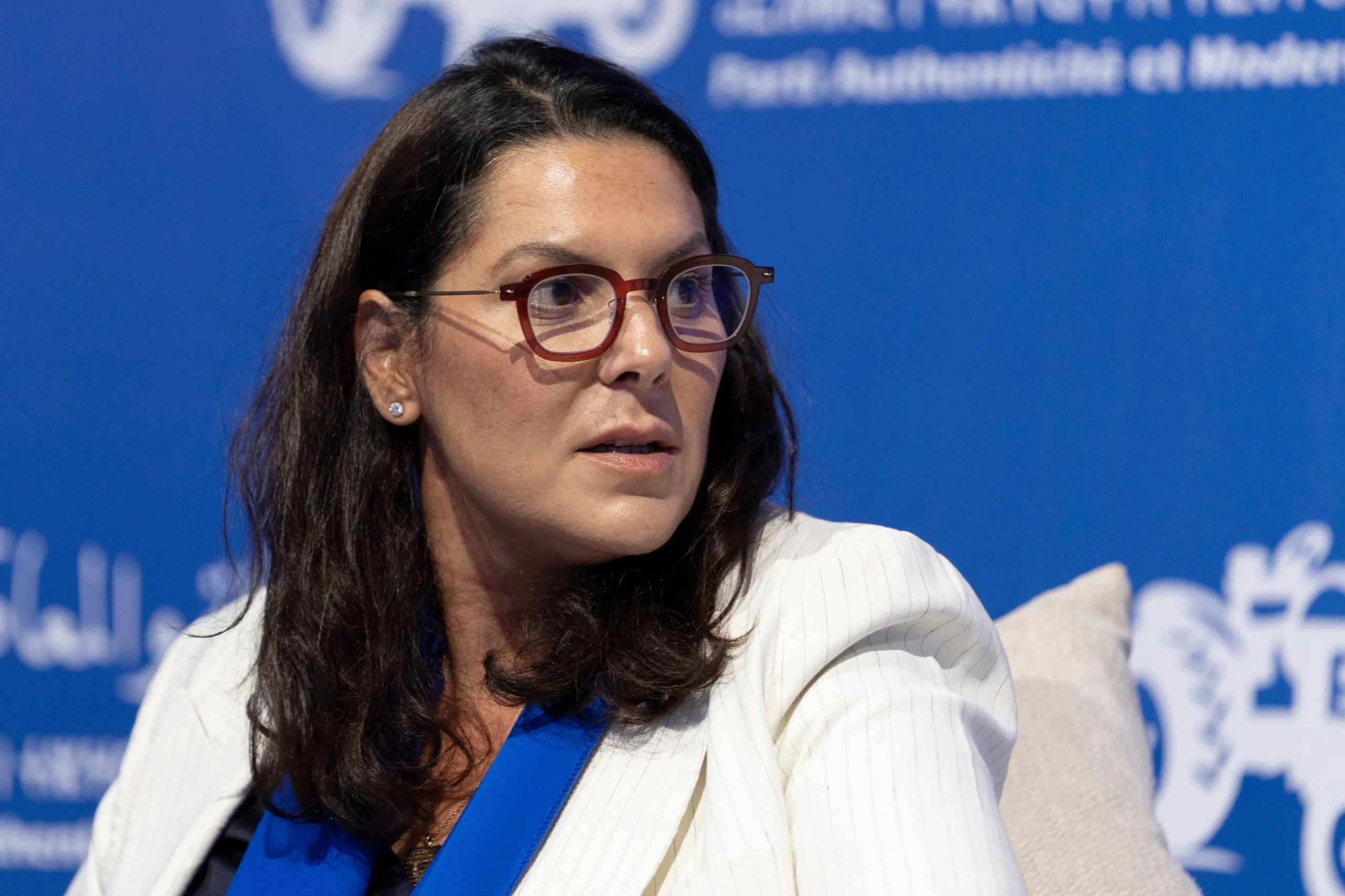
Speaking to reporters immediately after the Royal Audience, El Mansouri didn’t downplay the weight of the moment. She called it a source of pride for herself and, in her words, for all the women of the country, pointing out that this marks the first time a woman has ever been appointed to head a Moroccan government.
She described the audience with the King as a chance to receive his guidance on managing the period ahead, and said her appointment carries a message to Moroccan women more broadly to take part in building what she called a harmonious society alongside every part of it. She framed the moment as part of the sustained attention the King has shown toward women’s advancement throughout his reign.
On the work ahead, El Mansouri said she’d begin internal consultations within PAM immediately, followed by talks with other parties, as she works to assemble a government capable of meeting what she described as the high expectations of both the King and Moroccan citizens — young people especially. She said the coalition-building process would center on drafting a program built around realistic, concrete solutions rather than abstract promises.
Part of a Longer Story, Not a Standalone First
While El Mansouri’s appointment is the first time a woman has held the specific office of Head of Government, it lands within a much longer arc of Moroccan women reaching positions of serious institutional power — a point worth understanding in full rather than treating this appointment as an isolated breakthrough.
Zoulikha Nasri spent years as a close adviser to King Mohammed VI, becoming one of the most influential women ever to operate at the top level of the Moroccan state. Zineb El Adaoui was appointed by the King in 2021 to head the Court of Auditors, the institution responsible for auditing Morocco’s public finances — one of the most consequential oversight roles in the country. Amina Benkhadra has served as director general of the National Office of Hydrocarbons and Mines, putting her at the center of Morocco’s energy and natural resources strategy.
None of those roles are interchangeable with leading an elected government, and they shouldn’t be flattened into a single narrative. But taken together with the women who have held ministerial posts and senior public roles over the years, they make clear that El Mansouri’s rise isn’t happening in a vacuum — it’s the continuation of a trajectory that includes both royal appointments and, now, an elected mandate translated into the country’s top executive office.
Morocco’s push toward women’s empowerment has institutional roots that go back over two decades, most visibly through the 2004 reform of the Mudawana, the country’s family code, which reshaped women’s legal standing within marriage, divorce, and family life. That reform, paired with a steady increase in women appointed to senior institutional and diplomatic posts, forms the backdrop against which Tuesday’s appointment is being read across Morocco.
Who Is Fatima Ezzahra El Mansouri
El Mansouri isn’t a newcomer to executive responsibility. Before rising to lead PAM’s collective leadership, she served as mayor of Marrakech and held the housing and urban planning portfolio at the national level — giving her direct experience managing both a major city and a national ministry before taking on the country’s top government post.
That background matters for what comes next. Winning the election and receiving the King’s appointment were, in effect, the easy steps. What follows — assembling a working coalition, then actually governing — is widely viewed as the harder test, and it’s one El Mansouri now has to pass under intense public scrutiny.
What’s Waiting for Her
The agenda facing the incoming government is not light. Moroccans are looking for answers on jobs, wages, the cost of living, healthcare, and education, all while the country manages major infrastructure and investment commitments tied to co-hosting the 2030 World Cup. Balancing that economic and logistical workload against the everyday expectations of citizens — particularly the country’s large youth population — will likely define how this government is judged.
For young Moroccan women specifically, the symbolism of Tuesday’s appointment is hard to overstate: a position that was, until this week, simply unavailable to them now has a face and a name. But as observers close to Morocco’s political scene have noted, the lasting significance of the moment won’t be settled by the appointment itself. It will be settled by what El Mansouri’s government actually delivers, and by whether her rise translates into broader opportunities for capable women across Moroccan political and public life in the years that follow.
Morocco, in other words, is holding two truths at once this week: a genuine first, and the continuation of a path that women were already building long before Tuesday’s announcement. The history books will record the appointment. What it ultimately unlocks is still being written.
About the Author