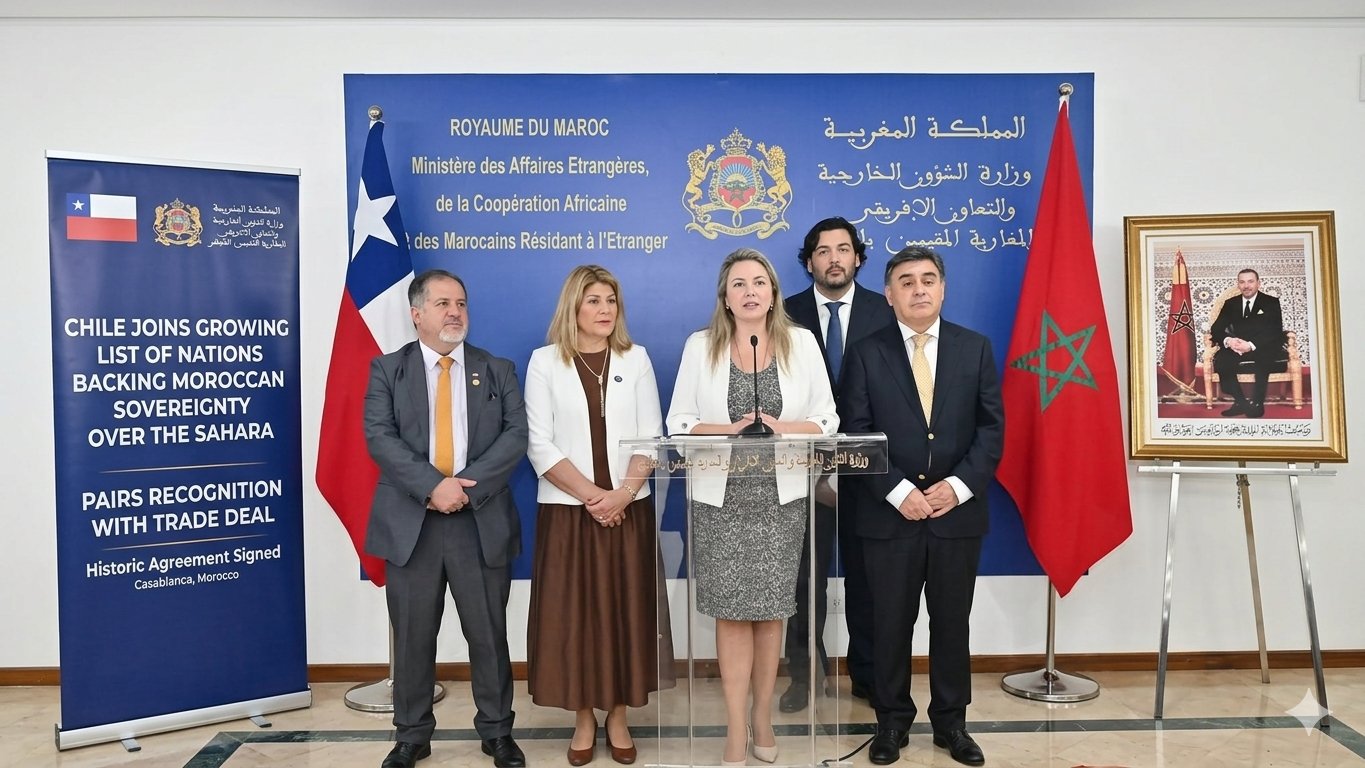
Chile has become the latest country to throw its diplomatic weight behind Morocco’s position on the Sahara, formally recognizing Rabat’s sovereignty over the territory in a joint declaration signed this week in New York — a move that also comes bundled with the opening stages of a bilateral free trade agreement between the two countries.
A Declaration Years in the Making
The announcement was formalized Monday on the sidelines of the 81st session of the United Nations General Assembly, where Morocco’s Minister of Foreign Affairs, African Cooperation and Moroccan Expatriates, Nasser Bourita, met with his Chilean counterpart, Francisco Pérez Mackenna. Chilean President José Antonio Kast was present for the signing, lending the moment a level of political weight that goes beyond a routine ministerial meeting.
In the joint communiqué that followed, Chile stated plainly that it backs Moroccan sovereignty “over its entire territory, including the Sahara region,” and went a step further by endorsing the specific mechanism Morocco has pushed for nearly two decades: the 2007 autonomy plan, which Santiago described as the just, lasting, and mutually acceptable political solution to the dispute.
It wasn’t a decision that came out of nowhere. Chile’s Republican Party, the movement Kast founded in 2019 and which now controls the presidency after his inauguration in March, has built up ties with Rabat over the preceding months. A Chilean parliamentary delegation from the Morocco-Chile Friendship Group, led by lawmaker Catalina Del Real — herself a Republican Party member — visited Rabat earlier this year and met directly with Bourita, voicing support for Morocco’s position well before this week’s formal declaration made it official state policy.
Beyond Words: A Trade Agreement Attached
What separates Chile’s announcement from a purely symbolic gesture is what came attached to it. The same communiqué stated that Chile intends to “translate its support into bilateral action,” specifically by promoting economic and trade cooperation inside the Moroccan Sahara itself — investment, trade, and productive development tied directly to the territory Rabat considers its own.
On the same day, Pérez Mackenna and Bourita signed the Terms of Reference launching negotiations toward a full free trade agreement between the two countries, structured around World Trade Organization standards. For Chile, the logic is regional as much as ideological: Morocco offers a foothold into West African and Maghreb markets, while Rabat, in turn, gains a commercial gateway into South America’s Southern Cone. Analysts have described the shift as a genuine strategic realignment in Chilean foreign policy toward North Africa, not simply a diplomatic courtesy extended during a UN summit week.
Endorsing the UN Track
Chile’s communiqué didn’t stop at bilateral trade. It also explicitly welcomed and endorsed UN Security Council Resolution 2797, adopted in October 2025, aligning Santiago with the Council’s call for negotiations to proceed “without preconditions” and on the basis of Morocco’s autonomy proposal, with the stated goal of reaching a definitive political solution acceptable to all parties involved.
That alignment matters diplomatically. Resolution 2797 has become the reference point around which an increasing number of governments are organizing their own positions, and Chile’s explicit endorsement adds another government to that list at a moment when Morocco is actively working to consolidate international support ahead of further UN-led discussions expected in October.
Part of a Broader Wave
Chile’s move did not happen in isolation. On the very same day in New York, Panama issued a nearly identical joint statement following talks between Bourita and Panamanian Foreign Minister Javier Eduardo Martínez-Acha Vásquez, backing Moroccan sovereignty and describing the autonomy plan as the only serious, credible, and realistic basis for resolving the dispute. Panama went further still, noting that its embassy in Morocco exercises consular jurisdiction across the entirety of Moroccan territory — a diplomatic detail meant to underscore that its recognition isn’t merely rhetorical.
Chile’s decision also places it alongside a growing list of Latin American governments that have shifted toward Morocco’s position in recent months, following Honduras and Colombia, both of which extended similar recognition earlier this year. Taken together, the pattern points to a broader softening of Latin American ambiguity on the Sahara question — a region that had historically been more sympathetic, diplomatically, to the Polisario Front and the self-declared Sahrawi Arab Democratic Republic. Notably, despite years of lobbying efforts by Polisario supporters inside both chambers of the Chilean parliament, Santiago has never recognized the SADR, and this week’s declaration moves the country further from that possibility rather than closer to it.
Why It Matters Now
The timing lines up with a wider diplomatic push by Rabat this month. Bourita’s New York schedule extended well beyond the Chile and Panama meetings, including talks with UN Secretary-General António Guterres and a trilateral meeting with Israeli Foreign Minister Gideon Sa’ar and the U.S. Ambassador to the UN, where Morocco, Israel, and the United States issued a joint statement reaffirming recognition of Moroccan sovereignty over the Sahara and describing Morocco’s autonomy plan as the only basis for a just and lasting resolution — while explicitly rejecting alternative paths as unacceptable.
Seen against that backdrop, Chile’s announcement isn’t a standalone diplomatic event so much as one more data point in a fast-consolidating international consensus. What was once an open-ended contest between competing endgames for the Sahara is increasingly being reframed, in diplomatic circles, as a narrower conversation about the shape autonomy should take under Moroccan sovereignty — a framing Rabat has spent years working to establish as the only serious starting point for negotiations, and one that now counts a growing share of the UN’s member states among its backers.
About the Author