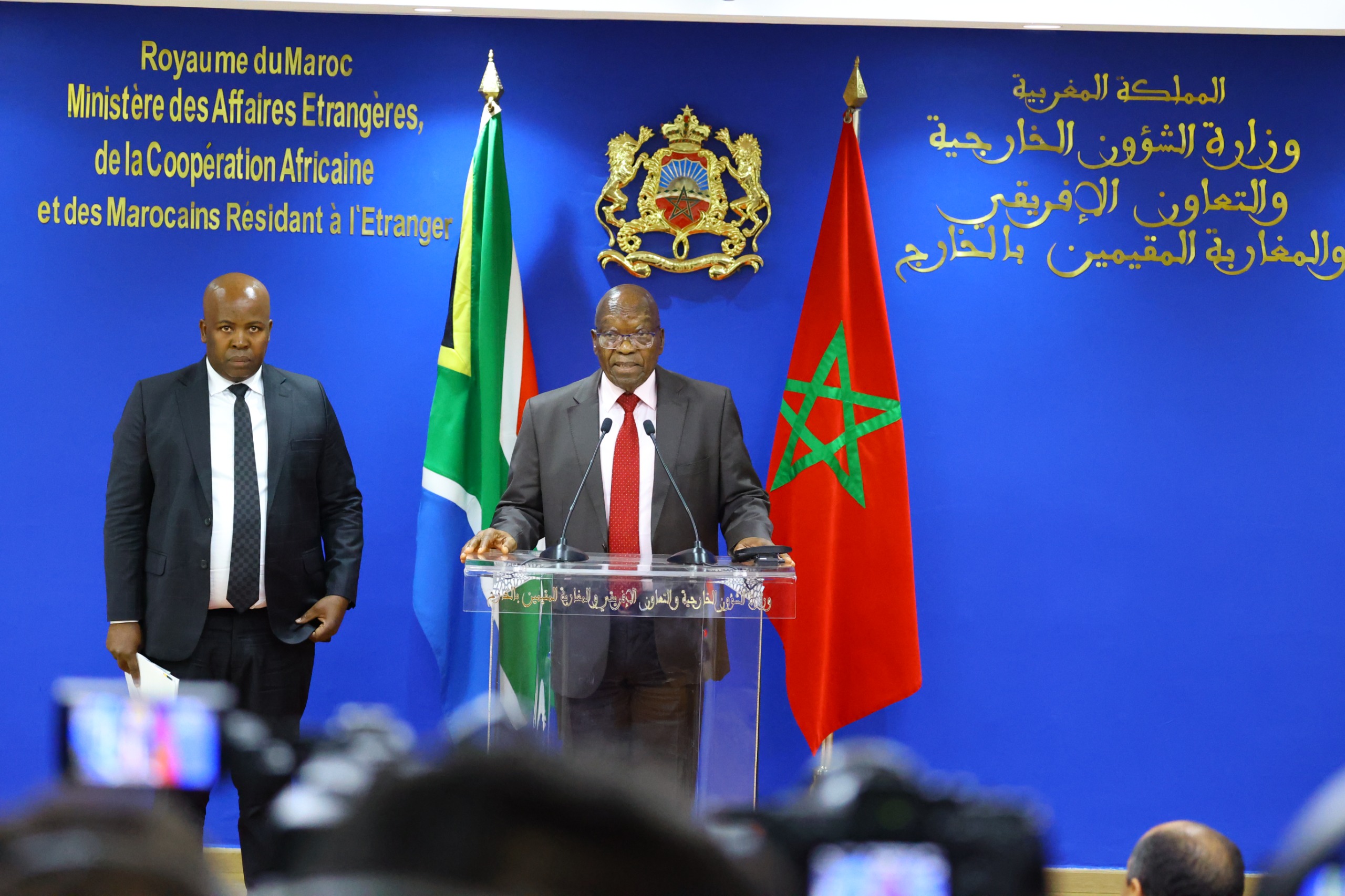
Rabat – The recent visit of former South African President Jacob Zuma to Morocco — and his vocal support for Morocco’s sovereignty over the Sahara — has sent shockwaves through Pretoria’s political establishment, exposing divisions within South Africa’s foreign policy ranks.
Zuma, now leader of the Umkhonto We Sizwe (MK) Party, openly endorsed Morocco’s Autonomy Proposal, describing it as the only viable path to a just and lasting resolution to the Sahara dispute. His remarks, made during high-profile meetings in Rabat, directly challenge South Africa’s long-standing and uncompromising pro-Polisario stance.
Unable to counter Zuma’s position on substance, South Africa’s Department of International Relations and Cooperation (DIRCO) issued a terse statement objecting to the use of the South African flag during the visit — a reaction Morocco has described as “epidermal”, betraying deep discomfort at the political impact of Zuma’s words.
A Fractured Consensus in Pretoria
Zuma’s intervention has revealed that South Africa’s ruling elites are far from united on the Sahara question. As a historic figure of the anti-apartheid struggle and former head of state, Zuma’s voice carries significant weight — one that resonates with political, intellectual, and social currents across the country.
The MK Party is no fringe movement. Rooted in the liberation heritage of the African National Congress (ANC), it holds seats in the South African Parliament and is gaining traction among voters. Its backing of Morocco’s position adds a powerful alternative voice to South Africa’s political debate on continental issues.
Morocco’s Transparent and Sovereign Diplomacy
Morocco emphasized that Zuma’s visit was conducted with complete transparency. The South African Embassy in Rabat itself formally requested that Zuma be given protocol honors, including the display of the South African flag — making Pretoria’s subsequent complaint appear contradictory.
As a state with a millennia-old diplomatic tradition, Morocco underscored that it engages openly with political actors from across Africa and the world, regardless of their alignment with current governments. In October 2024, Rabat hosted an ANC delegation led by senior party official Obed Bapela, part of a broader policy of fostering inclusive African dialogue.
Flag Controversy Seen as a Distraction
The Moroccan government dismissed Pretoria’s focus on the flag as a diversion from the core issue: Zuma’s endorsement of Morocco’s sovereignty over the Sahara. Rabat noted that South African public figures have used the national flag in initiatives hostile to Morocco’s territorial integrity without triggering any objections from DIRCO.
An African Consensus in the Making
Morocco reaffirmed that its position on the Sahara is backed by history, law, and a growing international consensus — with over two-thirds of African countries supporting or adopting a constructive stance toward the Autonomy Plan. The proposal has been described by the United Nations as “serious and credible”.
While official South Africa remains in the minority rejecting this consensus, Morocco extended an “outstretched hand” for open, ideology-free dialogue with Pretoria, stressing its respect for the South African people.
Jacob Zuma’s visit to Morocco has done more than spark a diplomatic spat over a flag. It has challenged the illusion of unanimous South African support for Pretoria’s official position on the Sahara, and has shown that influential voices within the country are willing to back a pragmatic and internationally recognized solution.
In Morocco’s view, the episode is not a diplomatic crisis, but a sign of political pluralism — and perhaps the first step toward a more balanced African conversation on the Sahara.
About the Author