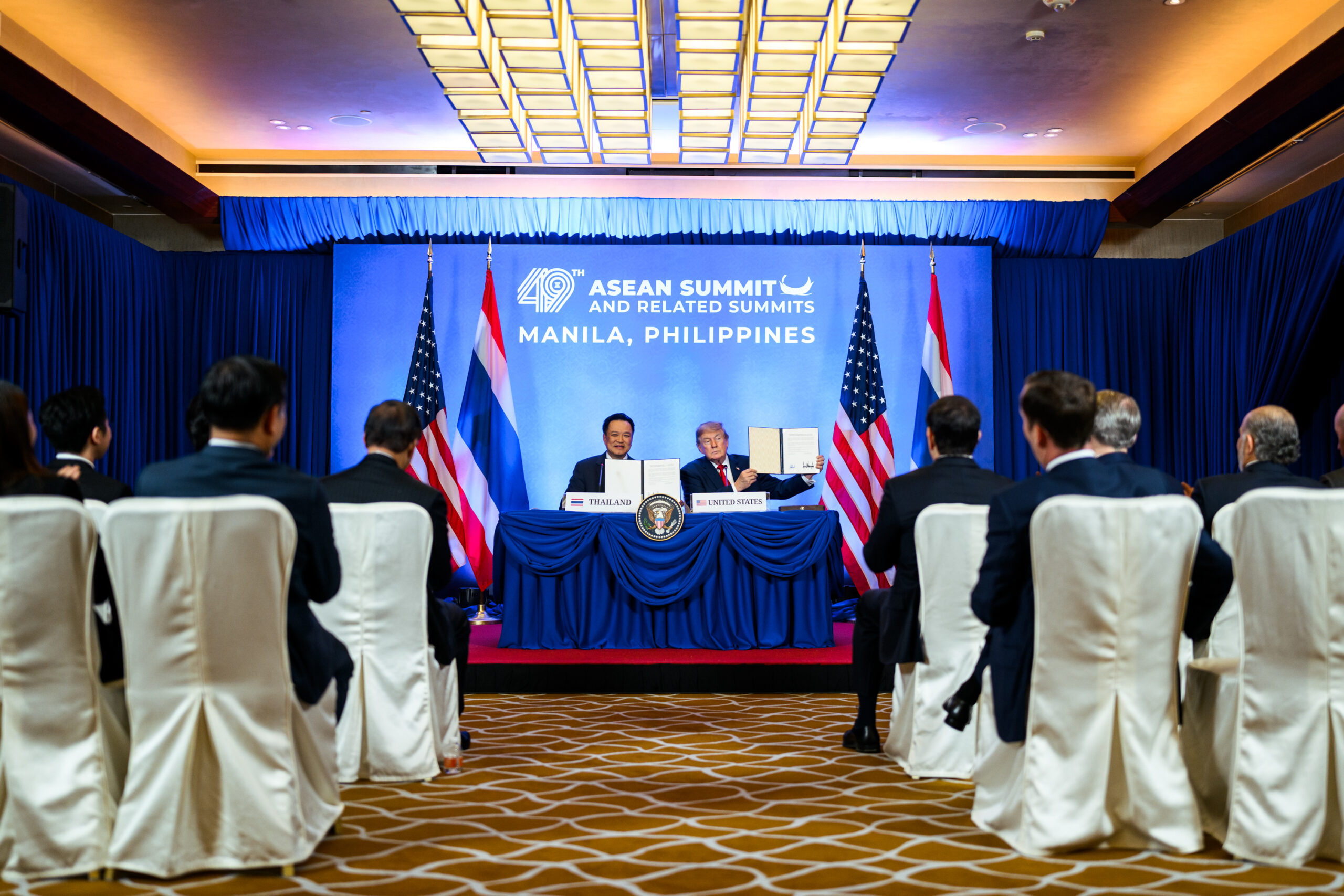
President Donald Trump speaks before signing a trade deal with Thai Prime Minister Anutin Charnvirakul at the ASEAN Summit in Manila, November 17, 2026. Official White House photo by Daniel Torok; public-domain U.S. government work.
By World Media Feed Editorial Team
U.S. President Donald Trump has announced more than $17 billion in commercial deals and strategic investment plans involving American companies across Southeast Asia, using his visit to the Philippines for the ASEAN summit to promote a mix of aviation, defense, energy and artificial intelligence projects.
The package spans the Philippines, Thailand, Indonesia, Malaysia and Brunei. But the headline figure combines agreements at different stages: a major aircraft order and signed supply contract sit alongside proposed financing, planned purchases, tenders and projects still under negotiation. That distinction will matter as governments and companies move from announcements to implementation.
Aviation deal anchors the announcement
The largest component is a deal valued by the White House at $12 billion involving Boeing, GE Aerospace and Philippine Airlines for up to 20 Boeing 787 aircraft with GE engines. Reuters reported that the companies had finalized the sale. The Nation, citing Boeing, said the airline placed a firm order for 15 787-10 Dreamliners with an option for five more.
The aircraft agreement is expected to support manufacturing and supply-chain jobs in the United States, while giving Philippine Airlines additional long-haul capacity. The precise delivery schedule and the division between firm orders and options will determine how quickly the announcement translates into production activity.
Defense cooperation deepens in the Philippines and Thailand
Washington and Manila said they would pursue more than $2 billion in U.S. financing for Philippine defense purchases. The White House also identified $400 million in Foreign Military Financing for capabilities intended to support Philippine operations in the South China Sea, including command systems, infrastructure and drones.
Those financing plans are significant, but they should not be confused with completed arms deliveries. The announcement describes a package the two governments will pursue, with purchases and implementation still to follow.
Thailand, meanwhile, said it intended to spend up to $123 million on U.S.-made High Mobility Artillery Rocket Systems, or HIMARS. If completed, the purchase would be the first of its kind in mainland Southeast Asia, according to the White House. The two countries also announced the substantial conclusion of a reciprocal trade deal, but domestic procedures remain before it can be signed and enter into force.
Energy projects reveal a continued role for coal
The package also includes major energy-related announcements. In Indonesia, U.S. company Latitude Energy and sovereign wealth fund Danantara are negotiating a proposed $2 billion project to develop coal resources using U.S. technology. It remains a negotiation, not a completed investment.
In Malaysia, Navajo Transitional Energy Company signed a three-year agreement worth $100 million to supply coal from its Montana mine to TNB Fuel Services, a subsidiary of national utility Tenaga Nasional Berhad. The deal underscores how the administration’s regional commercial push includes fossil-fuel trade as well as technology and security cooperation.
In the Philippines, Subic Grain is set to build a $40 million fuel storage depot at Subic Bay. The government also plans to modernize Basco Airport, a project the White House says will support military access, disaster response and commercial supply chains.
AI and data-center plans extend the U.S. technology push
Washington also announced support for artificial intelligence infrastructure in Malaysia and Brunei. A U.S. consortium is expected to help Malaysia develop a sovereign AI cloud, with the United States offering $50 million in support. Malaysia’s communications regulator said the project would remain under Malaysian control, including the data it holds.
In Brunei, Unified National Networks plans to award U.S. company Vertiv a data-center tender. The White House said nearly $1 billion in spending for the project would be sourced from U.S. vendors. The tender and planned procurement still need to progress through the relevant commercial processes.
What the $17 billion figure does — and does not — show
The announcement illustrates the breadth of U.S. commercial engagement in Southeast Asia, from airline fleets and defense equipment to energy supply and digital infrastructure. It also links economic policy with Washington’s security relationships in a region where maritime routes and the South China Sea remain strategically important.
However, the headline total is not equivalent to $17 billion in cash already invested, contracts fully executed or goods delivered. Some elements are firm commercial agreements; others are proposed financing, intended purchases, procurement plans or negotiations. The White House presented the package as a measure of economic opportunity and American jobs, while independent reporting confirms the announcements but does not establish that every project will proceed at its stated value.
The next test will be implementation: whether aircraft orders move into production and delivery, defense financing becomes approved purchases, the Indonesian coal proposal reaches a final investment decision, and the AI and data-center plans become operational projects. Those milestones will show how much of the summit’s headline value becomes lasting economic activity.
Sources and editorial note
This report draws on the White House fact sheet dated November 18, 2026, Reuters reporting dated November 19 and The Nation’s account of the announced agreements. Financial values and projected job figures are attributed to the White House or the companies and governments cited in those sources. This article distinguishes completed agreements from proposed, intended or still-negotiated projects; it does not treat the full announced value as money already spent.
Photo: U.S. President Donald Trump and Thai Prime Minister Anutin Charnvirakul at the ASEAN Summit in Manila on November 17, 2026. Official White House photograph by Daniel Torok, via Wikimedia Commons.
About the Author