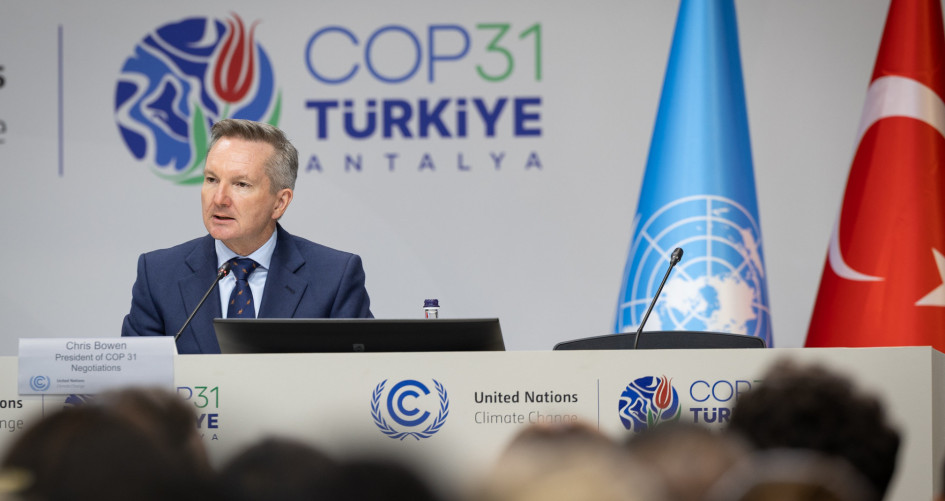
Australia's Climate Change and Energy Minister Chris Bowen speaks at COP31 in Antalya on November 20, 2026. Photo: Kiara Worth / UN Climate Change.
By World Media Feed Editorial Team
United Nations climate negotiations in Antalya, Türkiye, moved toward a possible agreement early Sunday after the COP31 presidency presented a revised package intended to break a dispute over fossil fuels and financial support for countries facing climate impacts. But the deal had not yet been formally adopted in the latest account from the summit.
COP31 President Murat Kurum said he believed the new text could win the support of all participating parties. Delegations were given until 0300 GMT to raise objections, with a plenary session scheduled for 0600 GMT to begin the approval process, Reuters reported late Saturday. The negotiations had continued beyond the conference’s Friday deadline and through Saturday night.
Fossil fuels return to the centre of the dispute
The revised package followed criticism of an earlier draft that omitted explicit references to fossil fuels. That omission had angered countries seeking a stronger commitment to move away from coal, oil and gas, while governments more dependent on fossil-fuel production or consumption resisted language they considered too prescriptive.
Reuters reported that Kurum said the new text addressed concerns about fossil fuels. However, the full wording of the latest package was not yet public in the report, making it too early to determine whether it restores a clear transition commitment, sets out a timetable or relies on broader language.
The dispute follows the 2023 COP28 agreement in Dubai, where countries called for a transition away from fossil fuels in energy systems. At COP31, governments have been divided over how that commitment should be reflected in the next political decision and how national circumstances should shape implementation.
Climate finance remains a test for the negotiations
A second major issue is how developing countries will pay for adaptation: measures such as flood protection, drought-resistant agriculture, stronger infrastructure and early-warning systems. Countries vulnerable to rising temperatures and extreme weather have argued that commitments to adapt must be matched by predictable financial support.
Kurum said the revised package also addressed concerns over financing adaptation in developing countries. Yet until the text is published and adopted, the scale, timing and form of any financial commitment remain uncertain. Earlier drafts and proposals had exposed disagreement over targets, funding sources and whether support would be provided as grants, concessional loans or other forms of finance.
The question is especially consequential for lower-income countries that face high costs from climate-related disasters while having limited public resources to rebuild homes, transport links, power systems and agricultural livelihoods.
Nearly 200 delegations face a consensus decision
The talks are being led by Australia, which is responsible for the negotiations, while Türkiye is hosting the summit. The revised package followed consultations involving nearly 200 delegations with sharply different economic priorities and levels of exposure to climate change.
Because COP decisions are reached by consensus, the presidency must find language that no participating party formally blocks. That process can produce compromises that keep countries at the table but leave disagreements over ambition, finance and implementation unresolved.
The United Nations climate process is also operating against a worsening scientific outlook. Reuters noted that this is the first COP since the UN confirmed that global temperatures are on course to exceed the 1.5-degree Celsius threshold that countries agreed to try to avoid under the Paris Agreement. Exceeding that level increases the risks of severe climate impacts, although every fraction of a degree matters.
What to watch in the final text
The immediate test is whether the revised package wins formal approval and what it says about fossil fuels and adaptation finance. A reference to the transition away from fossil fuels would signal that governments are retaining the direction set at COP28, while vague or indirect wording could leave the central dispute unresolved.
On finance, the key questions are whether the agreement includes a measurable target, a timetable and a clearer explanation of how support will reach vulnerable countries. Without those details, a political statement of support may do little to resolve the funding gap facing communities already dealing with floods, droughts, heat and coastal erosion.
For now, COP31 is close to a possible deal, not a completed one. The final assessment will depend on the text governments actually adopt, not the expectations expressed by the summit presidency before the approval session.
Sources and editorial note
This report draws on Reuters reporting from Antalya, published November 21 and updated as talks continued into Sunday, the Associated Press account of the negotiations, and The Guardian’s live coverage. The status of the agreement and the approval timetable are attributed to Reuters and the summit presidency. At publication, the revised text had not been confirmed as formally adopted. World Media Feed will distinguish any final decision from the negotiating proposal.
Photo: Australia’s Climate Change and Energy Minister Chris Bowen speaks at COP31 in Antalya on November 20, 2026. Photo: Kiara Worth / UN Climate Change.
About the Author