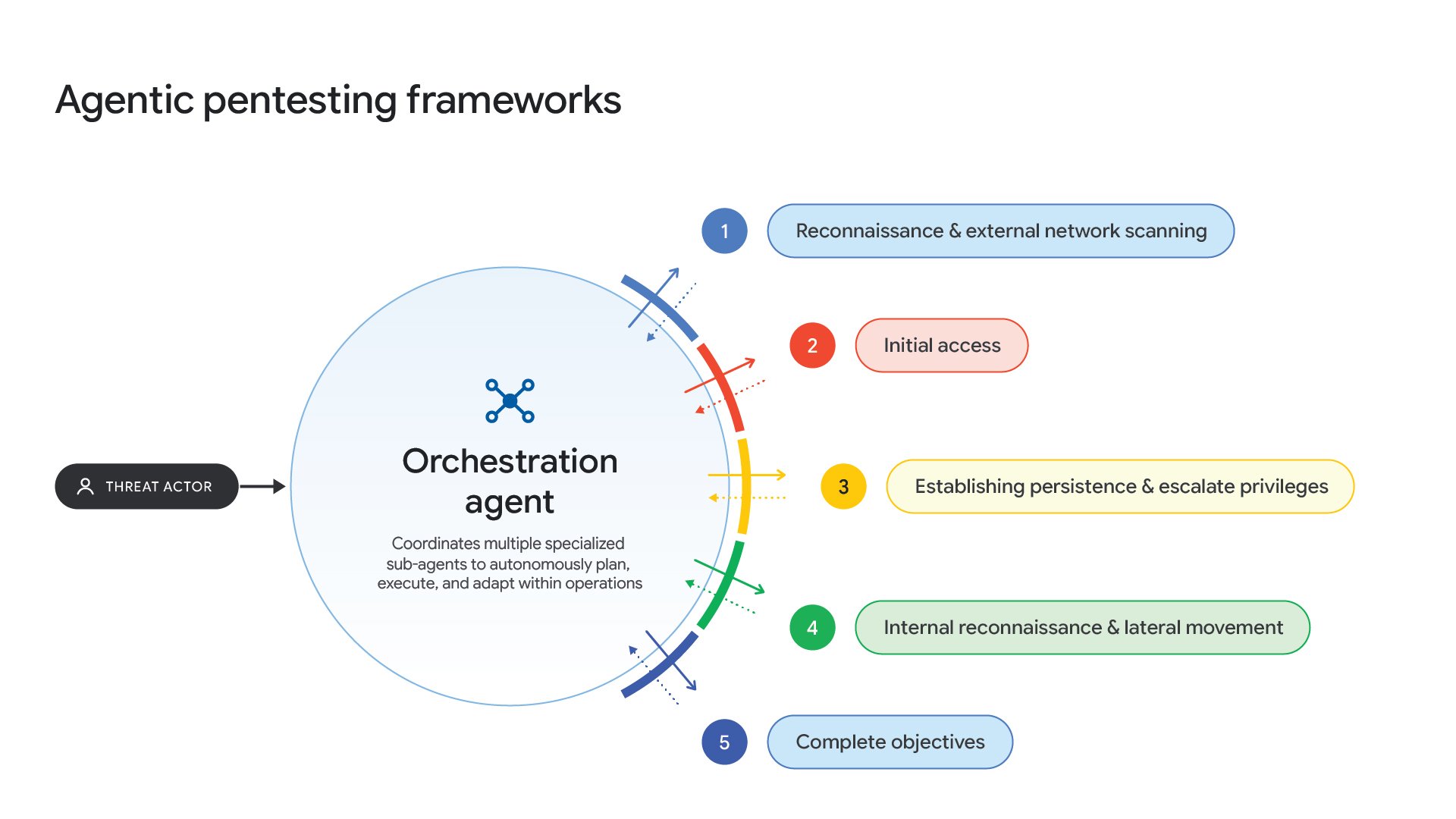
Diagram illustrating multi-agent LLM frameworks observed in cyber intrusions. Source: Google Threat Intelligence Group, November 16, 2026.
By World Media Feed Editorial Team
Google’s Threat Intelligence Group says criminal, espionage and influence-operation actors are increasingly using generative artificial intelligence in more automated forms, including multi-agent frameworks and vulnerability-exploitation workflows.
In a November 16 report, Google Threat Intelligence Group and Mandiant described a shift beyond basic prompting toward systems that can coordinate multiple steps in an operation. The researchers said these tools can help attackers compress timelines, scale activity and automate parts of complex intrusions.
The report identifies several areas of concern, including automated vulnerability exploitation and schemes that monetize access to AI services. One example is so-called LLMjacking, in which attackers misuse or take over access to large language model resources for their own purposes.
The findings do not mean that AI agents have replaced human operators or that every reported activity is fully autonomous. Threat groups still need access, infrastructure and operational decisions, and the effectiveness of automated tools varies. The report is an assessment by Google’s security researchers, not a comprehensive public census of all cyber activity.
Even so, the trend matters for defenders. Automation can allow attackers to move more quickly between reconnaissance, vulnerability discovery and follow-on actions. Security teams may have less time to identify suspicious activity and contain an intrusion once a chain of actions begins.
Organizations are likely to face pressure to improve asset inventories, patch management, identity controls and monitoring of automated workloads. They may also need to examine how their own AI agents are granted access to systems, credentials and sensitive data.
The same technologies can also support defensive work, such as analyzing alerts and helping security teams prioritize vulnerabilities. The central challenge is ensuring that defensive automation is reliable and controlled while anticipating how adversaries may adapt similar capabilities.
Google’s assessment adds to a growing debate about the security implications of AI agents. The immediate concern is not simply that models can generate code or text, but that increasingly connected systems can take actions across multiple tools and services.
What the development means
Source: Google Cloud, Google Threat Intelligence Group, November 16, 2026.
Source
About the Author