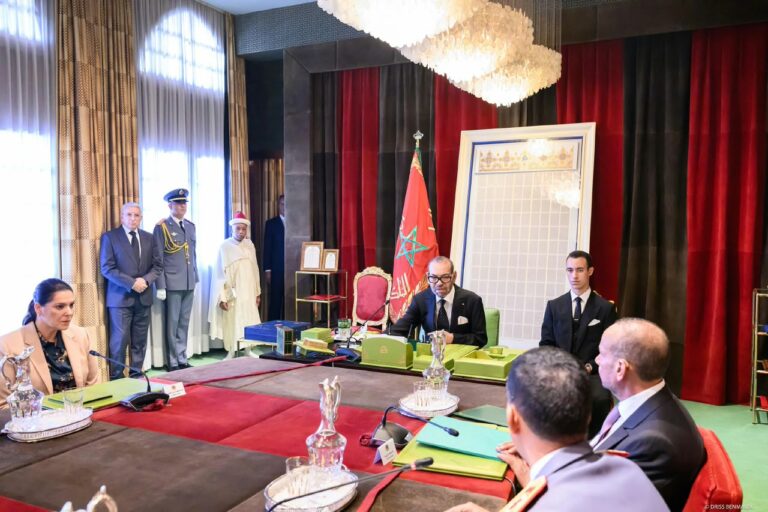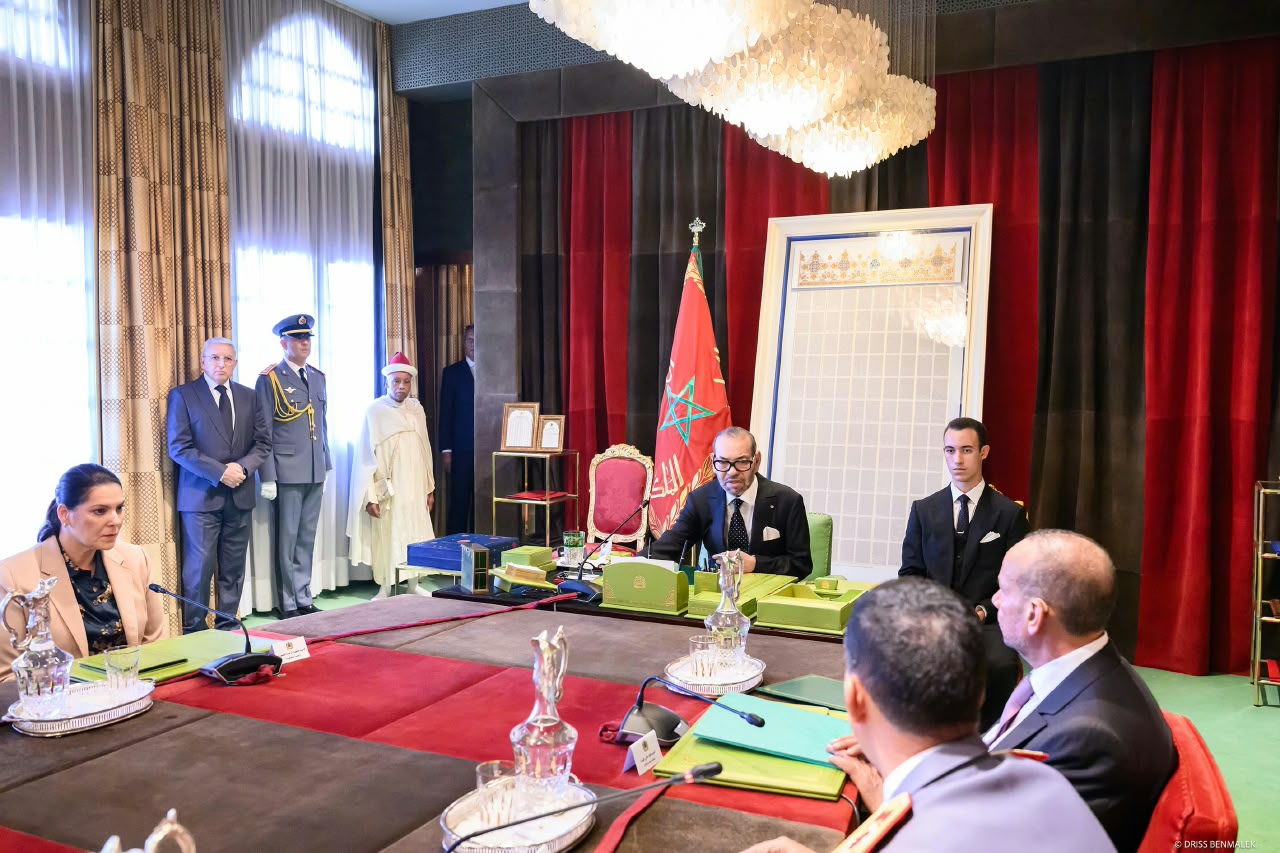
King Mohammed VI, accompanied by Crown Prince Moulay El Hassan, chairs a working session on the Morocco Offer for defense and security industries at the Royal Palace in Rabat, November 18, 2026.
By World Media Feed Editorial Team
RABAT, Morocco — Morocco is moving to establish itself as a producer and exporter of defense and security equipment, following a major royal working session on Wednesday that unveiled a national roadmap backed by a 4-billion-dirham contribution from the Hassan II Fund for Economic and Social Development.
King Mohammed VI, accompanied by Crown Prince Moulay El Hassan, chaired the session at the Royal Palace in Rabat on November 18, 2026. The meeting presented the “Morocco Offer,” a strategy designed to develop an integrated national defense and security industry, strengthen domestic production capabilities and create new opportunities in technology, investment and employment.
The announcement marks an important step in Morocco’s ambition to move beyond relying primarily on external suppliers and develop a domestic industrial base capable of designing, manufacturing, maintaining and eventually exporting defense and security systems.
According to the Royal Office statement, the roadmap builds on Morocco’s existing industrial capabilities, particularly in aerospace, automotive manufacturing and electronics. The objective is to use that industrial foundation to accelerate the country’s entry into the group of nations producing defense and security equipment.
A 4-billion-dirham commitment and a long-term industrial target
One of the most significant elements of the announcement is the contribution of 4 billion dirhams from the Hassan II Fund for Economic and Social Development to support implementation of the roadmap.
The funding is intended to help establish the institutional, financial and industrial structures required to develop the sector. King Mohammed VI also instructed officials to accelerate implementation, prioritize governance arrangements and establish a financing plan while simplifying investment procedures and mobilizing private-sector participation.
The roadmap sets ambitious targets for 2035.
Morocco expects its defense and security industrial base to:
- Create approximately 50,000 direct and indirect jobs.
- Meet around 40% of the needs of the Royal Armed Forces and security agencies through domestic industry.
- Generate more than 65% of its revenue from exports.
These figures represent targets set out in the national roadmap, rather than current production or employment levels. Their achievement will depend on investment, industrial development, technology partnerships and the successful implementation of the strategy.
Drones, artificial intelligence and advanced defense technologies
The proposed industrial ecosystem is designed to cover the entire value chain, including design, production, maintenance, testing and storage.
Among the priority areas identified in the Royal Office statement are drones and autonomous systems, land-based defense systems, naval systems, defense electronics, cyberdefense and artificial intelligence.
The roadmap also emphasizes dual-use technologies—innovations that can serve both civilian and defense applications.
This approach could allow Morocco to build on existing industrial expertise while developing more specialized technological capabilities. It also places research, engineering and technical training at the center of the country’s long-term industrial ambitions.
The strategy is not limited to assembling equipment. Its stated objective is to develop a more integrated ecosystem in which design, manufacturing, testing, maintenance and technological development operate within a coordinated national framework.
Benguerir and Benslimane identified for new industrial zones
Infrastructure will be another central part of the plan.
In addition to two defense industrial acceleration zones already in place, the Morocco Offer calls for two new large-scale zones dedicated to defense industries, one in Benguerir and another in Benslimane.
The Royal Office statement also confirmed that the King was briefed on progress at existing facilities, industrial projects already underway and investment prospects, including interest from investors considering projects in Morocco, particularly those oriented toward export markets.
The new zones are intended to provide an environment in which specialized companies and industrial projects can develop, supported by investment, infrastructure and the broader national industrial strategy.
A new agency, an industrial holding company and specialized training
The roadmap also proposes a new governance structure to coordinate the development of the sector.
A dedicated strategic agency is expected to oversee implementation of the national defense-industry strategy and support investors. An industrial holding company is also planned to organize the industrial ecosystem, mobilize public and private capital and encourage the emergence of major Moroccan industrial companies.
Human capital is another major component.
The Royal Office statement calls for the creation of a specialized academy offering advanced training programs in partnership with industrial stakeholders. The initiative is intended to draw on civilian and military expertise within Morocco, as well as the skills of Moroccans living abroad.
The King also stressed early career guidance for young people and stronger professional training to prepare the next generation of engineers, technicians, researchers and other specialists needed by the industry.
International partnerships and the export ambition
Morocco’s strategy is also built around international cooperation.
The Royal Office said the Morocco Offer would rely on the Kingdom’s strategic partnerships to strengthen its integration into global value chains and develop export capabilities.
That dimension is important because the roadmap does not envision domestic production serving only Moroccan institutions. Its stated ambition is to create an industrial platform that can supply national needs while competing in international markets.
Achieving that objective will require sustained investment, industrial expertise, technology cooperation and the ability of Moroccan companies to meet the requirements of potential international customers.
The target of generating more than 65% of industry revenue through exports by 2035 illustrates the scale of that ambition.
From industrial ambition to implementation
The working session brought together senior government, military and investment officials, including Head of Government Fatima Ezzahra El Mansouri, Royal Advisor Fouad Ali El Himma, Industry Minister Ryad Mezzour, Minister Delegate in charge of National Defense Administration Abdeltif Loudyi, Royal Armed Forces Inspector General Lieutenant General Mohammed Berrid, and Moroccan Investment and Export Development Agency Director General Ali Seddiki.
Their participation reflected the government’s, military’s and investment institutions’ roles in the proposed industrial framework.
The next phase will be measured less by the scale of the announcement than by the implementation of its commitments: establishing the governance bodies, organizing financing, attracting investors, developing industrial zones, building research capabilities and training the workforce.
Morocco’s existing strengths in manufacturing and technology provide a foundation for the initiative. But developing a competitive defense industry will require years of investment and the successful transfer and development of specialized expertise.
The 2035 objectives are ambitious. The challenge now is to translate the Morocco Offer into functioning industrial capacity, skilled employment and products capable of serving both domestic requirements and international markets.
Source: Royal Office statement, November 18, 2026, published through the Moroccan News Agency (MAP) and the official Moroccan government portal.
Byline: World Media Feed Editorial Team
About the Author