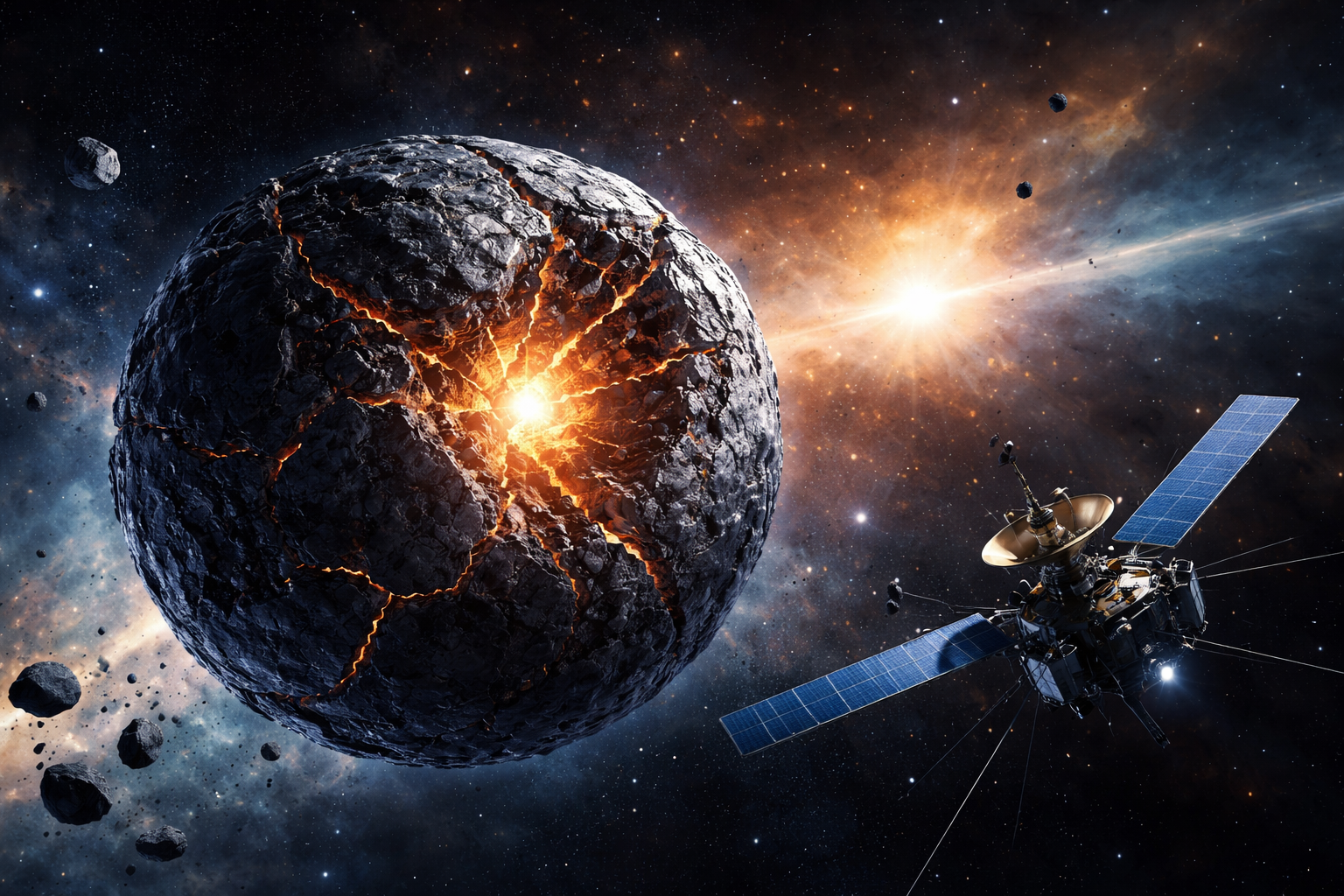
NASA’s Psyche spacecraft is on its way to a metal-rich asteroid that may offer clues about how rocky planets formed, but scientists will not get their first close-up observations from the mission until the spacecraft reaches its target in August 2029.
The asteroid, also called Psyche, orbits the Sun in the main asteroid belt between Mars and Jupiter. It is unusual because observations indicate a high metal content. One possibility is that it represents part of the exposed iron-rich core of an early planetesimal whose outer layers were removed by collisions.
That interpretation remains a scientific hypothesis, not an established description of the asteroid. NASA’s mission is designed in part to determine whether Psyche is the remnant of a differentiated body’s core or a metal-rich object formed through another process.
Launched on October 13, 2023, the spacecraft will orbit the asteroid for about two years after its planned arrival in August 2029. Its instruments will map the surface and measure properties that can help researchers understand the object’s composition and history.
The mission is not approaching the asteroid for an immediate encounter in 2026. The spacecraft remains in transit, and NASA’s published schedule places the start of its prime science mission in 2029.
If Psyche contains material from an ancient planetary core, studying it could provide a rare opportunity to investigate processes that occur deep inside Earth-like planets. If it is instead a mixture of metal and rock, that result would also help refine theories about the early solar system.
Sources: NASA Psyche mission overview; NASA Jet Propulsion Laboratory mission information.
About the Author