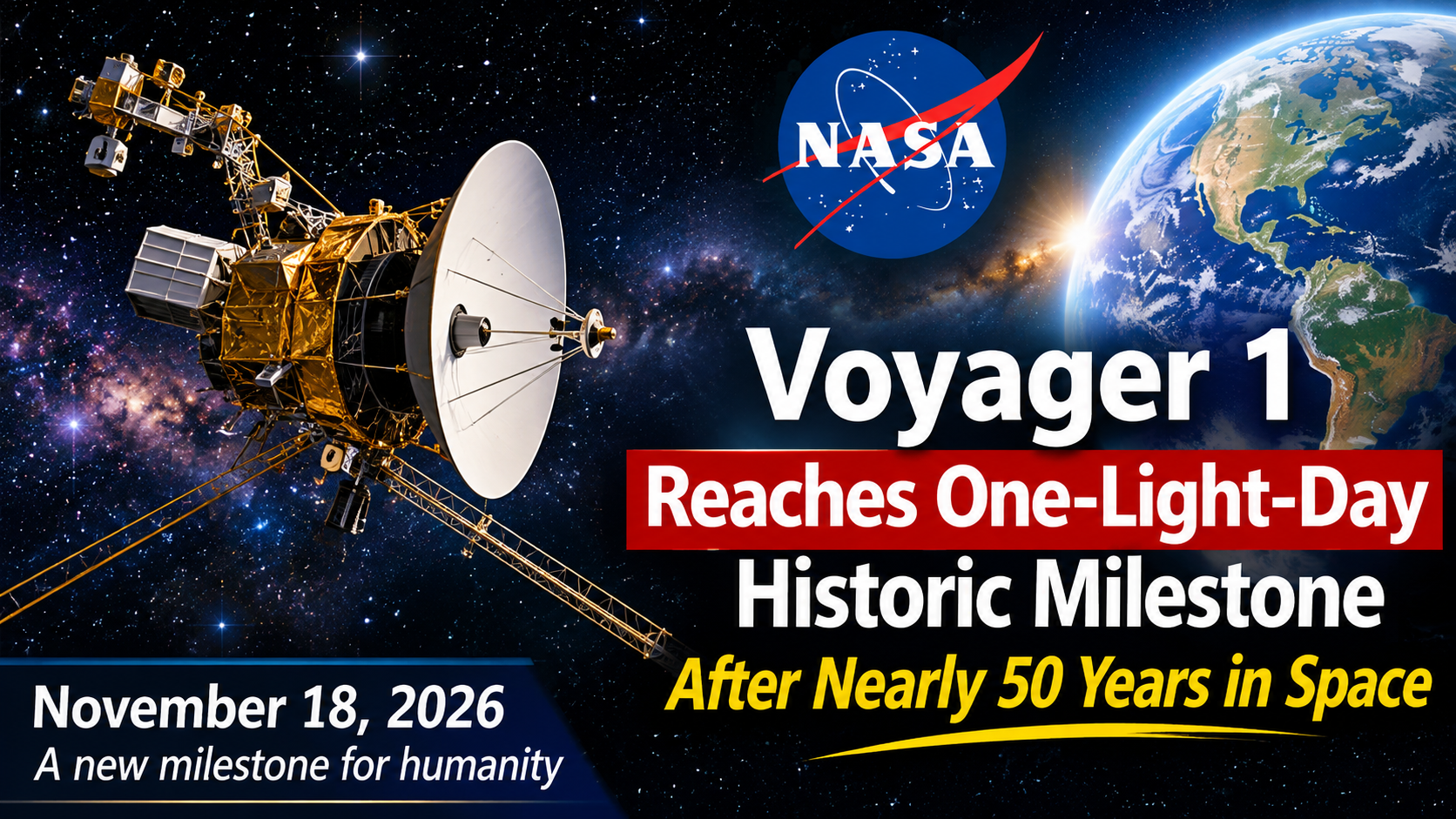
WASHINGTON — NASA’s Voyager 1 spacecraft is approaching an extraordinary milestone in space exploration. On November 18, 2026, the probe is expected to reach a distance of one light-day from Earth, becoming the first human-made object to travel that far from our planet.
Launched on September 5, 1977, Voyager 1 has spent nearly five decades traveling through space. It is now operating beyond the heliosphere, the vast protective region shaped by the Sun’s particles and magnetic field.
According to NASA’s Jet Propulsion Laboratory, the spacecraft is expected to be approximately 16.09 billion miles (25.89 billion kilometers) from Earth when it reaches the milestone.
What Does One Light-Day Mean?
A light-day is the distance light travels in 24 hours. Because light moves at approximately 186,000 miles per second, one light-day represents roughly 16.1 billion miles.
For Voyager 1, reaching this distance will have a practical consequence for communication with Earth.
Radio signals travel at the speed of light. Once the spacecraft reaches one light-day away, a command sent from Earth will take approximately 24 hours to arrive. A response will require another 24 hours to return.
That means a complete communication exchange could take about two days.
Engineers Work to Keep the Mission Alive
Despite its historic journey, Voyager 1 faces the challenges of aging equipment and a declining power supply.
The spacecraft relies on radioisotope thermoelectric generators, which produce electricity from heat generated by radioactive decay. Their power output gradually decreases over time, forcing engineers to carefully manage the energy available to the spacecraft.
NASA engineers recently completed an energy-saving operation known as the “Big Bang,” replacing three devices with lower-power alternatives to help preserve the spacecraft’s remaining scientific capabilities.
The mission team is also investigating a communications interruption that occurred in October 2026. Contact was restored after approximately 48 hours, and engineers continued troubleshooting the spacecraft.
NASA has emphasized that maintaining Voyager 1 requires careful decisions as its available power becomes increasingly limited.
A Mission That Changed Our Understanding of Space
Voyager 1 was originally launched to study the outer planets, including Jupiter and Saturn. Its observations provided valuable information about these distant worlds and their moons.
In August 2012, the spacecraft crossed the heliopause and entered interstellar space. Its twin, Voyager 2, followed in 2018.
The two spacecraft remain the only human-made probes to have directly explored this region beyond the Sun’s heliosphere.
Their continued operation gives scientists an opportunity to study an environment that no other spacecraft has yet reached.
A Historic Moment in Exploration
Reaching one light-day from Earth will not cause a physical change aboard Voyager 1. The spacecraft will continue its journey through interstellar space.
The significance of the milestone is what it represents: the extraordinary distance a human-made machine can travel and the engineering effort required to keep it operating for nearly 50 years.
As November 18 approaches, NASA’s mission team continues working to preserve the probe’s remaining instruments and maintain communication with humanity’s most distant explorer.
Sources:
- NASA Jet Propulsion Laboratory — NASA’s Voyager 1 Conserves Power, Resolves Brief Communications Pause
- NASA Science — Voyager 1: What Is a Light-Day?
- NASA Science — Voyager 1 Mission
World Media Feed will continue following developments in space exploration and scientific research. The November 18 milestone is an expected event based on NASA’s published projection.
About the Author