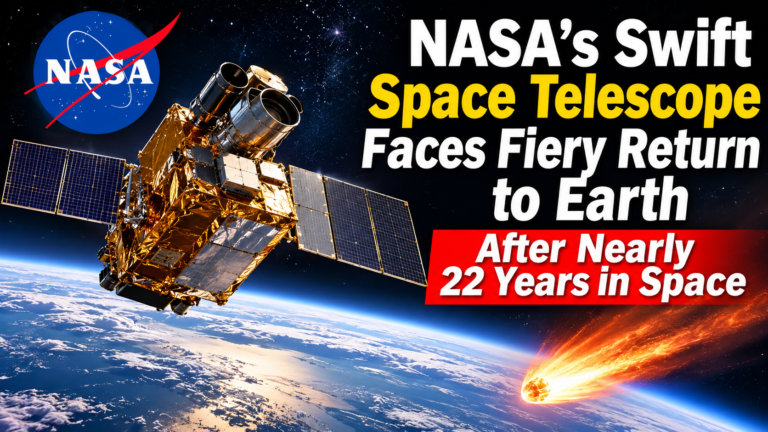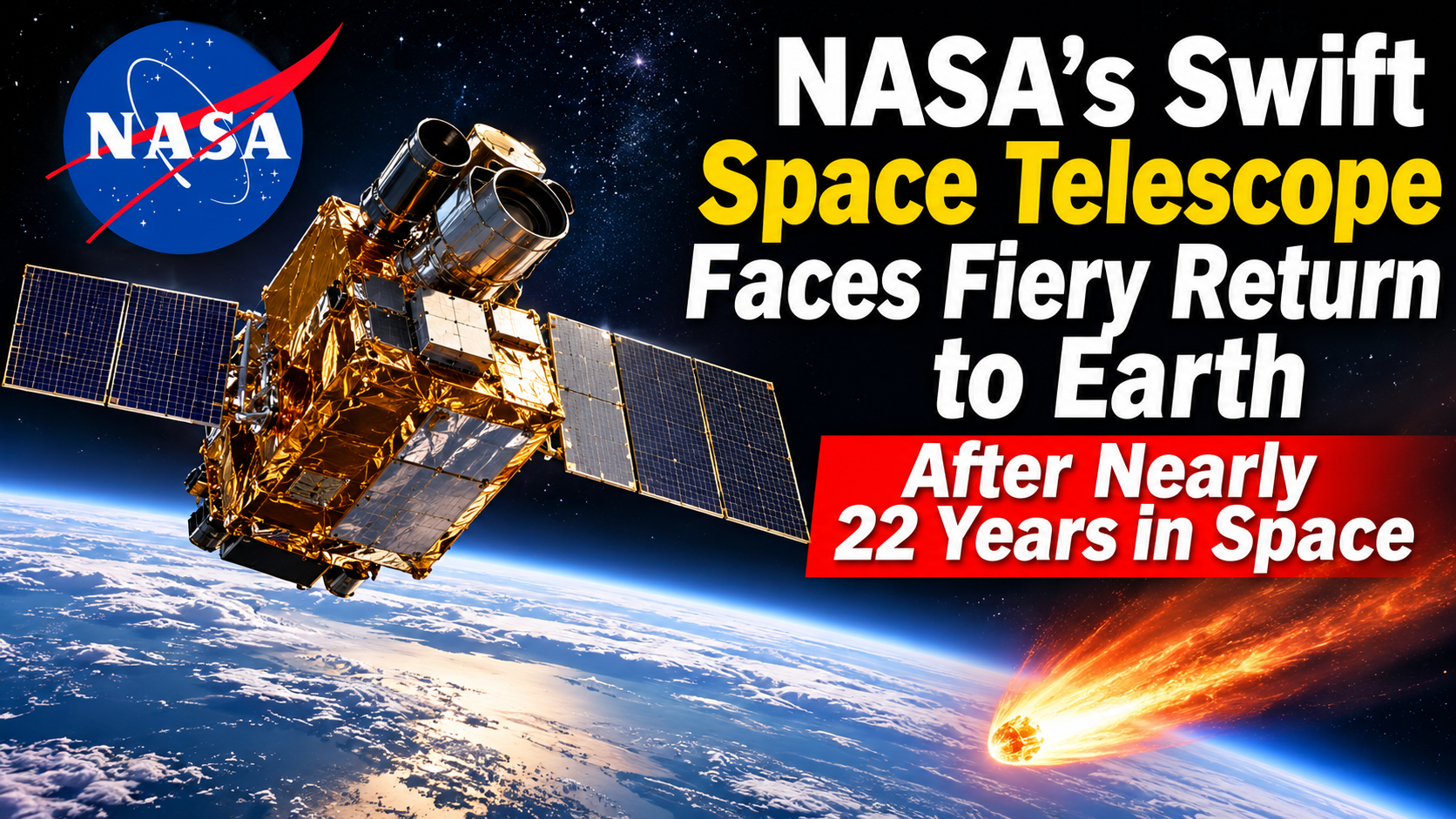
WASHINGTON, November 3, 2026 — One of NASA’s important space observatories is approaching the end of its remarkable journey. The Neil Gehrels Swift Observatory is expected to re-enter Earth’s atmosphere on Wednesday, November 4, nearly 22 years after its launch.
The spacecraft, weighing approximately 3,200 pounds, was originally designed for a two-year mission. Instead, it continued operating for more than two decades, helping scientists study some of the universe’s most powerful explosions.
According to NASA, the U.S. Space Force’s latest prediction places the re-entry at approximately 3:30 a.m. Eastern Time on November 4, with an uncertainty window of about 11 hours.
What will happen when Swift returns?
NASA expects most of the spacecraft to burn up as it travels through Earth’s atmosphere. However, some components could survive and reach the surface.
NASA estimates the risk of harm to anyone on Earth at approximately 1 in 2,100. The agency and the U.S. Space Force are continuing to monitor the spacecraft and update their predictions.
Because Swift travels in a relatively low-inclination orbit, any surviving debris would be limited to a region between approximately 20.6 degrees north and 20.6 degrees south latitude.
The exact location of any surviving fragments cannot be determined in advance with certainty.
A mission that transformed space science
Launched on November 20, 2004, Swift was designed to detect and study gamma-ray bursts — extraordinarily powerful explosions associated with some of the most energetic events in the universe.
Its three telescopes allowed scientists to observe these events across different wavelengths, including gamma rays, X-rays and ultraviolet or optical light.
The observatory also helped researchers study supernovae, black holes, active galaxies and other cosmic phenomena.
Its ability to rapidly turn toward sudden cosmic events made it an important tool for astronomers around the world.
A rescue attempt that could not save the spacecraft
NASA and commercial partner Katalyst Space attempted to extend Swift’s life by raising its orbit using a robotic servicing spacecraft called LINK.
The rescue effort did not succeed. NASA later explained that technical problems prevented LINK from capturing and boosting Swift into a higher orbit.
Increasing atmospheric drag, intensified by solar activity, accelerated the observatory’s descent.
Swift eventually entered safe mode, bringing its scientific operations to an end.
The end of an extraordinary journey
Although Swift’s mission is ending, the scientific observations it collected over nearly 22 years will continue to help researchers investigate the universe.
The spacecraft’s return also highlights a growing challenge in space exploration: managing aging satellites and reducing the risks associated with objects re-entering Earth’s atmosphere.
For NASA, Swift leaves behind a lasting scientific legacy — a mission designed to last two years that ultimately served humanity for almost 22.
World Media Feed will continue following NASA and U.S. Space Force updates on the spacecraft’s re-entry.
Sources:
- NASA — Swift Observatory to Re-Enter Atmosphere
- NASA — Swift Mission Ends Ahead of Re-Entry
- Spaceflight Now — Swift Observatory to Burn Up This Week
- NASA Goddard — Official Swift Mission Video
Editorial note: The re-entry time and risk estimates are based on NASA’s November 2 update and may change. This article should be updated if NASA issues a new forecast.
About the Author