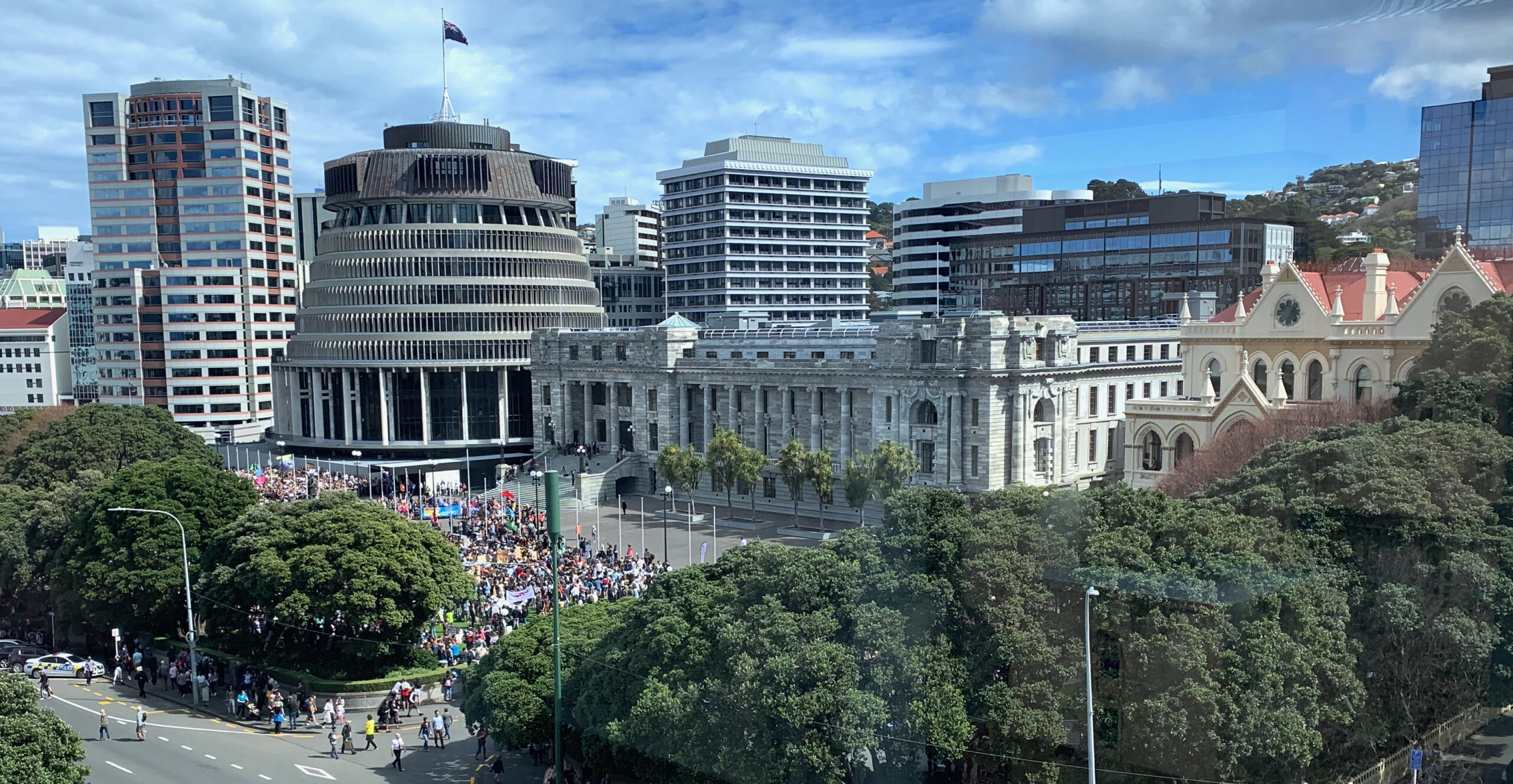
New Zealand Parliament Buildings in Wellington. Photo: Tom Ackroyd, Wikimedia Commons, CC BY-SA 4.0.
WELLINGTON, New Zealand — New Zealand’s final election results have left the country’s Parliament without a clear majority, placing a newly elected centrist party in a pivotal position as Prime Minister Christopher Luxon seeks to form another government.
The Electoral Commission announced the official results Friday after counting ordinary and special votes from the Nov. 7 general election. The National Party won 40 seats, while its coalition partners ACT New Zealand won 13 and New Zealand First won 12, giving the governing bloc 65 seats in the 130-seat Parliament — one short of a majority.
The Opportunity Party, a new parliamentary force led by Qiulae Wong, won seven seats and is now positioned to determine whether Luxon’s coalition can return to power.
Special votes changed the balance
The final result differed from election-night projections after nearly 485,000 special votes were counted. The Electoral Commission said the National Party lost two seats compared with the preliminary count, while the Green Party gained one.
Labour won 36 seats, the Greens 17 and Te Pāti Māori five. The centre-left parties cannot form a government with Opportunity alone because they would still lack enough seats to reach a majority.
That leaves Luxon’s National-led bloc with the clearest route to government, provided it can reach an agreement with Wong’s party.
Negotiations could take time
Wong has said all options remain open, including a coalition arrangement or a confidence-and-supply agreement that would allow a government to remain in office without giving the smaller party full participation in cabinet.
But the negotiations are unlikely to be simple. Opportunity has campaigned on issues including climate policy, political donations, competition in the supermarket sector and health planning. Some of those positions differ from those of the existing coalition parties.
Wong has also objected to New Zealand First leader Winston Peters continuing as foreign minister, adding another potential obstacle to an agreement.
Another election remains possible
Luxon has said the priority is to form a stable government rather than rush into an agreement. Under New Zealand’s parliamentary system, the incumbent government remains in a caretaker role while negotiations continue.
If the parties cannot reach an arrangement capable of commanding confidence in Parliament, New Zealand could eventually face another election.
The Electoral Commission said Parliament must meet by Jan. 14, 2027, while the final results remain subject to any applications for judicial recounts.
Why the result matters
The election has produced an unusually fragmented Parliament in which neither of the two major blocs can govern alone. The result also gives a newly established centrist party significant influence over the country’s next government.
For Luxon, the immediate challenge is to turn the 65-seat governing bloc into a workable majority arrangement without losing support from his existing coalition partners or making concessions that could fracture the alliance.
World Media Feed will continue to follow New Zealand’s government-formation talks as negotiations develop.
Sources: New Zealand Electoral Commission; Associated Press; Reuters.
About the Author