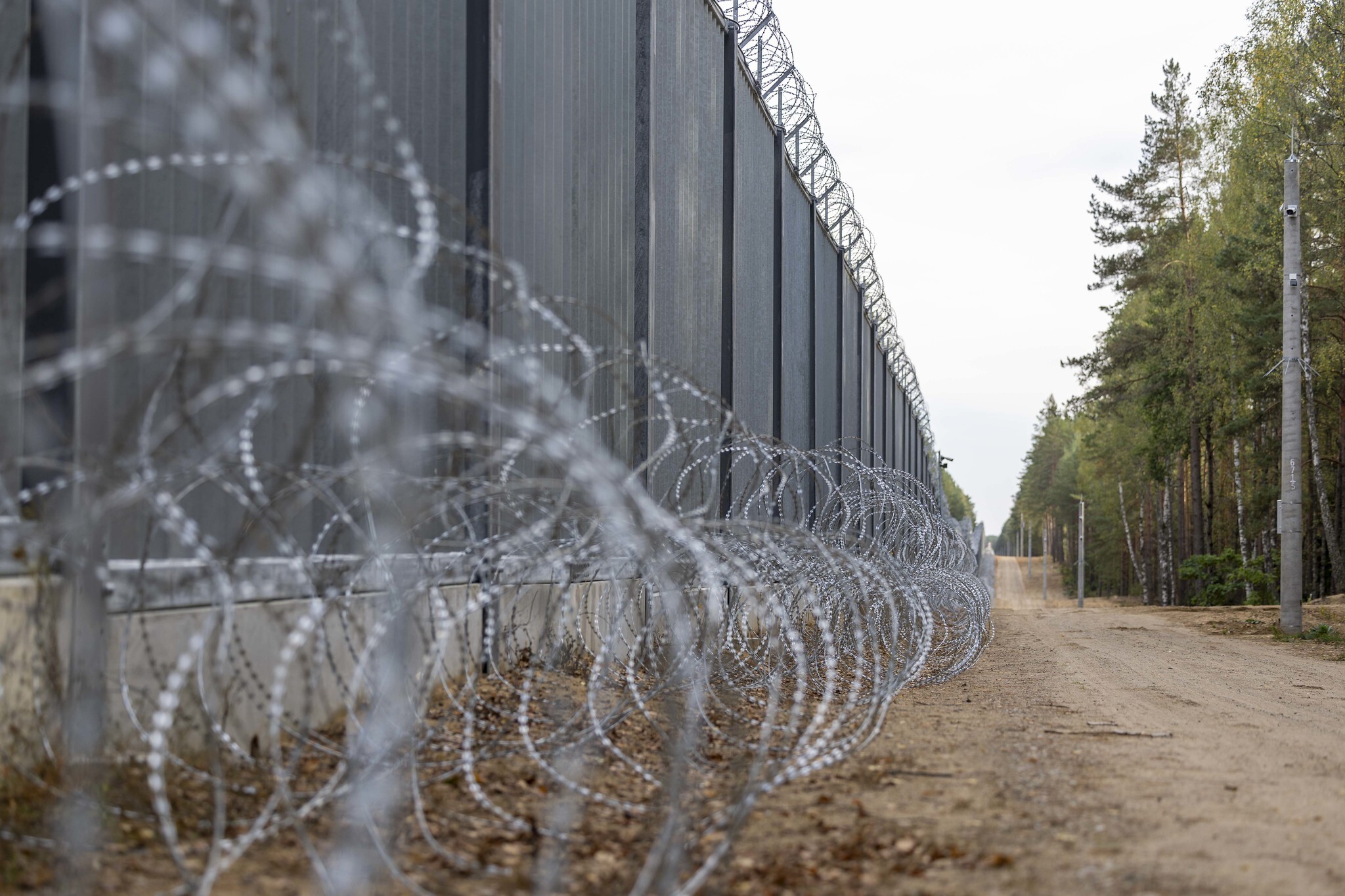
Illustrative file photograph of the Poland–Belarus border barrier, September 20, 2023. Photo: Ministry of National Defence of Lithuania via Wikimedia Commons; GNU Free Documentation License 1.2 or later.
The European Court of Human Rights has issued three major rulings on migrant pushbacks at the borders of Poland, Latvia and Lithuania with Belarus, clarifying when governments may return people who cross irregularly during what the Court described as the “instrumentalisation” of migration by a neighbouring state.
The Grand Chamber judgments, delivered on November 24, concern events from 2021 and 2022, when Belarusian authorities encouraged, facilitated or forced people from third countries to travel to the EU’s eastern borders. The Court accepted that these actions formed part of a hostile strategy intended to destabilise neighbouring countries.
What the Court decided
The Court said states retain the right to control their borders and that, in the specific context of migration being instrumentalised by another state, returning a person to that state does not automatically violate the Convention’s ban on torture and inhuman or degrading treatment.
But the judgments do not give governments an unrestricted right to push people back. Authorities must identify individuals who are particularly vulnerable or face a real and immediate risk of serious harm. The Court found violations in parts of the Polish and Latvian cases, including the removal of children and accompanying family members in Latvia and the removal of an Afghan applicant in Poland despite an interim measure protecting him. It found no violation in the Lithuanian case involving four Cuban nationals.
Why the rulings matter
The decisions address a difficult collision between two realities: governments facing deliberate pressure at their borders and individuals seeking protection from danger. The Court recognised the security challenge described by Poland, Latvia and Lithuania while reiterating that essential human-rights safeguards remain in force.
Human-rights organisations criticised the judgments. Amnesty International said the rulings risk narrowing practical protection against ill-treatment by placing greater emphasis on whether individuals can demonstrate specific vulnerabilities or an immediate threat. The organisation also stressed that the decisions do not remove states’ obligations under international human-rights and refugee law, including the right to seek asylum.
A ruling with consequences beyond the three borders
The judgments could influence how European governments respond to future migration movements they believe are being orchestrated by hostile states. They may also shape debate over proposed emergency border measures across Europe.
The legal distinction is important: the Court did not declare that all pushbacks are lawful. It assessed three specific cases under the circumstances created by Belarus’s actions and maintained that vulnerable people must still be protected. The rulings leave national authorities with significant responsibilities to identify risk before removing anyone.
What to watch next
- How Poland, Latvia and Lithuania implement the judgments and comply with any findings of violations.
- Whether European governments cite the rulings when proposing new border procedures.
- How courts and asylum authorities assess vulnerability and access to protection in future cases involving alleged state-organised migration.
The central question now is how governments will apply the Court’s balance between border control and individual protection in practice. The judgments recognise the use of migration as a geopolitical pressure tool—but they do not erase the safeguards owed to people caught in the middle.
Sources
European Court of Human Rights: Grand Chamber judgments, November 24, 2026; ECHR questions and answers on the cases; Amnesty International response, November 24, 2026; Euronews coverage of the judgments.
By World Media Feed Editorial Team
About the Author