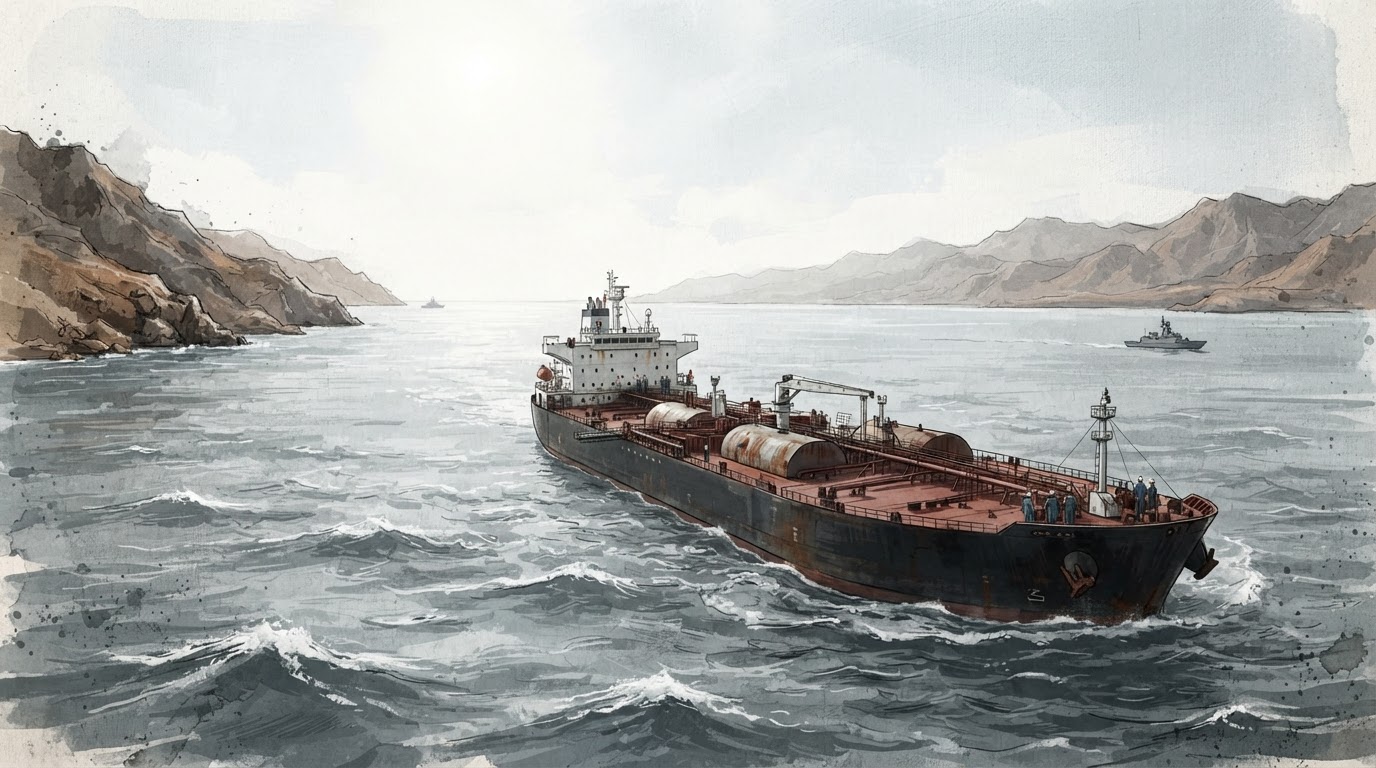
Editorial illustration. Not a documentary photograph.
By World Media Feed Editorial Team
Commercial shipping faced another dangerous day near the Strait of Hormuz on Saturday after the United Kingdom Maritime Trade Operations agency reported two incidents involving tankers struck by unidentified projectiles off Oman. The reports add to a rising number of maritime security incidents in and around the waterway, where the confrontation involving Iran, the United States and Israel has disrupted one of the world’s most important energy routes.
In its first warning, UKMTO said an outbound tanker was hit on the stern by an unknown projectile about 11 nautical miles north of Khasab, Oman. A later notice described a tanker struck in its engine room about 17 nautical miles east of Khasab. UKMTO said there were no reported casualties in the first incident and that the environmental impact had not been confirmed. It was not immediately clear whether the two reports involved separate vessels.
Separate accounts leave key details unresolved
Iran’s navy separately said an oil tanker caught fire after hitting a naval mine in a restricted area east of the Strait of Hormuz. Iranian state media said the vessel had ignored warnings. That account has not been independently verified, and public information does not establish whether the tanker described by Iran was one of the vessels in UKMTO’s two notices.
The distinction matters. The maritime agency has described the projectiles as unidentified and has not publicly attributed the incidents to a particular country or armed group. The Iranian account is a separate claim and should not be treated as confirmation of the cause of either UKMTO-reported strike.
A pattern of rising maritime incidents
The latest reports come amid a broader increase in attacks around the waterway. Data cited by ABC News from UKMTO showed 31 reported attacks in and around the Strait of Hormuz during October and approximately 19 more in November as of November 18. The International Maritime Organization’s tally was lower, but it also recorded a marked rise in incidents during October and November.
The figures differ because maritime agencies use their own reporting and confirmation methods. They nevertheless point to a deteriorating security environment for commercial vessels, including ships that are not directly involved in the conflict.
Why the shipping disruption matters globally
The Strait of Hormuz connects the Persian Gulf with the Gulf of Oman and the Arabian Sea. Before the war began in February, close to one-fifth of global oil supplies moved through the passage. The route is also essential for liquefied natural gas shipments, particularly from Qatar.
Recent traffic data underline the pressure on the route. The Financial Times reported that 263 vessels transited the strait in the week to November 18, 15 percent fewer than the previous week. The number of oil tankers fell from 52 to 37. The publication cautioned that preliminary figures may change as additional vessel movements are identified.
Fewer transits can mean longer delivery times, higher freight and insurance costs, and additional uncertainty for energy importers. The consequences can extend well beyond the Gulf, affecting markets and businesses that depend on predictable fuel supplies and shipping schedules.
The human and environmental risks
For seafarers, the immediate danger is fire, explosion, evacuation or being caught in a military incident while carrying out commercial work. The International Maritime Organization and maritime security agencies have repeatedly urged vessels to follow official safety guidance and report suspicious activity.
The environmental risk is also significant. A damaged tanker can release oil or other hazardous cargo into sensitive marine areas. British endurance swimmer and ocean advocate Lewis Pugh, who recently completed a swim in the strait, warned that pollution from damaged vessels could threaten marine life and coastal ecosystems. The full environmental impact of the latest incidents remains unknown.
A fragile route at the center of a wider confrontation
The latest incidents illustrate how commercial navigation has become part of the wider security contest. Iran has sought to restrict shipping through the strait, while the United States has taken steps to challenge those restrictions and maintain access for maritime traffic. Each new incident raises the risk of miscalculation, retaliation or further disruption.
For now, several central questions remain unanswered: whether the two UKMTO reports involved one vessel or two, who was responsible for the projectile strikes, and whether the tanker described by Iran was connected to either report. Authorities have not confirmed an environmental impact from the UKMTO incidents.
What is clear is that the security of the Strait of Hormuz is no longer only a regional military concern. It is a global economic and environmental issue, with commercial crews and energy supply chains exposed to the consequences of an increasingly dangerous passage.
World Media Feed will continue monitoring official maritime warnings, shipping data and statements from the governments involved.
Sources
- United Kingdom Maritime Trade Operations — Warning 215-26, November 21, 2026
- Reuters — Tanker incidents reported near Oman’s Khasab, November 21, 2026
- ABC News — Attacks in and around the Strait of Hormuz reach their highest level since the war began, November 21, 2026
- Financial Times — Oil shipments through Hormuz fall as attacks increase, November 21, 2026
- The Associated Press — Ocean advocate warns of environmental risks in the Strait of Hormuz, November 21, 2026
Editorial note: The reports by UKMTO, the Iranian navy and other parties are presented separately. WMF has not independently verified the cause of the tanker incidents or established that the Iranian navy’s account refers to either vessel in the UKMTO notices. Figures may change as authorities update their reports.
About the Author