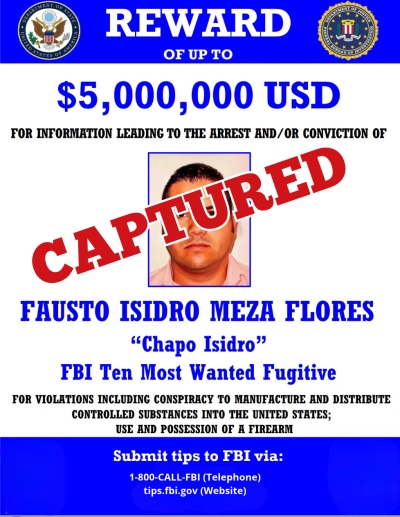
Image: U.S. Department of Justice / FBI captured poster.
By World Media Feed Editorial Team
Mexican forces have captured Fausto Isidro Meza Flores, known as “El Chapo Isidro,” a suspected senior figure in the country’s organized-crime networks who was among the FBI’s Ten Most Wanted fugitives. The operation in Guasave, in the northwestern state of Sinaloa, was carried out on Friday, November 20, and announced by Mexican and U.S. authorities the following day.
The arrest was followed by an outbreak of violence in the area, including armed clashes, burning vehicles and roadblocks. Four Mexican soldiers and seven alleged cartel gunmen were reported killed during the operation, according to reporting by The Associated Press and Reuters. Authorities said security forces remained deployed to protect residents.
A high-profile capture backed by U.S. intelligence
The U.S. Department of Justice said Meza Flores was captured by the Mexican military following an investigation involving the Homeland Security Task Force. The department also confirmed the arrest of another alleged cartel figure, Germán Rolando Gálvez Meza, known as “El Serafín.” Mexican officials and U.S. agencies described the operation as a joint effort involving intelligence cooperation.
Meza Flores had been listed among the FBI’s Ten Most Wanted Fugitives. The U.S. State Department had offered a reward of up to $5 million for information leading to his arrest or conviction.
U.S. prosecutors have charged him with a range of offenses, including leading a continuing criminal enterprise, drug-trafficking conspiracies, money laundering, narcoterrorism and firearms offenses. These are allegations, not findings of guilt. Meza Flores is presumed innocent unless and until proven guilty in court.
Violence followed the operation in Sinaloa
The raid triggered a tense night in and around Guasave. The Associated Press reported gunfire, burning vehicles and businesses, and residents seeking shelter as clashes unfolded. Reuters also reported roadblocks and armed confrontations. Mexican security officials said forces would remain in the state to protect the population.
The reported deaths of four soldiers and seven suspected cartel gunmen underline the risks faced by security personnel and civilians during operations against heavily armed criminal organizations. The immediate calm reported by authorities does not necessarily mean the wider security situation has been resolved.
Why the arrest matters beyond Mexico
U.S. authorities have accused Meza Flores and the organization associated with him of moving large quantities of cocaine, methamphetamine, heroin, marijuana and fentanyl toward the United States. The case therefore sits at the center of a wider cross-border security challenge involving drug trafficking, weapons, money laundering and violence.
The capture also comes amid sustained pressure from Washington for Mexico to intensify action against powerful criminal groups. The operation demonstrates close security cooperation between the two governments, but it also raises a difficult question: whether removing a senior figure will weaken a criminal network or trigger a struggle among factions seeking to take his place.
Analysts have long cautioned that arrests of high-ranking cartel figures can be followed by internal competition and localized violence if the wider organization remains intact. The coming days will show whether authorities can maintain security in Sinaloa and whether the operation produces lasting disruption rather than a temporary change in the balance of power.
What happens next
Meza Flores faces prosecution in the United States under a federal indictment. The Justice Department says the charges carry the possibility of a death sentence or mandatory life imprisonment if he is convicted. Any extradition or court proceedings will depend on the legal process and decisions by the relevant authorities.
For residents of Sinaloa, the immediate concern is security. For Mexico and the United States, the larger test is whether intelligence-sharing and targeted arrests can be matched by sustained efforts against the financial, logistical and armed structures that allow criminal organizations to operate.
World Media Feed will continue following developments in the case and the security situation in Sinaloa.
Sources
- U.S. Department of Justice — Arrest announcement, November 21, 2026
- Reuters — Capture and violence in Sinaloa, November 21, 2026
- The Associated Press — Cartel leader captured in northern Mexico, November 21, 2026
- U.S. Drug Enforcement Administration — Statement on the capture, November 21, 2026
Editorial note: Allegations against Meza Flores are attributed to U.S. authorities and court filings. He has not been convicted of the charges described in this report. The casualty figures and details of the operation are based on reporting by AP and Reuters and may be updated as authorities release further information.
About the Author