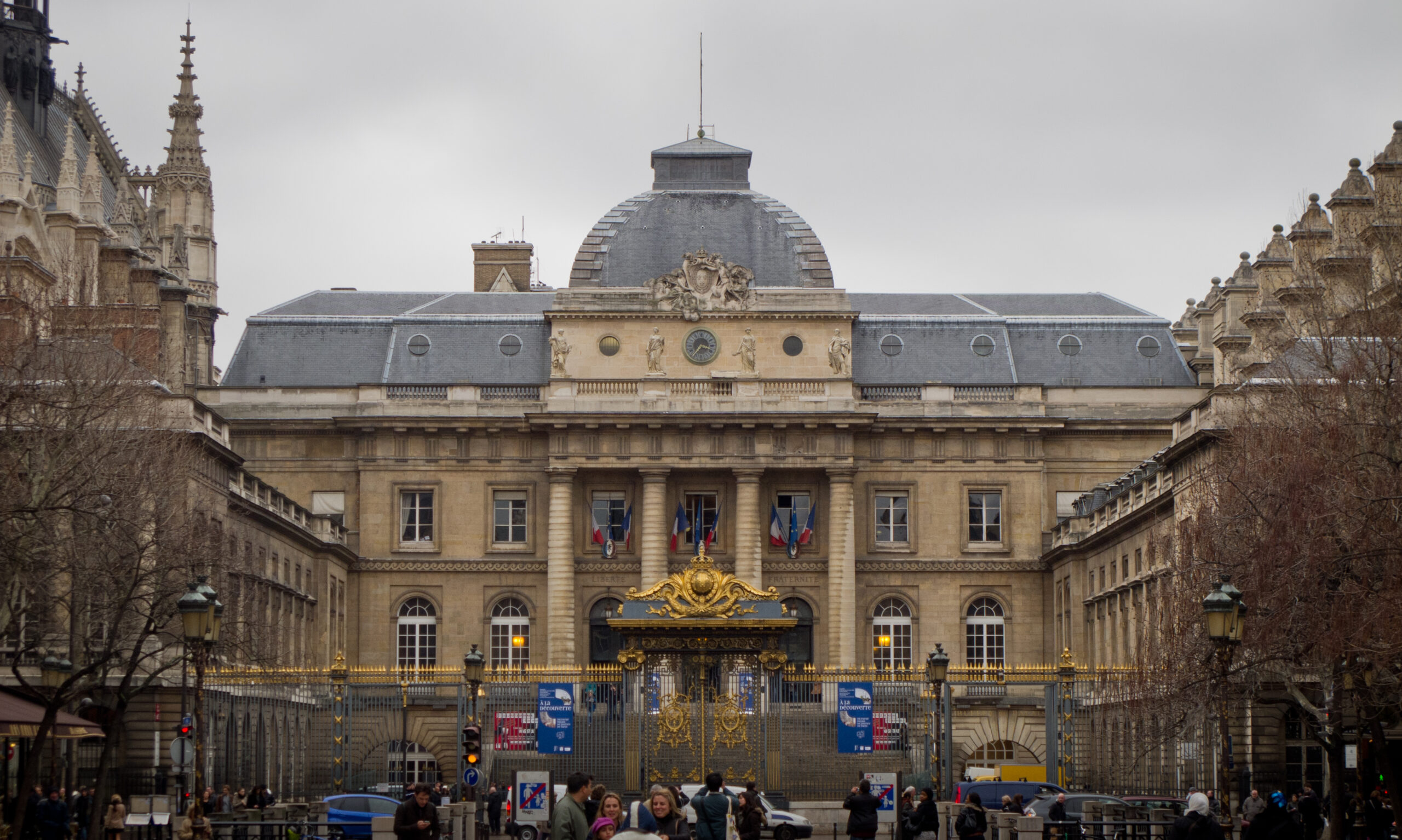
<p>Archive photograph of the Palais de Justice in Paris; it does not depict the Michel Zecler trial or the November 20 verdict. Photo: Carlos Delgado / Wikimedia Commons, CC BY-SA 3.0. https://creativecommons.org/licenses/by-sa/3.0/</p>
By World Media Feed Editorial Team
PARIS — A Paris criminal court has sentenced three police officers over the 2020 beating of Black music producer Michel Zecler, explicitly recognizing racist motivation as an aggravating factor in a case that became a national symbol of concerns about police violence and accountability in France.
The verdict was delivered late Friday, November 20, after a trial that examined both the assault inside Zecler’s recording studio and the officers’ subsequent account of the arrest. The court found the officers guilty of group violence and falsifying an official report. It also accepted that a racist insult had been used during the incident, despite the racist aggravating circumstance not being included in the original indictment.
Five-year sentences, with different custodial terms
Each officer received a five-year prison sentence, but most of each term was suspended. According to detailed reporting by Le Monde, Aurélien Lapersonne received three years suspended, leaving two years to serve; Philippe Tondeux received three and a half years suspended, leaving 18 months; and Pierre Plantier received four years suspended, leaving one year that can be served under electronic monitoring.
All three were permanently barred from working as police officers. The ban was ordered to take effect immediately, including in the event of an appeal, according to French reporting. The court also ordered delayed enforcement of the custodial portions for two of the officers.
The sentences were below the four-to-six-year prison terms sought by the prosecution. The officers apologized to Zecler before the verdict, according to reports from the courtroom.
Video evidence contradicted the police account
The assault took place on November 21, 2020, during France’s COVID-19 restrictions. Officers stopped Zecler outside his Paris recording studio, reportedly over an allegation that he was not wearing a face mask. He was then followed into the studio, where security-camera footage showed officers punching him, striking him with a baton and using tear gas.
The officers initially accused Zecler of attacking them and attempting to take a police weapon. The video footage contradicted important parts of that account. The court convicted the officers of falsifying the official report, finding that it had been written to protect them from disciplinary and criminal consequences.
Zecler suffered head and facial injuries and a serious injury to his biceps tendon. The court found that the violence caused 45 days of medically certified work incapacity, according to Le Monde’s account of the judgment.
Court recognizes racist motivation
One of the most consequential parts of the ruling was the court’s treatment of racism. Zecler had consistently said that one officer directed a racist slur at him during the beating. The court accepted his account, taking into consideration his repeated statements and testimony from people who were present in the studio.
Le Monde reported that the judges treated the racist aggravating circumstance as applying to all three officers who took part in the violence, even though the court identified one officer as the person who uttered the slur. The judges also said the officers’ falsified report undermined their credibility when they denied the racist insult.
Zecler’s lawyer, Serge Money, described the decision as a historic ruling and said it could establish what he called a “Zecler precedent”: that a victim’s account of police abuse can be believed even when officers have filed a false report. That is the lawyer’s characterization of the ruling’s potential significance; whether it shapes later cases will depend on future court decisions.
A case that became a national flashpoint
Footage of the 2020 assault circulated publicly days after the incident and prompted widespread outrage. President Emmanuel Macron condemned the images at the time, while the case renewed debate over allegations of excessive force, racial profiling and the handling of complaints against police officers.
The case also highlighted the role of independent evidence in investigations involving state authorities. Without the studio’s security cameras and footage from nearby residents, the conflicting accounts of the arrest would have been harder to assess.
France has faced repeated scrutiny over police conduct and discrimination. The Zecler verdict does not resolve those broader issues, nor does one criminal judgment establish how future complaints will be handled. But the court’s explicit recognition of racist motivation, combined with convictions for falsifying an official record, gives the decision significance beyond the sentences imposed on the three officers.
What the ruling means next
The officers’ permanent exclusion from police service is an immediate consequence of the judgment. The status of any appeal was not established in the reporting reviewed for this article. The ruling’s broader legal impact will become clearer only if later courts rely on similar reasoning in cases involving alleged racist violence by public officials.
For Zecler, the verdict marks the end of a six-year process to have the assault and the false account of his arrest formally recognized by a court. For France, it places a difficult question back at the centre of public debate: how can institutions entrusted with enforcing the law be held accountable when their own officers violate it?
Image note: The photograph accompanying this report shows the Palais de Justice in Paris. It is an archive image of the courthouse, not a photograph of Michel Zecler, the officers, the trial proceedings or the November 20 verdict.
Sources and reporting
- Associated Press — French police officers sentenced to prison for racist violence against Black man in landmark ruling (November 21, 2026)
- Reuters — French policemen convicted of racist assault on music producer (November 21, 2026)
- Le Monde — Police beating of Black music producer: Court recognizes racist nature of violence (November 21, 2026)
- The Local France / AFP — French court sentences three policemen for beating Black producer (November 21, 2026)
Editorial note: WMF distinguishes the court’s findings from the broader arguments made by the victim’s legal team and advocacy groups. Sentence descriptions in some brief reports use the custodial portion only; this article explains the five-year total sentences and the suspended portions as detailed by Le Monde. The photograph is clearly identified as an archive image.
About the Author