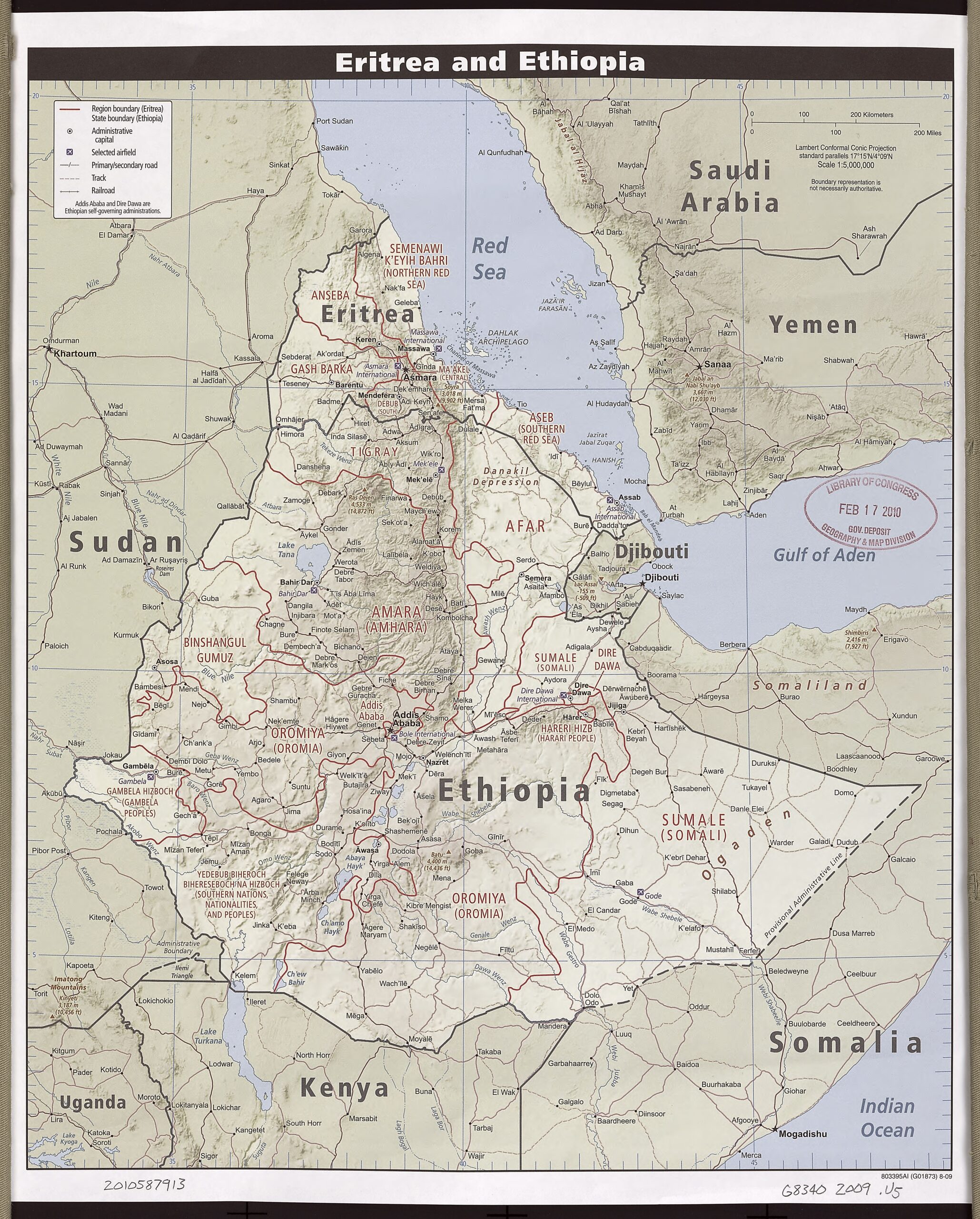
Reference map of Eritrea and Ethiopia, based on a 2009 U.S. Central Intelligence Agency map held by the Library of Congress. Public domain. This is a geographic reference map, not a current military situation map.
By World Media Feed Editorial Team
HORN OF AFRICA — Ethiopia and Eritrea have reinforced military positions along their shared border as renewed fighting in northern Ethiopia brings the former wartime allies closer to a potentially dangerous confrontation. Conflict monitors have reported drone and artillery activity around the disputed border town of Badme, while the two governments trade accusations over interference and security threats.
The latest developments do not establish that a full-scale war between the two countries has begun. But the military movements, reported strikes and breakdown in relations are raising concern among analysts who fear that fighting inside Ethiopia’s Tigray region could spill across an international border.
Troop movements and strikes reported near Badme
Reuters reported on November 18 that both countries had concentrated forces along their shared border, citing conflict monitors and people with links to opposing armed factions in Tigray. The news agency said it could not independently verify reports of direct skirmishes between Ethiopian and Eritrean troops.
The Armed Conflict Location and Event Data project (ACLED) reported that Ethiopian drones targeted positions it assessed were likely Eritrean around Badme on November 12, while Eritrean forces fired artillery toward Ethiopian positions. ACLED also reported a clash between the two armies on the Ethiopian side of the border the following day. Accounts from people connected to opposing Tigrayan factions differed over whether direct fighting between the national armies had taken place.
ACLED’s subsequent Ethiopia alerts recorded further developments: a reported Ethiopian drone strike on Badme on November 19 that prompted residents to flee, and the movement of Ethiopian National Defense Force troops and heavy equipment toward the border on November 20. ACLED said there were no reports of active fighting during that latest troop movement.
These reports indicate a volatile border situation, but they do not provide a fully verified picture of who controls every position around Badme or the precise location of every reported strike.
A fragile peace has unravelled
Ethiopia and Eritrea fought a devastating border war from 1998 to 2000. The two governments signed a peace agreement in 2018, ending years of formal hostility and opening a period of rapprochement. Eritrean forces later fought alongside Ethiopian federal troops during the 2020–2022 war in Tigray.
Relations have deteriorated again. One major source of tension is Ethiopia’s effort to secure reliable access to the sea. Prime Minister Abiy Ahmed has said his landlocked country intends to pursue sea access through peaceful means. Eritrea has viewed some of the rhetoric around ports and access to the Red Sea as a potential threat.
The current conflict in northern Ethiopia began in September, when fighting resumed between federal forces and Tigrayan forces. Eritrea and Ethiopia have accused each other of aggression and support for armed opponents. Those claims remain disputed and should not be treated as independently established facts.
Badme carries the weight of an earlier war
Badme is a border town whose status became a central issue in the 1998–2000 war. Its location gives renewed military activity in the area significance beyond the immediate fighting in Tigray.
Conflict monitors have offered differing accounts of control around the town at different points in November. ACLED reported on November 15 that Eritrean forces had regained control of Badme after withdrawing in mid-October. Other reporting has described Ethiopian forces entering or operating near the town. The available accounts do not support a simple, definitive statement that the territorial situation has been settled.
Geographic reference: The map below shows the general location of Ethiopia and Eritrea. It is based on a 2009 public-domain reference map and does not depict current front lines, military positions or disputed territorial control.
Why a wider conflict would matter
A direct confrontation between Ethiopia and Eritrea would carry consequences well beyond their border. The Horn of Africa is already facing overlapping conflicts, displacement, food insecurity and diplomatic rivalries. A new interstate war could disrupt trade and transport routes, increase civilian displacement and draw neighbouring governments more deeply into the crisis.
Analysts cited by Reuters have warned that Eritrean involvement in the fighting on the side of Tigrayan forces could create a pathway to direct conflict with Ethiopia. The International Crisis Group has also cautioned that clashes near the border could escalate, even without a deliberate decision by either government to begin a wider war.
The risk is compounded by limited trust and weak communication between the two governments. When military units operate close to one another and both sides suspect hostile intent, an isolated incident can become harder to contain.
Diplomacy remains the critical test
The immediate priority is to prevent the fighting in Tigray from becoming a direct interstate war. That will require restraint by military commanders, credible communication channels and diplomatic engagement involving regional and international partners.
For now, the available evidence points to a serious military build-up and reported exchanges around Badme, not a confirmed declaration of war between Ethiopia and Eritrea. Independent monitoring and careful verification will be essential as events develop.
The danger is that a conflict already devastating communities in northern Ethiopia could widen into a confrontation between two states whose previous war left a deep legacy of loss. Preventing that outcome is now one of the most urgent tests for diplomacy in the Horn of Africa.
Sources and verification
- Reuters — Ethiopia and Eritrea amass forces along border, heightening war fears (November 18, 2026)
- ACLED — Ethiopia Alerts archive, including updates dated November 15–20, 2026
- Critical Threats Project / Institute for the Study of War — Ethiopia War Security Review (November 20, 2026)
- Tafakari Digital Hub — Ethiopia: Bi-weekly Conflict and Peace Monitoring Update, November 9–22, 2026
Editorial note: WMF distinguishes documented troop movements and conflict-monitor reporting from disputed claims about direct clashes and territorial control. Reuters said it could not independently verify reports of skirmishes between Ethiopian and Eritrean forces. The map is a geographic reference only and is not evidence of current military positions.
About the Author