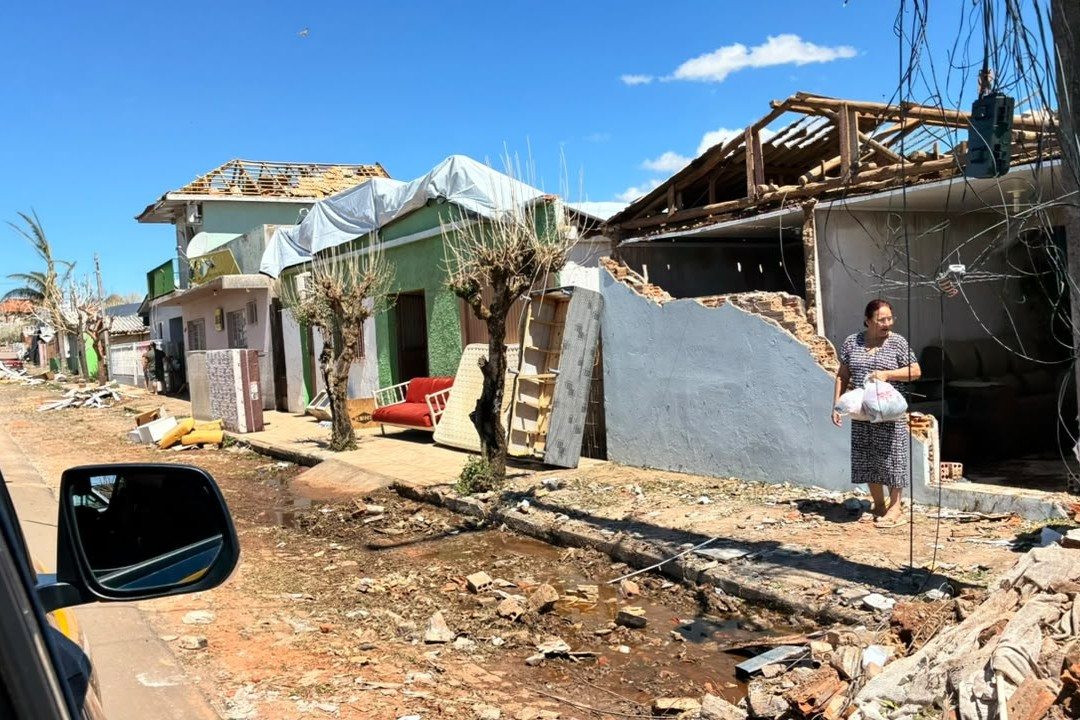
Storm damage in Tupanciretã, Rio Grande do Sul, after the November 20, 2026 storm. Photo: Brazilian Ministry of Integration and Regional Development (MIDR).
By World Media Feed Editorial Team
The death toll from a destructive storm in southern Brazil has risen to five, with 265 people injured and more than 25,000 affected across Rio Grande do Sul state, according to the latest Civil Defense figures reported Sunday. The town of Tupanciretã remains the hardest-hit community after a powerful storm tore through the area before dawn on Friday.
The updated state assessment says the storms have affected 25,123 people in 38 municipalities. Nearly 20,000 residents have been displaced, while 7,971 homes have lost their roofs. The figures are provisional and may change as emergency teams complete inspections, Folha de S.Paulo reported, citing Civil Defense data.
Tupanciretã bears the heaviest losses
Tupanciretã, an agricultural town of about 20,000 people, suffered the worst of the damage. Earlier assessments described thousands of homes with roofs torn away, damaged schools and a hospital, fallen trees and widespread disruption to electricity, water, telephone and internet services.
Brazil’s federal government has formally recognized a state of calamity in the municipality, allowing national agencies to mobilize assistance and speed up recovery plans. The Ministry of Integration and Regional Development said the first priorities include food, drinking water, hygiene supplies, debris removal, roof repairs and rebuilding damaged public infrastructure.
The federal response includes engineers from the National Civil Defense, health professionals and social-assistance teams. The government said 300 food baskets had been delivered, while about 200 Brazilian Army personnel were helping clear debris and reopen access routes.
Officials investigate the storm’s force
Brazil’s National Institute of Meteorology recorded wind gusts reaching 114 kilometers per hour. Civil Defense described the event as a supercell, a severe thunderstorm characterized by a rotating updraft. Technical assessments have also examined whether a downburst — a powerful current of air descending from a storm and spreading outward at the surface — contributed to the destruction.
Authorities have not confirmed that a tornado struck Tupanciretã. The possibility has not been ruled out, but officials have cautioned against treating it as an established explanation while the technical assessment continues.
Recovery will take longer than the emergency response
The immediate task is to restore essential services and provide shelter and supplies to residents whose homes are unsafe or uninhabitable. The damage to health facilities, schools, roads and electricity infrastructure means recovery will extend beyond replacing roofs and removing debris.
State authorities have announced financial assistance for the municipality, while federal agencies are preparing separate work plans for repairs and reconstruction. Officials say the full cost of rebuilding has not yet been established because engineers are still assessing damaged homes and public facilities.
The disaster also highlights the vulnerability of smaller communities when severe storms overwhelm local infrastructure. For residents who have lost homes, access to temporary shelter, clean water, medical care and reliable information will remain critical after the initial rescue effort ends.
Sources and editorial note
This update draws on the Brazilian federal government’s emergency response statement, Reuters reporting from Tupanciretã, Agence France-Presse and updated Civil Defense figures reported by Folha de S.Paulo. Casualty and damage totals are attributed to the authorities and remain subject to revision. The cause of the destruction is described using the preliminary technical assessment; a tornado has not been confirmed.
Photo: Storm damage in Tupanciretã, Rio Grande do Sul. Credit: Brazil’s Ministry of Integration and Regional Development (MIDR).
About the Author