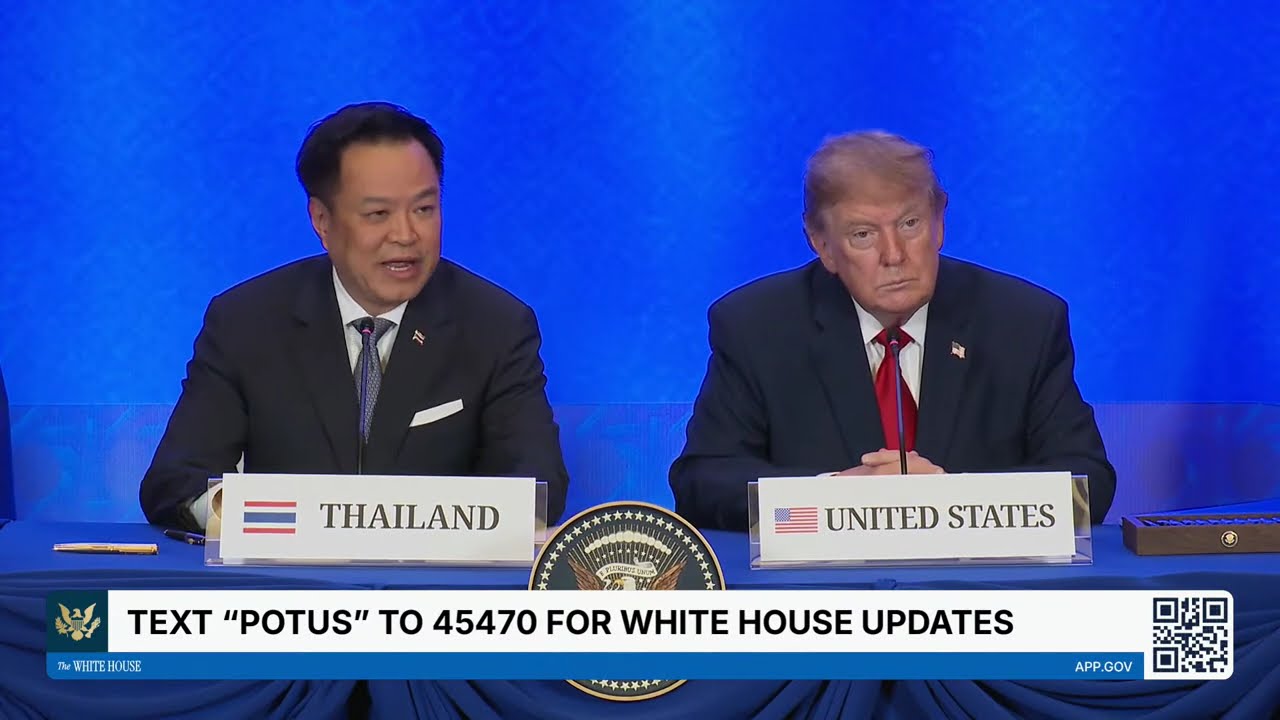
Image from the White House video, “President Trump Participates in a U.S. – Thai Trade Deal Signing,” November 16, 2026. Source: The White House.
By World Media Feed Editorial Team
The United States and Thailand have reached the substantial conclusion of negotiations on a reciprocal trade agreement, President Donald Trump and Thai Prime Minister Anutin Charnvirakul announced Tuesday during Trump’s visit to Manila.
A joint statement issued by the White House said the two governments had completed the negotiating stage of the proposed Agreement on Reciprocal Trade. The announcement marks a step forward in economic relations between Washington and Bangkok, but it does not mean the agreement is already in force.
What the announcement means
Under the joint statement, both governments will now begin their respective internal procedures to prepare the agreement for signature and entry into force. Those steps matter: until the formal process is completed, businesses cannot treat the announcement as a fully implemented trade pact.
The White House described the agreement as a way to strengthen the two countries’ longstanding economic relationship. That relationship already rests on earlier arrangements, including the 1966 Treaty of Amity and Economic Relations and a 2002 Trade and Investment Framework Agreement.
Trade, supply chains and regional competition
The announcement comes as the United States seeks to reshape trade relationships across the Indo-Pacific and strengthen commercial ties with partners in Southeast Asia. Thailand is an important manufacturing and export economy, with connections to regional supply chains in vehicles, electronics, agriculture and industrial goods.
For companies, the significance of a reciprocal trade agreement will depend on the final text: which tariffs or market barriers are changed, what sectors receive new access, and what rules govern investment and trade. The joint statement released Tuesday confirms the negotiating milestone but does not provide a complete schedule of tariff changes or sector-by-sector commitments.
Next steps before implementation
Trump said the United States expected Thailand to make additional purchases of American agricultural products. That figure was presented by the president in remarks at the signing event; the joint statement itself focuses on the completion of negotiations and the steps required before the agreement enters into force.
The next stage will be closely watched by exporters, manufacturers and investors in both countries. A completed legal text and clear implementation timetable will determine whether the announcement translates into meaningful changes for businesses and consumers.
For now, the agreement is best understood as a political and negotiating breakthrough—not yet a finished trade regime. Its practical impact will become clearer once the two governments publish the full terms and complete their domestic procedures.
Sources
- The White House — Joint Statement on the U.S.–Thailand Reciprocal Trade Agreement (November 17, 2026)
- Trump remarks at the U.S.–Thailand announcement (transcript)
Editorial note: WMF distinguishes the governments’ announcement that negotiations have substantially concluded from the later legal steps required for signature and entry into force.
About the Author