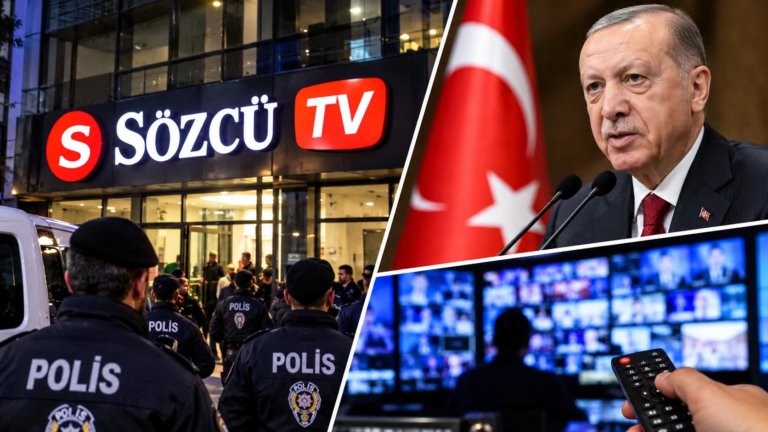
Images illustrating the police raid on Sözcü TV, Turkey’s political leadership and the impact on television broadcasting.
By World Media Feed Editorial Team
Turkish authorities raided the Istanbul headquarters of opposition-aligned broadcaster Sözcü TV before dawn on Tuesday, detained four media executives and placed the television channel and its digital news operation under state-appointed management. The operation has intensified concerns about the shrinking space for independent and opposition-oriented journalism in Turkey.
The intervention is significant not only because of the broadcaster involved, but because it follows a similar move against another opposition-leaning television station, Halk TV, last month. Together, the cases raise questions about how the use of judicial investigations and government-appointed trustees is reshaping the country’s media environment.
A pre-dawn raid and four detentions
Police entered Sözcü TV’s Istanbul premises early on November 17 under a court order. The operation also targeted the media group’s online news operation.
According to reporting by Reuters and Turkish media outlets, four executives were detained, including board chair Funda Tuncer Sıdalı, former general manager Asım Akgül, İsmail Öz and Yonca Yücekaleli.
Turkey’s Savings Deposit Insurance Fund, known as TMSF, was appointed to oversee the television channel and its news website. The intervention did not extend to the group’s printed newspapers, including Sözcü, Tavır and Korkusuz.
The broadcaster initially experienced a disruption to its regular programming. Its morning news coverage was replaced by recorded content, but Deutsche Welle later reported that regular news bulletins had resumed by midday. The channel said it was challenging the trustee decision through legal channels.
What authorities say
The Istanbul Chief Public Prosecutor’s Office said the operation was connected to an investigation involving alleged links between media group owner Burak Akbay and the network associated with the late cleric Fethullah Gülen.
Turkish authorities have long accused Gülen’s movement of involvement in the failed 2016 coup attempt. Gülen denied the accusations and died in 2024.
Prosecutors allege that companies connected to the media group were financed through overseas accounts and that the businesses were linked to the network. The investigation reportedly draws on financial records and allegations connected to an earlier case.
These are allegations, not a final judicial determination of guilt. The executives detained in the operation have not been convicted through this action.
Sözcü’s lawyer has challenged the legal basis for the intervention. Deutsche Welle reported that the lawyer argued the trustee decision arose from an earlier case in which a court had found no criminal intent or wrongdoing before the matter was subsequently reopened.
Why the latest intervention matters
The Sözcü operation comes just weeks after authorities placed another opposition-aligned broadcaster, Halk TV, under trustee management.
Reuters reported that Sözcü TV is the sixth major Turkish news outlet to have a trustee appointed since 2022, following similar interventions involving Halk TV, Flash TV, Eko Türk, Habertürk and Tele1.
The significance extends beyond the management of individual media companies. Television and digital news platforms remain important channels through which citizens receive political information, scrutinize government decisions and hear competing viewpoints.
When control of major broadcasters changes during politically sensitive investigations, questions arise over editorial independence, newsroom decision-making and the ability of journalists to report critically on those in power.
The government maintains that legal actions against media organizations follow judicial procedures and that Turkey’s judiciary operates independently. Opposition politicians and journalism organizations, however, have condemned the latest operation, arguing that the use of trustees is restricting critical reporting.
A wider test for Turkey’s media environment
Turkey’s media landscape has been under sustained pressure for years, with ownership concentration, legal cases and state intervention repeatedly raising concerns among press-freedom organizations.
The latest case adds another layer to that debate. The issue is not simply whether prosecutors have the authority to investigate alleged financial or organizational links. Governments have a responsibility to investigate credible allegations and enforce the law.
The broader question is whether such investigations are conducted with safeguards that protect due process and prevent the state’s intervention from undermining independent journalism.
The distinction matters. An investigation into alleged wrongdoing should not automatically become a mechanism through which a broadcaster’s editorial direction or institutional independence is placed at risk.
For Sözcü TV, the immediate legal challenge may determine how its management and operations proceed. For Turkey’s wider media sector, the case is another measure of how much room remains for outlets that regularly give prominence to opposition perspectives.
The coming days will show whether the broadcaster can maintain its editorial independence under the new management arrangement and whether the courts provide meaningful review of the decision.
Sources consulted:
- Reuters — Turkey takes pro-opposition TV channel Sozcu off air in raid, appoints trustee.
- Associated Press — Turkish authorities carry out a raid on another opposition TV station and appoint trustees.
- Deutsche Welle — Turkish authorities raid opposition Sozcu news channel.
- Hürriyet Daily News — Sözcü TV placed under trustee control after police raid.
Editorial note: This is a reported news analysis, not an independent WMF investigation. The article does not claim to have independently reviewed the court file or verified the allegations against the media group.
About the Author