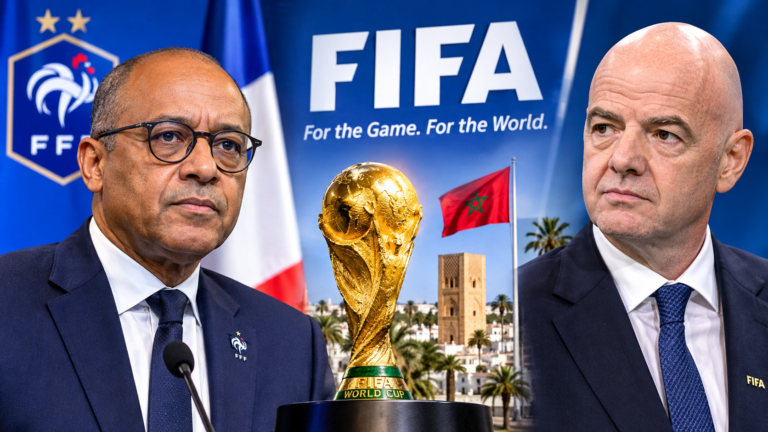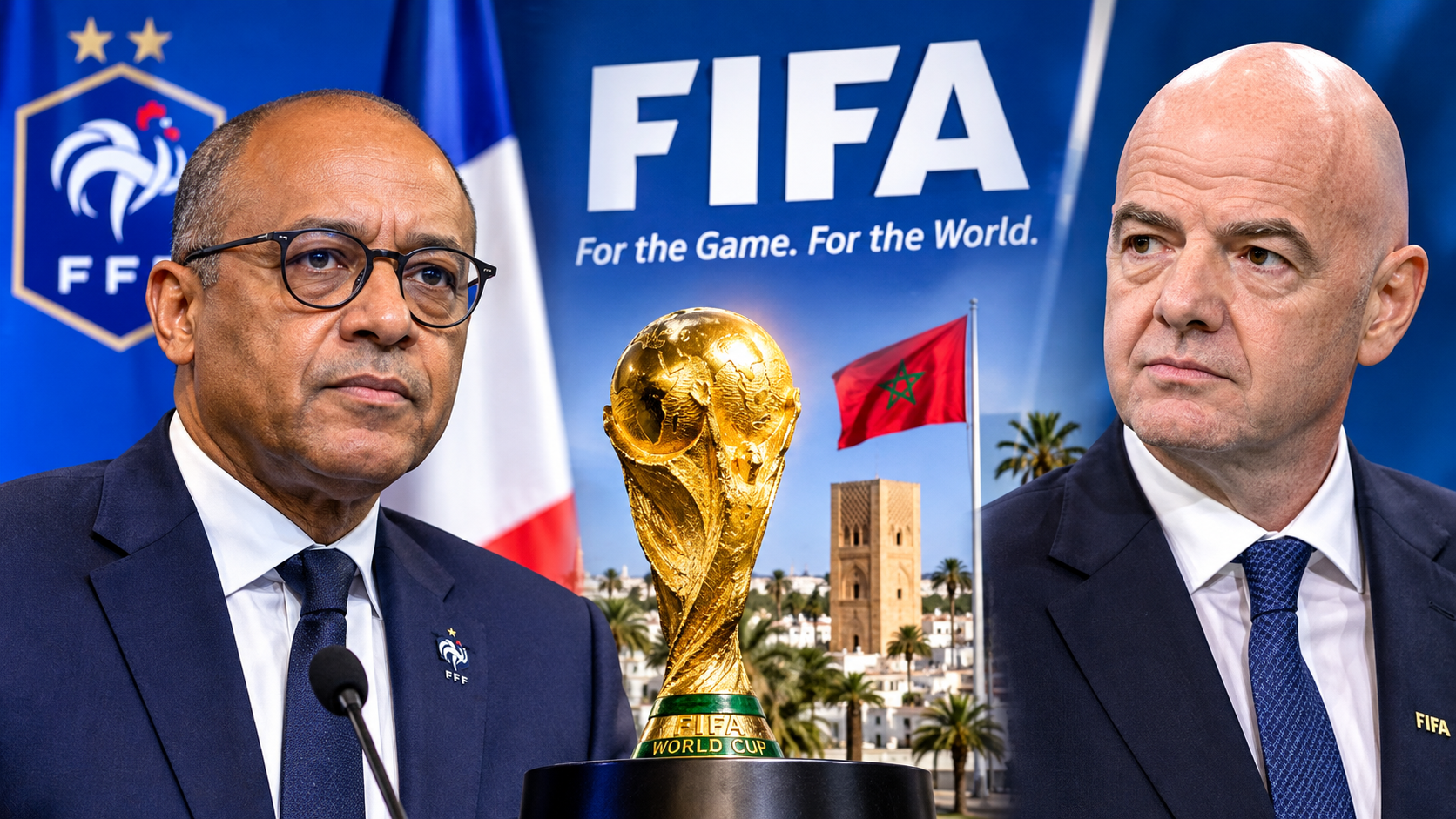
Philippe Diallo and Gianni Infantino face a potential contest for FIFA’s presidency, with the election scheduled to take place in Rabat in March 2027. Note: AI-generated editorial illustration, not an actual event photograph.
By World Media Feed Editorial Team
A contest that once appeared likely to be a straightforward re-election for Gianni Infantino has become a significant challenge to his leadership of world football.
Philippe Diallo, president of the French Football Federation, confirmed on Tuesday that he will stand against Infantino in the FIFA presidential election scheduled for March 18, 2027, in Rabat, Morocco.
Diallo’s candidacy was formally ratified by the French federation’s executive committee, following a unanimous decision by European football officials to support him as their preferred challenger.
The development creates the most consequential electoral contest Infantino has faced during his presidency and brings questions about FIFA’s governance, financial direction and relationship with its member associations into the center of the campaign.
UEFA backs a challenger
The announcement followed a November 16 meeting chaired by UEFA president Aleksander Čeferin.
European national associations represented on UEFA’s Executive Committee and the FIFA Council unanimously invited Diallo to run and pledged their support.
UEFA said it wanted renewed unity and trust within international football, stronger governance standards and a greater emphasis on developing the game across all regions.
Diallo accepted the invitation, saying he had initially not planned to enter the race but agreed after encouragement from his European colleagues.
His candidacy was subsequently approved by the French Football Federation on November 17.
The endorsement gives Diallo an organized political base, but UEFA’s backing alone cannot determine the outcome. FIFA’s presidential election is decided by its member associations, not by continental confederations acting as voting blocs.
The dispute behind the challenge
The disagreement between Infantino and sections of European football intensified after a proposal emerged in July to create a commercial company connected to World Cup rights and open it to private investors.
The proposal prompted criticism from football officials concerned about transparency, financial control and the future ownership of the competition’s commercial value. It was subsequently abandoned.
The French Football Federation withdrew its support for Infantino’s re-election in September, citing concerns about FIFA governance and the principles it believed should guide the organization.
Diallo has since argued that the relationship of trust between FIFA’s leadership and parts of the football community has been damaged.
His campaign is expected to emphasize a different approach to governance, solidarity among member associations and the development of football beyond its most commercially powerful markets.
Infantino and FIFA have defended their record and the organization’s direction. FIFA has also dismissed UEFA’s legal moves against its leadership as a smear campaign, according to Associated Press reporting.
The election is therefore becoming more than a contest between two administrators. It is developing into a debate about who should control the direction of the world’s most influential football institution.
Infantino still enters as the favorite
Despite the challenge, removing the incumbent will be difficult.
Infantino has led FIFA since 2016 and is seeking another term. He has cultivated support across the global football system, including in Africa, Asia and South America.
Le Monde reported that endorsements from associations in those three regions represented a combined 110 of FIFA’s 211 member associations, giving the incumbent a potentially decisive advantage if that support translates into votes.
Diallo has acknowledged the scale of the challenge. He says he needs 106 votes to secure a majority and has indicated that he has received encouraging signals from associations outside Europe.
However, expressions of support are not the same as confirmed votes. The balance could change during the campaign, and the positions of individual federations will matter.
The French candidate also faces the challenge of building an international profile beyond European football administration.
Why the election matters beyond Europe
FIFA is not simply a governing office. Its leadership influences the distribution of development funding, the organization of international competitions, commercial agreements and the relationship between wealthy football markets and smaller national associations.
For many federations, FIFA funding is an important part of their ability to develop facilities, youth programs, coaching and national competitions.
That makes the presidential election especially important for countries that do not have the commercial resources of Europe’s leading football nations.
Diallo will need to persuade associations in Africa, Asia, the Americas and Oceania that his proposed alternative would serve their interests.
Infantino, meanwhile, can point to FIFA’s expanded development commitments and the financial scale of the organization under his leadership.
The central question is whether member associations believe continuity offers greater benefits than a change in leadership.
Rabat becomes the center of football politics
The election will take place in Rabat on March 18, 2027, placing Morocco at the center of an important moment in international football governance.
Morocco has increasingly occupied a prominent position in the global game, including through its role in the 2030 FIFA World Cup hosting partnership with Spain and Portugal.
The FIFA Congress will bring representatives of the organization’s member associations together to decide who leads the governing body for the next presidential term.
The location gives the election additional international visibility, but the outcome will be determined by the votes of the member associations rather than by the host country.
For now, Diallo has secured the backing of European football’s leadership structure. Whether he can transform that support into a winning global coalition remains uncertain.
The campaign will test not only his ability to challenge Infantino, but also whether dissatisfaction with FIFA’s leadership is strong enough to overcome the incumbent’s established international network.
For world football, the real contest is now underway.
Sources and verification
- UEFA — Primary source: European national associations unanimously support Philippe Diallo.
- French Football Federation — Primary source: FFF withdraws its support for Gianni Infantino.
- Associated Press: Diallo wants to restore broken trust in soccer as he challenges Infantino.
- Le Monde: Philippe Diallo emerges as unexpected challenger to Infantino.
- AFP: Diallo claims support beyond Europe
About the Author