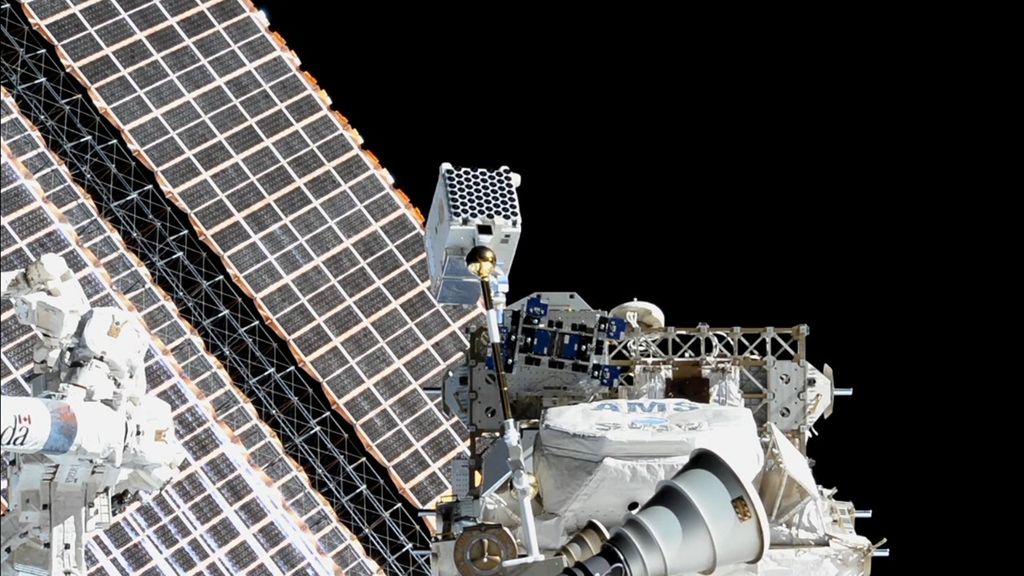
NASA's Neutron star Interior Composition Explorer (NICER) X-ray telescope mounted on the International Space Station. Credit: NASA.
By World Media Feed Editorial Team
NASA’s Neutron star Interior Composition Explorer, known as NICER, has ended science operations after more than eight years aboard the International Space Station, closing a mission that helped researchers study some of the universe’s most extreme objects.
Installed outside the station in 2017, NICER was designed for an initial mission of 18 months. It continued operating well beyond that period, measuring X-rays from neutron stars, black holes and active galaxies. The observations contributed to research on matter under extreme pressure and the behavior of highly energetic cosmic systems.
The telescope’s science work was interrupted in June 2025 after a motor problem limited its ability to swivel and track objects across the sky. NASA paused data collection while engineers investigated. The instrument has not returned to its earlier observing capability, and the agency says there is no current timetable for resuming science operations.
NASA and space-station teams are now focused on preserving NICER’s eight-year archive and preparing to decommission and detach the telescope. The immediate objective is to move it into a stowed configuration if needed for station operations. NASA says its current position does not pose a safety issue to the station or crew.
NICER also demonstrated a method of deep-space navigation using X-ray signals from pulsars. The technique could eventually support spacecraft navigation far from Earth, where conventional satellite-based positioning is unavailable.
The mission’s legacy extends beyond astronomy. NASA says technologies developed and tested for NICER are being incorporated into prototype portable CT scanners and communications systems, among other applications.
The end of observations is therefore not the end of the mission’s scientific contribution. Researchers will continue to analyze archived data, while engineers can draw on the instrument’s technical lessons for future space-based observatories and navigation systems.
What the development means
Source: NASA, “NICER Status Updates,” November 17, 2026.
Source
https://www.nasa.gov/missions/station/nicer-status-updates/
About the Author