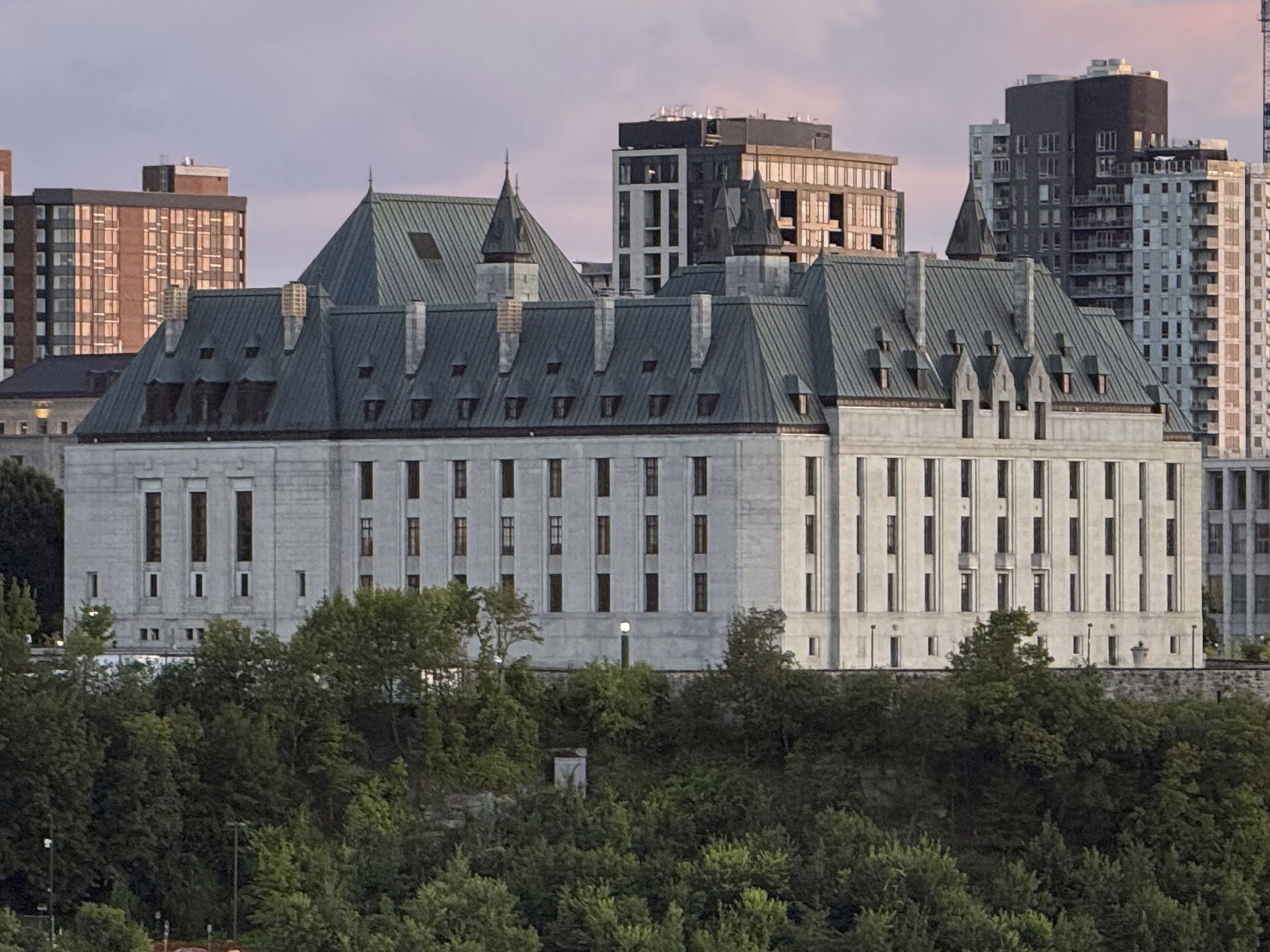
Supreme Court of Canada building in Ottawa. Illustrative image of the institution; not a photograph of the November 27, 2026 proceedings.
Canada’s Supreme Court has upheld the core of Quebec’s controversial Bill 21, allowing the province to continue barring many public employees in positions of authority from wearing religious symbols at work. The court’s November 27 ruling also found that one provision restricting elected legislators who wear face coverings infringes their democratic rights.
The decision in English Montreal School Board v. Quebec (Attorney General), 2026 SCC 41, is a major legal victory for Quebec’s secularism policy and a consequential interpretation of Canada’s constitutional notwithstanding clause.
Bill 21, adopted in 2019, bars certain public employees—including teachers, police officers and judges—from wearing visible religious symbols while performing their duties. The law has been challenged by civil-liberties groups and others who argue it disproportionately affects religious minorities, particularly Muslim women who wear hijabs, as well as Sikh men who wear turbans and Jewish men who wear kippahs.
Court confirms Quebec’s use of the notwithstanding clause
The Supreme Court concluded that Quebec validly invoked section 33 of the Canadian Charter of Rights and Freedoms, commonly known as the notwithstanding clause, as well as the corresponding provision in Quebec’s human-rights charter.
Section 33 allows federal or provincial legislatures to declare that legislation will operate notwithstanding certain Charter rights. Such a declaration can remain in force for up to five years and may be renewed.
The court confirmed that the use of the override does not prevent judges from examining whether a law is inconsistent with Charter protections. However, the court did not invalidate the main provisions of Bill 21 in this case.
A limited finding involving Quebec legislators
The court found that section 8 of Bill 21 infringes the democratic rights protected by section 3 of the Canadian Charter to the extent that it applies to members of Quebec’s National Assembly who, because of their religious beliefs, wear face coverings.
The provision prevents those elected members from sitting in the legislature and participating in its proceedings. The court’s case summary explains that this finding concerns the democratic right to sit and participate, rather than a general invalidation of the law’s restrictions on public employees.
The court dismissed the appeals brought by the English Montreal School Board and other parties, as well as Quebec’s cross-appeal.
Supporters call it a victory for secularism
Quebec Premier Paul St-Pierre Plamondon welcomed the decision as an affirmation of the province’s approach to state secularism. Supporters of Bill 21 have argued that public institutions should remain religiously neutral and that employees exercising state authority should not display religious affiliation while working.
Critics say the restrictions limit freedom of religion and create barriers to public-sector employment for people whose faith requires visible religious attire. The ruling is expected to renew debate over the balance between provincial autonomy, secularism and individual rights.
Why the decision matters beyond Quebec
The ruling has implications for other Canadian governments considering or using the notwithstanding clause. By confirming that courts can assess a law’s consistency with Charter rights even when an override is in place, the Supreme Court clarified an important part of the relationship between legislatures and the courts.
At the same time, the decision leaves Quebec’s central restrictions in force. The result is likely to remain politically divisive, particularly among religious communities and civil-liberties advocates who argue that the law places unequal burdens on minorities.
What the ruling does:
- Confirms Quebec’s use of the notwithstanding clause to maintain the main provisions of Bill 21.
- Leaves the law’s restrictions on religious symbols for specified public employees in force.
- Finds that section 8 infringes the democratic rights of certain elected National Assembly members who wear face coverings.
- Confirms that courts may examine Charter inconsistency even when the notwithstanding clause has been invoked.
Primary source: Supreme Court of Canada, English Montreal School Board v. Quebec (Attorney General), 2026 SCC 41, judgment dated November 27, 2026.
Additional reporting: Associated Press, “Canada’s Supreme Court largely upholds a Quebec ban on religious symbols for public servants,” November 27, 2026; Reuters, “Canada’s Supreme Court upholds Quebec ban on religious symbols for public servants,” November 27, 2026.
Image note: The featured photograph shows the Supreme Court of Canada building in Ottawa. It is an illustrative institutional image, not a photograph of the court proceedings.
About the Author