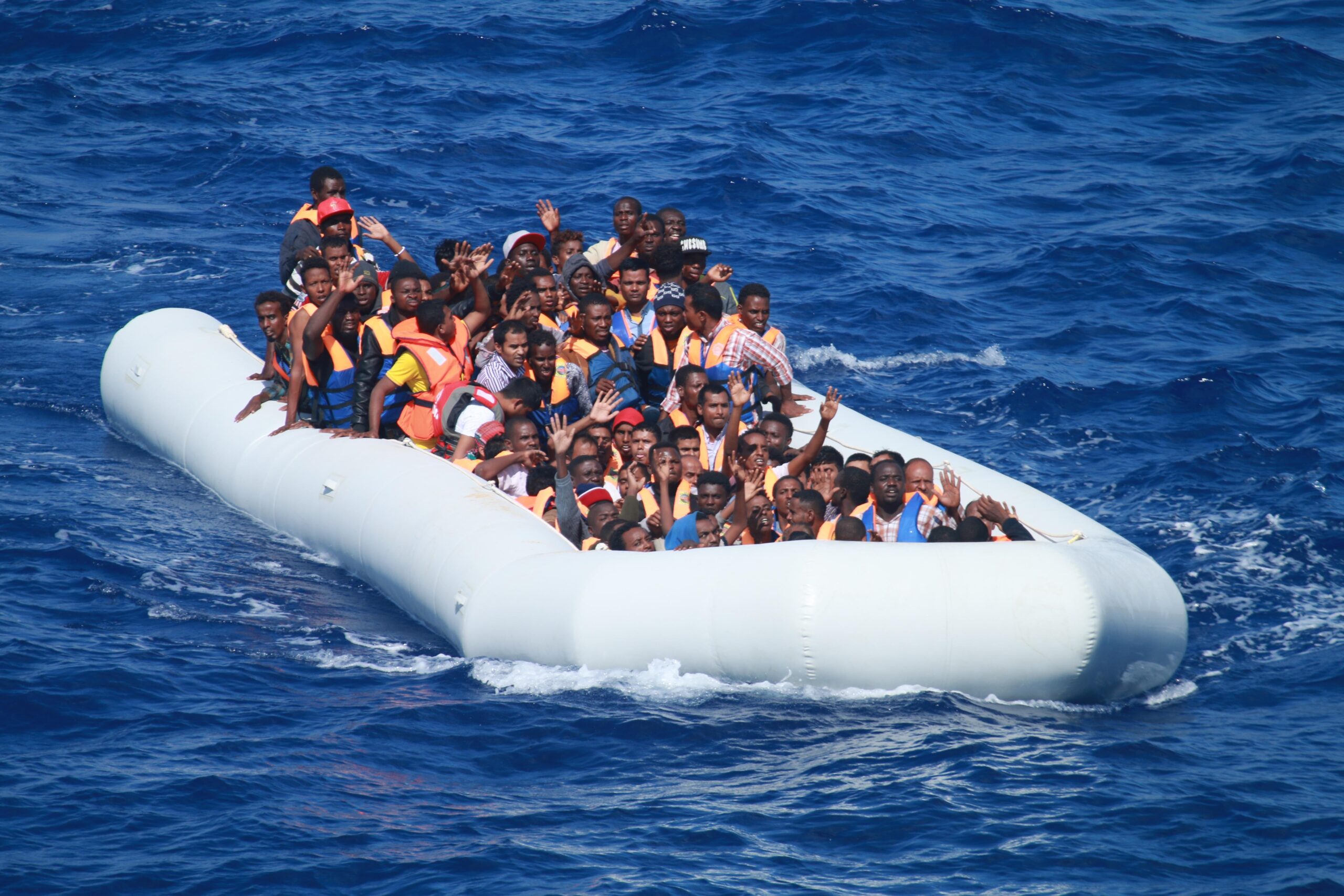
File photo: Migrants approach USS Carney in the Mediterranean Sea, July 29, 2016. U.S. Navy photo; public domain. This is not the boat found off Brazil.
Six of the nine people whose bodies were recovered from a drifting boat off Brazil in 2024 have now been identified, following a two-year investigation that connected Brazilian forensic specialists with families in Mauritania and Mali. The identifications offer long-awaited answers to relatives while exposing a wider gap in the international response to migrants who disappear at sea.
The 13-meter fishing vessel was found by fishermen near Bragança, in northern Brazil, in April 2024. Eight bodies were inside the boat and a ninth was found nearby. Investigators believe the vessel had departed Nouadhibou, Mauritania, on Jan. 23, 2024, carrying people hoping to reach Spain’s Canary Islands.
According to an Associated Press investigation published November 23, the boat lost its engine and rudder and drifted across the Atlantic for weeks. Evidence recovered from the vessel included 28 mobile phones, identification documents and handwritten notes that helped investigators trace possible passengers and contact their families.
A cross-border effort to identify the dead
Brazilian federal police forensic investigator Alexandre Deitos worked with AP journalist Renata Brito to reconstruct who may have been aboard. After attempts to obtain information through official channels in West Africa produced limited results, the team used phone records, personal belongings, family accounts and missing-person reports to develop a list of possible passengers.
The investigation eventually identified 42 people who may have boarded the vessel. In June 2026, Deitos and colleagues traveled to Mauritania to collect DNA samples from relatives. The team obtained 85 samples from 29 families. Brazilian authorities reported the results in October: six of the nine recovered bodies were identified.
Some identifications involved details beyond DNA. One father brought an old X-ray showing the surgical repair of his missing son’s ankle. The image could be compared with medical evidence from one of the unidentified bodies. The AP report described how the confirmation ended years of uncertainty for families who had no official proof of death.
Families face years of uncertainty
For relatives, the absence of a death certificate can create consequences beyond grief. Families may struggle with inheritance, access to bank accounts or benefits, children’s paperwork and other legal matters. The AP investigation documented the emotional and practical burden placed on people who do not know whether a loved one is alive or dead.
The wider scale is difficult to measure. The International Organization for Migration estimates that at least 86,000 people have gone missing or died on migration journeys by land and sea since it began tracking the issue in 2014. The agency has also warned that many deaths are never recorded, particularly on routes where boats disappear without witnesses or recoverable remains.
The Atlantic route from West Africa toward the Canary Islands is among the most dangerous migration corridors. The IOM has recorded thousands of deaths and disappearances along the route in recent years, but no comprehensive international database allows families to reliably search for missing relatives across borders.
A model that still depends on cooperation
The identification effort shows what can be achieved when forensic expertise, journalism and family networks work across national boundaries. It also reveals how much depends on individual initiative when governments lack shared systems for exchanging missing-person information and biological samples.
Three of the nine people recovered from the boat have not been identified. The results do not account for everyone who may have been aboard: investigators believe dozens boarded, and some people who died during the crossing may have been lost at sea.
For the families who received confirmation, the news brought pain but also an end to years of unanswered questions. For others still waiting, the case underscores a basic humanitarian obligation: people who die during migration should not disappear without a name, and their families should not be left without answers simply because the tragedy crossed borders.
Sources: Associated Press investigation by Renata Brito, published November 23, 2026; International Organization for Migration missing-migrant data. World Media Feed distinguishes the confirmed identifications from estimates about the number of people who may have traveled on the vessel.
About the Author