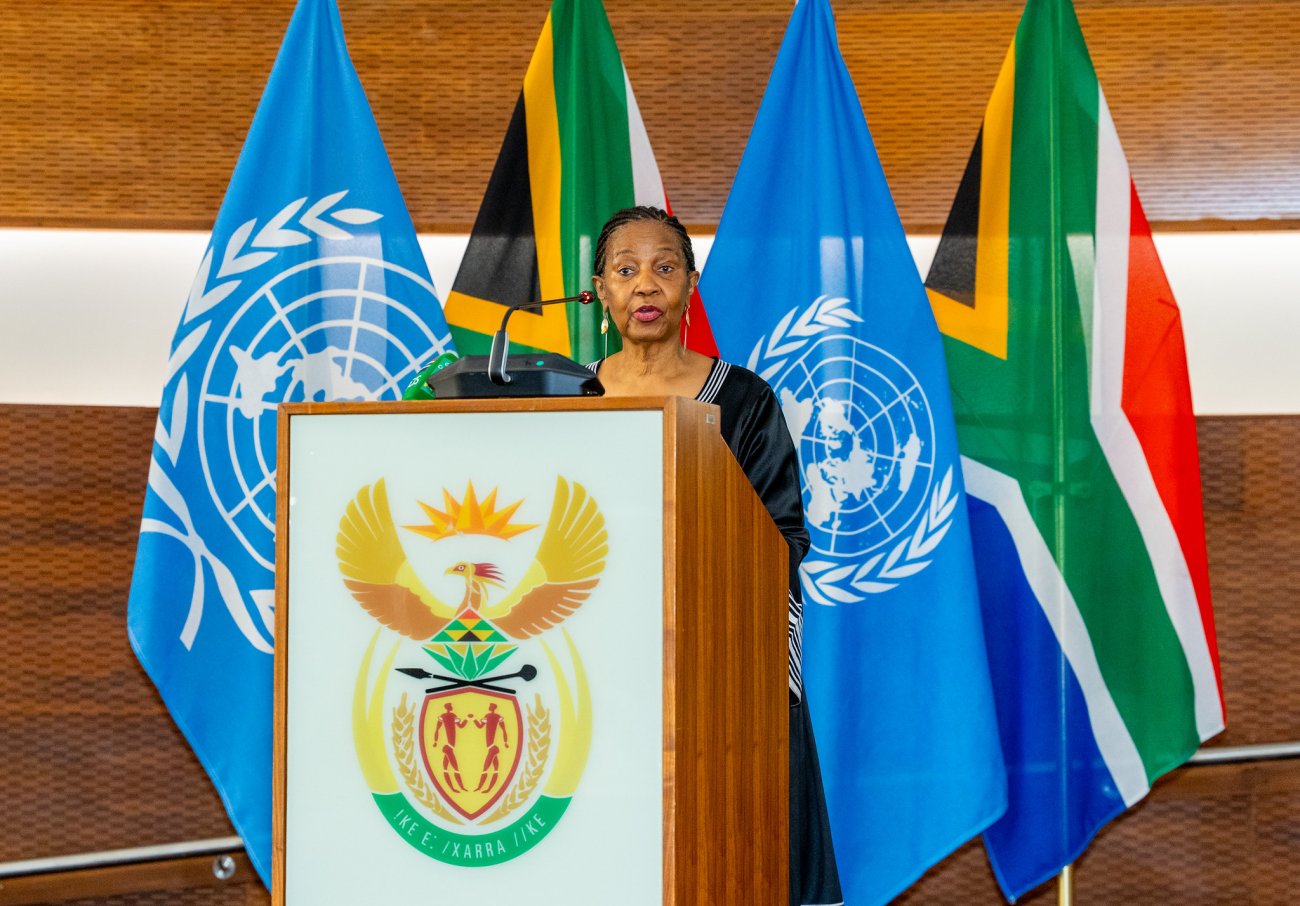
Phumzile Mlambo-Ngcuka at the United Nations Day commemoration in Pretoria on October 27, 2026. Photo: UN South Africa/Ropafadzo Chiradza.
By World Media Feed Editorial Team
South Africa is preparing to honour Phumzile Mlambo-Ngcuka, the country’s first woman deputy president and a former head of UN Women, with a state funeral after her death at the age of 71. Her passing on November 20 has prompted tributes from South African leaders and international institutions, reflecting a career that bridged the country’s democratic transition and global efforts to advance women’s rights.
President Cyril Ramaphosa confirmed that she would receive a State Funeral Category 2 on Saturday, November 28, in Middledrift, in the Eastern Cape. A state memorial service is scheduled for November 24 at Our Lady of Lourdes Catholic Church in Rivonia, Johannesburg, according to the Presidency.
A historic role in South Africa’s democratic government
Mlambo-Ngcuka became South Africa’s first woman deputy president in June 2005 and served until September 2008. Before that, she held senior government positions, including minister of minerals and energy and deputy minister of trade and industry. She entered Parliament in 1994, after the end of apartheid, and was part of the generation of lawmakers who helped shape the country’s democratic institutions.
South Africa’s Parliament said she served in the Constitutional Assembly and contributed to the drafting of the country’s democratic Constitution. It also highlighted her work on public administration, economic participation and the empowerment of women in the mining sector.
From Pretoria to the United Nations
Her influence extended well beyond South Africa. From 2013 to 2021, she served as United Nations Under-Secretary-General and Executive Director of UN Women, the UN entity dedicated to gender equality and the empowerment of women. In that role, she advocated for stronger political and economic participation by women and for action against violence and discrimination.
She also worked on public health and inequality. UNAIDS said she played an important role in South Africa’s national response to HIV and AIDS, including chairing the South African National AIDS Council during her time as deputy president. The agency described her as a strong advocate for placing the rights, leadership and safety of women and girls at the centre of the HIV response.
Tributes from South Africa and the United Nations
President Ramaphosa said she died on November 20, aged 71, following complications from a recent medical procedure. The Presidency said the state funeral would include ceremonial elements performed by the South African National Defence Force and that the national flag would be flown at half-mast through November 28.
The United Nations Resident Coordinator in South Africa said her commitment to equality, justice and the rights and dignity of women and girls had changed lives in South Africa and internationally. UN Secretary-General António Guterres also paid tribute to her as a lifelong champion of women’s rights.
Her family asked for privacy following the announcement of her death. The Presidency’s statement did not initially provide details, while the subsequent official funeral announcement attributed her death to complications from a recent medical procedure.
A legacy across two arenas
Mlambo-Ngcuka’s career connected two defining arenas of public service: the building of democratic institutions after apartheid and the international campaign for gender equality. Her appointment as South Africa’s first woman deputy president marked a milestone in national political representation. Her later leadership of UN Women placed her at the centre of debates over women’s political participation, economic opportunity and protection from violence.
Her death leaves a significant place in South Africa’s political history and in the international institutions where she worked. The memorial and state funeral will bring national recognition to a public career that extended from the country’s first democratic Parliament to the highest levels of the United Nations.
Sources and editorial note
This report is based on official statements from the South African Presidency, Parliament of South Africa, the United Nations in South Africa and UNAIDS, with biographical and independent reporting from Reuters and the Associated Press. Dates, funeral arrangements and cause-of-death details are attributed to the Presidency. The family has requested privacy.
Photo: Phumzile Mlambo-Ngcuka at the United Nations Day commemoration in Pretoria on October 27, 2026. Photo: UN South Africa/Ropafadzo Chiradza.
About the Author