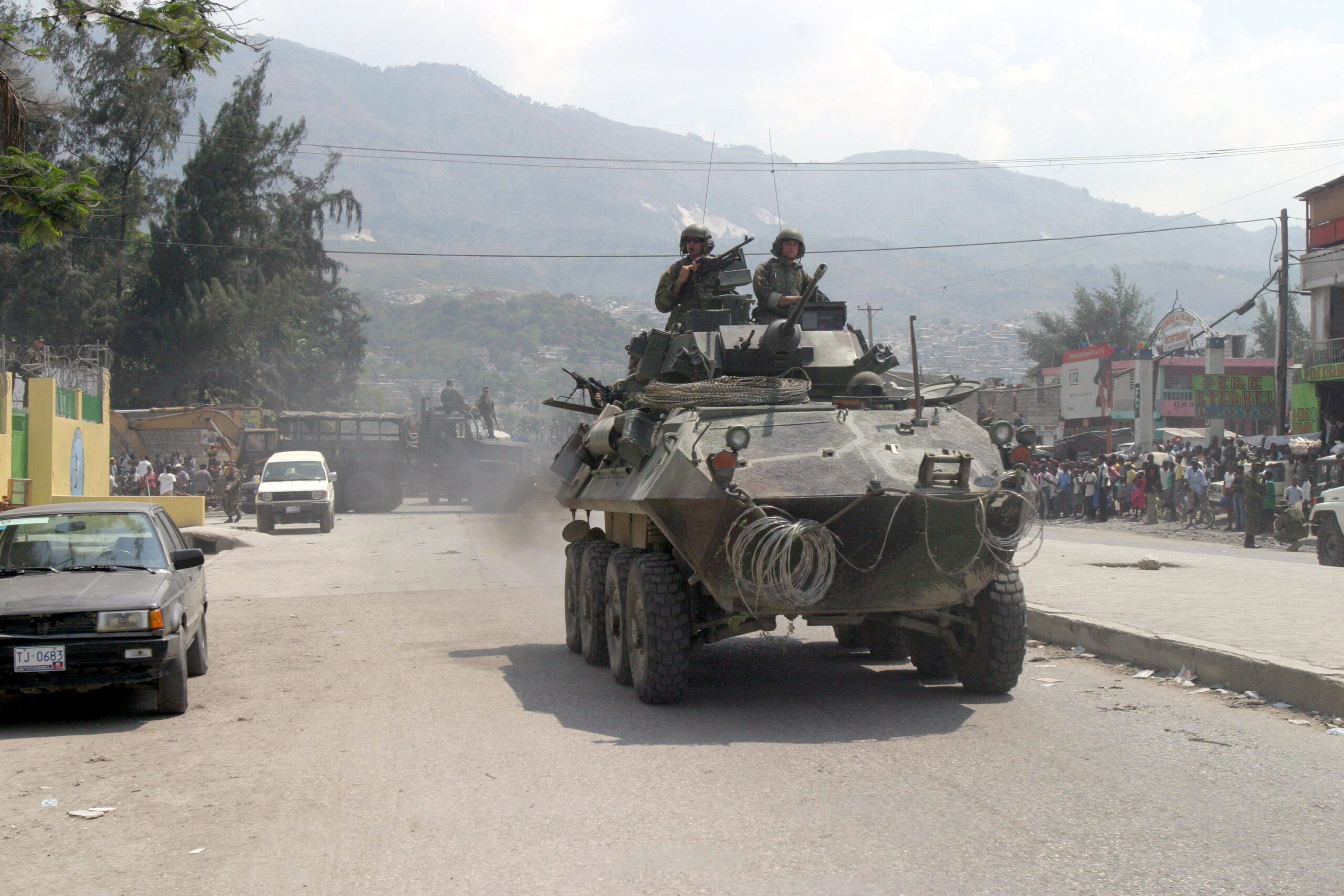
Archive photograph: A U.S. Marine Corps light armored vehicle in Port-au-Prince, Haiti, April 5, 2004. Photo by Cpl. Eric Ely, U.S. Marine Corps; public domain. This image is not from the November 2026 operation in Martissant.
By World Media Feed Editorial Team
PORT-AU-PRINCE — Haitian security forces launched a major operation in the gang-controlled Martissant district this week, targeting armed groups that have controlled a strategic road corridor south of the capital since 2021. Police said at least 34 suspected gang members were killed in Thursday’s operation, while local reporting described heavy gunfire and the use of explosive drones.
The operation is one of the most significant efforts in years to challenge gang control of Martissant, an area along Route 2 that links Port-au-Prince with western and southern Haiti. The campaign is part of a wider push to reopen roads, restore access to public institutions and weaken armed groups that have isolated communities.
Police report 34 suspected gang members killed
Haiti’s National Police said at least 34 suspected gang members were killed during Thursday, November 19, fighting in Martissant. Reuters reported that police said no officers or civilians were injured in that operation. The casualty figure is an official police claim and has not been independently verified by WMF.
Reuters said it verified footage released by Haitian police as having been filmed in Martissant by comparing road layouts, buildings and vegetation with satellite imagery. The video showed a building collapsing in a large cloud of smoke. Haitian media also reported heavy gunfire and the use of explosive drones during the operation.
The operation was conducted by Haitian police alongside the government’s Task Force, which works with the private security company Vectus Global. Police told Reuters that Salvadoran personnel did not take part in Thursday’s Martissant operation.
A corridor that gangs have controlled for five years
Martissant lies along National Route 2, the main road connecting the capital with important communities in Haiti’s west and south. Before armed groups seized control in 2021, thousands of people used the route each day. Since then, gangs have reportedly demanded payments from motorists, attacked vehicles and restricted the movement of goods.
The takeover of the area in 2021 triggered mass displacement. The Associated Press, citing a United Nations report from July 2022, said the clashes forced at least 19,000 people to flee their homes and affected approximately 800,000 people.
For residents and businesses, restoring the corridor would mean more than a security victory. It could help reconnect communities, make transport more predictable and improve access for humanitarian organizations. But clearing an area is not the same as securing it for the long term.
The international role is expanding — with risks
The offensive is unfolding as international involvement in Haiti’s security crisis grows. El Salvador has deployed more than 2,000 troops to Haiti, while a separate UN-backed Gang Suppression Force has reported operations in parts of Port-au-Prince and the Artibonite region.
Reuters reported on November 20 that three Salvadoran soldiers had died while handling explosives in Haiti, marking the first officially confirmed deaths among the Salvadoran contingent since its deployment. The military did not disclose where the explosion occurred or what explosives were involved. This incident was separate from the November 19 Martissant operation.
The use of explosive drones and other forceful tactics has raised concerns about civilian safety. Reuters cited United Nations estimates that more than 2,250 people had been killed during security operations in the first nine months of 2026, including more than 300 civilians. Those figures cover operations across Haiti, not the Martissant raid alone.
The real test is whether the state can hold the area
Security analysts have warned that operations that push armed groups out without a credible plan to maintain control can expose residents to renewed violence. The challenge for Haitian authorities is to protect civilians, prevent gangs from returning, restore public services and ensure that alleged abuses are investigated.
The UN-backed force has described its broader objective as dismantling gang strongholds and preventing their return, while restoring freedom of movement and access to public institutions. That goal will be measured not by the number of operations announced, but by whether people can travel, work, attend school and reach medical care without fear.
For now, police reports indicate a major assault on gang positions in Martissant, but they do not establish that the entire corridor has been secured or reopened to regular civilian traffic. Independent monitoring of the area will be essential to assess what has changed on the ground.
Sources and further reporting
- Reuters — Haiti police operation kills 34 suspected gang members in capital (November 19, 2026)
- Associated Press — Heavy fighting erupts in Haiti as armed forces fight gangs to regain control of key corridor (November 19, 2026)
- Reuters — Three Salvadoran soldiers killed while handling explosives in Haiti (November 20, 2026)
- United Nations — Haiti: human rights and security updates
Editorial note: Casualty figures attributed to Haitian police are presented as official claims, not independently verified totals. The reported deaths of Salvadoran soldiers occurred in a separate explosives incident and are not attributed to the Martissant operation. The accompanying image is a 2004 archive photograph and does not depict current events.
About the Author