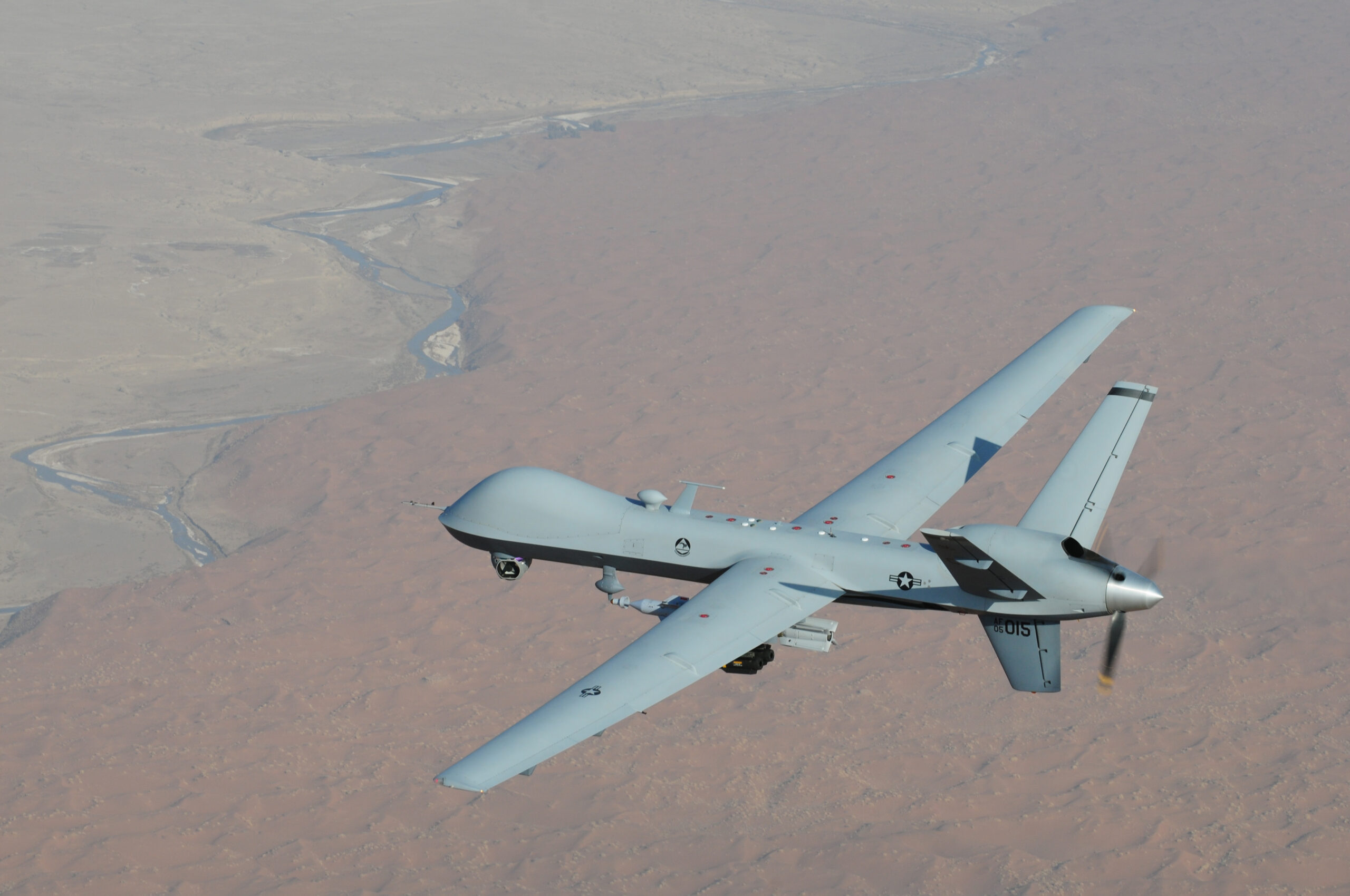
Illustrative archive photograph: A U.S. Air Force MQ-9 Reaper unmanned aircraft over southern Afghanistan, November 29, 2008. U.S. Air Force photo by Lt. Col. Leslie Pratt; public domain. This is not a photograph from the Geneva conference and does not establish that this aircraft operates autonomously.
By World Media Feed Editorial Team
GENEVA — Governments have agreed to continue work on international rules for lethal autonomous weapons, but stopped short of committing to a legally binding agreement, leaving a central dispute over human control of weapons unresolved after a week of United Nations-backed negotiations.
The compromise reached at the November 20–21 review conference of the Convention on Certain Conventional Weapons gives government experts two years, covering 2027 and 2028, to develop an instrument addressing autonomous weapons systems. Its eventual legal form remains undecided.
The outcome keeps the possibility of an international agreement alive. It does not, however, deliver the binding restrictions sought by a broad group of countries and humanitarian advocates.
A mandate, but no guarantee of binding rules
In a statement published November 21, Switzerland’s Federal Department of Foreign Affairs said the 128 states participating in the convention had agreed to draw up an instrument regulating lethal autonomous weapons systems over the next two years.
Switzerland, which chaired the conference, described the agreement as progress after more than a decade of discussions. But it also acknowledged that consensus could not be reached on an immediate mandate for a legally binding instrument. The legal nature of the future text will be considered after the work is completed.
Reuters reported that around 100 countries had supported legally binding rules on a shorter timetable, while the United States, Russia and Israel opposed that approach. The resulting compromise leaves open whether the future instrument will create binding obligations or take another form.
Why the disagreement matters
Lethal autonomous weapon systems are designed to identify and engage targets with varying degrees of human involvement. They are different from many remotely operated or AI-assisted systems, where a person still makes the decision to authorize an attack.
The central concern is whether a machine should be able to select and attack a target without a human making the final decision. Humanitarian organizations warn that unpredictable system behavior, technical failures and difficulty assessing battlefield conditions could put civilians at risk.
The International Committee of the Red Cross has called for limits on autonomous weapons, emphasizing the need to preserve human control over the use of force and ensure compliance with international humanitarian law.
Consensus rules remain a major obstacle
The negotiations took place under the Convention on Certain Conventional Weapons, a forum in which decisions are made by consensus. That means a single participating state can prevent agreement on a proposed decision.
Reuters reported that opposition from major military powers weakened efforts to secure a clear mandate for binding rules. The final compromise gives diplomats more time to work, but also postpones the decision that advocates say is most important: whether states will accept enforceable international limits.
The Swiss government said the mandate was developed through intensive consultations led by conference chair Ambassador Julien Thöni, working with Peru’s Ambassador Elmer Schialer Salcedo. It said the next phase would build on the discussions and work already completed.
The next test comes in 2027 and 2028
The next two years will determine whether governments can turn the mandate into a meaningful international framework. The experts’ work is expected to inform a recommendation on the instrument’s legal nature and form, including whether it should become a binding protocol.
For now, there is no new treaty specifically regulating lethal autonomous weapons under the convention. The agreement in Geneva establishes a process, not a completed set of restrictions.
The distinction is important. Governments have acknowledged the need to keep working on the issue, but they have not yet agreed on how far international law should go in limiting weapons that can make targeting decisions with little or no human oversight.
Why it matters: As military technology advances, the question of who remains responsible for decisions involving human life is becoming more urgent. The Geneva outcome avoids a complete breakdown in negotiations, but the absence of an agreed legal obligation leaves the central humanitarian concern unresolved.
Sources and documents
- Swiss Federal Department of Foreign Affairs — New mandate on lethal autonomous weapons systems adopted in Geneva (November 21, 2026)
- Reuters — States agree to UN talks aiming to regulate ‘killer robots’ by 2028 (November 21, 2026)
- Associated Press — Nations agree to extend talks on AI killer robots but no firm commitment to rein them in (November 21, 2026)
- United Nations Office at Geneva — Should machines make the decisions in war?
Editorial note: The agreement establishes a process to develop a possible instrument. It should not be described as a ban or as a binding treaty already adopted. WMF distinguishes the official description of the mandate from the positions attributed to individual governments in news reporting.
About the Author