By World Media Feed Editorial Team
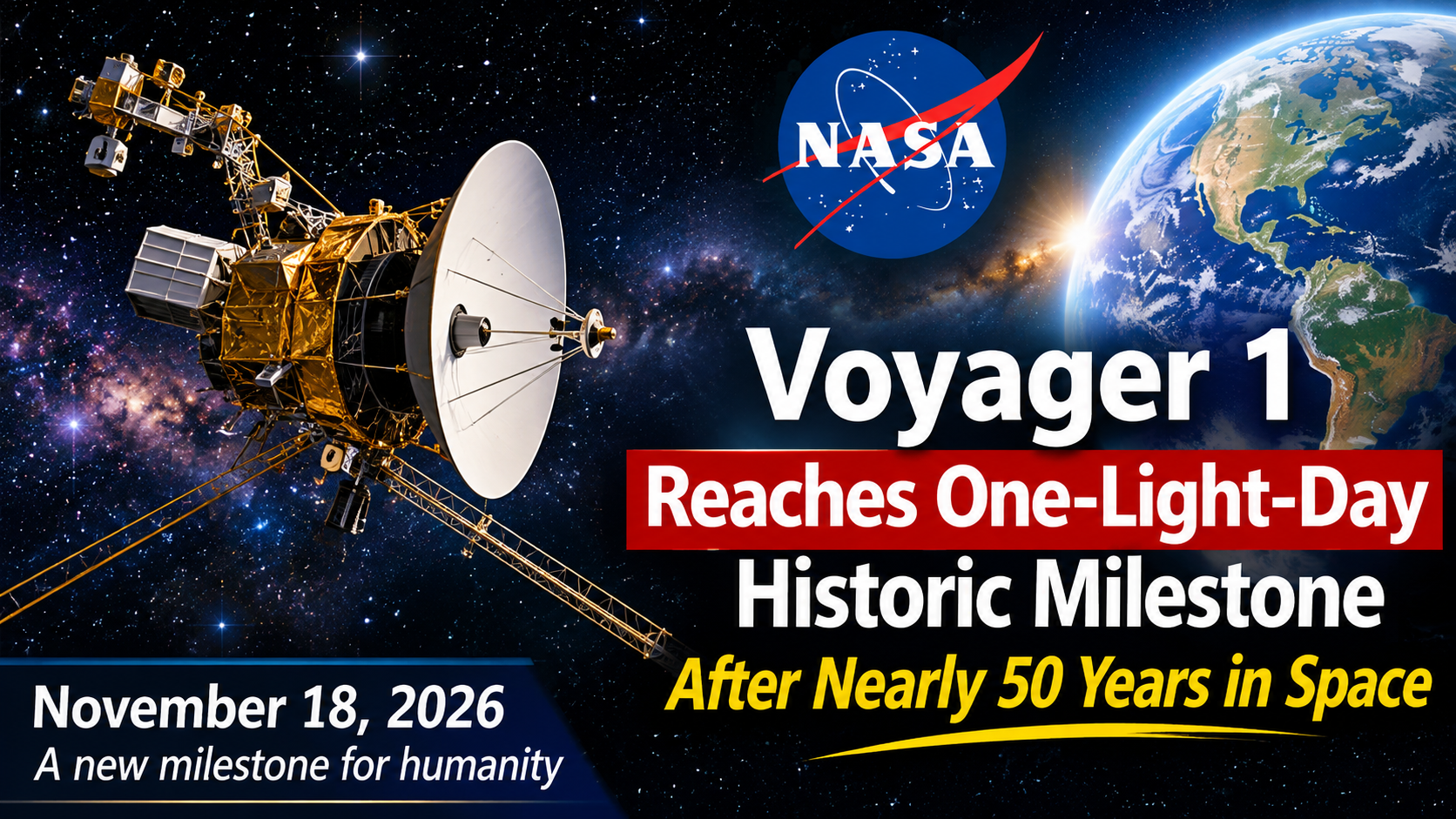
Voyager 1 has reached a distance of one light-day from Earth, a milestone that puts the spacecraft more than 25.9 billion kilometers away and highlights the extraordinary reach of a mission launched in 1977.
A light-day is a measure of distance, not time: it is how far light travels in 24 hours. At that distance, a radio message sent from Earth takes roughly a full day to reach Voyager 1, and a reply takes about another day to return, even before accounting for processing time.
NASA marked the milestone with a public invitation called “Shine Bright for Voyager.” On November 17, people around the world were encouraged to shine a light skyward and signal the spacecraft’s initials, V-G-R, in Morse code. The activity is symbolic; it does not mean the spacecraft can see or respond to individual lights from Earth.
Voyager 1 was launched nearly half a century ago to explore the outer planets. It later continued into interstellar space, becoming the most distant human-made object. Its instruments and communications systems have required careful management as power supplies decline and components age.
The spacecraft’s longevity has made it a rare scientific platform. Its measurements beyond the Sun’s protective bubble give researchers information about the environment between stars, including energetic particles and magnetic fields that cannot be sampled in the same way from Earth.
The one-light-day mark is not a new destination or a change in the spacecraft’s scientific status. It is a way to express the scale of its journey in a form that is easy to understand: even a signal traveling at the fastest speed known takes an entire day to cross the gap.
Voyager 1’s continued operation also reflects decades of engineering decisions, mission-team troubleshooting and careful prioritization of limited onboard power. Its journey remains a reminder that spacecraft built for a finite mission can sometimes deliver discoveries for generations.
What the development means
Source: NASA/JPL-Caltech, “Shine Bright for Voyager’s Light-Day,” November 2026.
Source
https://science.nasa.gov/mission/voyager/voyager-1/shine-bright-for-voyagers-light-day/
About the Author