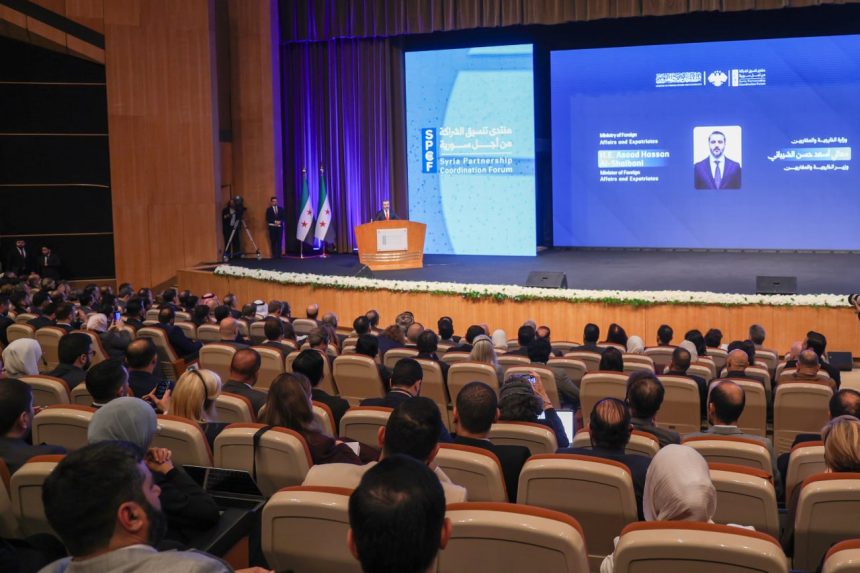
Delegates attend the Syria Partnership Coordination Forum in Damascus, November 17, 2026. Photo: Syrian Arab News Agency (SANA).
By World Media Feed Editorial Team
The European Union is moving toward a deeper relationship with Syria, with foreign ministers backing renewed work on a long-delayed association agreement as international partners gather in Damascus to discuss reconstruction and economic recovery.
EU foreign policy chief Kaja Kallas said ministers supported advancing the agreement after a meeting in Brussels on November 16. The pact, first initialled in 2008 but never signed, could provide a framework for trade, political dialogue and wider cooperation between the European bloc and Syria.
A diplomatic opening after years of isolation
The renewed effort reflects a major shift in Europe’s approach following the fall of Bashar al-Assad’s government at the end of 2024. European officials say Syria’s transition has created an opportunity for closer engagement, but they also acknowledge that political reconciliation, economic recovery and the safe return of refugees remain difficult challenges.
The EU Council said closer relations must be accompanied by tangible progress and clear commitments from Syrian authorities, particularly on an inclusive political transition, human rights and the rule of law. The bloc has also stressed the importance of protecting Syria’s territorial integrity and strengthening state institutions.
Reconstruction moves onto the agenda
On November 17, Syria and the EU co-chaired the first Syria Partnership Coordination Forum in Damascus. The meeting brought together EU member states, G7 and Arab partners, the United Nations, international financial institutions and civil society representatives to coordinate support and identify investment opportunities.
The European Commission said the forum was intended to translate Syria’s recovery priorities into practical projects. The EU has announced around €620 million in support for 2026 and 2027, covering recovery and humanitarian assistance. That funding is part of a broader effort to help restore institutions, services and economic activity.
Engagement comes with conditions
The proposed association agreement is not yet signed, and technical and legal work remains. EU officials have indicated that a modernised framework should reflect current conditions, including stronger human-rights safeguards and expectations for Syria’s political transition.
For European governments, the challenge is to support recovery without giving up leverage over governance and rights. For Syria’s transitional authorities, closer ties with Europe could help attract investment, reopen trade channels and strengthen international legitimacy.
But reconstruction will depend on more than diplomatic agreements or pledges. Investors will look for predictable rules, functioning institutions, security and confidence that political progress will endure. Syrians will judge the process by whether it leads to jobs, reliable services and safer conditions for communities across the country.
The EU’s decision marks an important diplomatic step, not a guarantee of rapid recovery. The negotiations ahead will test whether closer relations can translate into practical improvements while keeping political reform and human rights at the centre of the relationship.
Sources
- Council of the European Union — Foreign Affairs Council, main results (November 16, 2026)
- European Commission — Syria Partnership Coordination Forum in Damascus (November 17, 2026)
- Reuters — EU ministers agree to move ahead with EU–Syria deal (November 16, 2026)
Editorial note: The agreement remains under preparation and has not entered into force. Funding figures and policy commitments are attributed to EU institutions.
About the Author