By World Media Feed Editorial Team
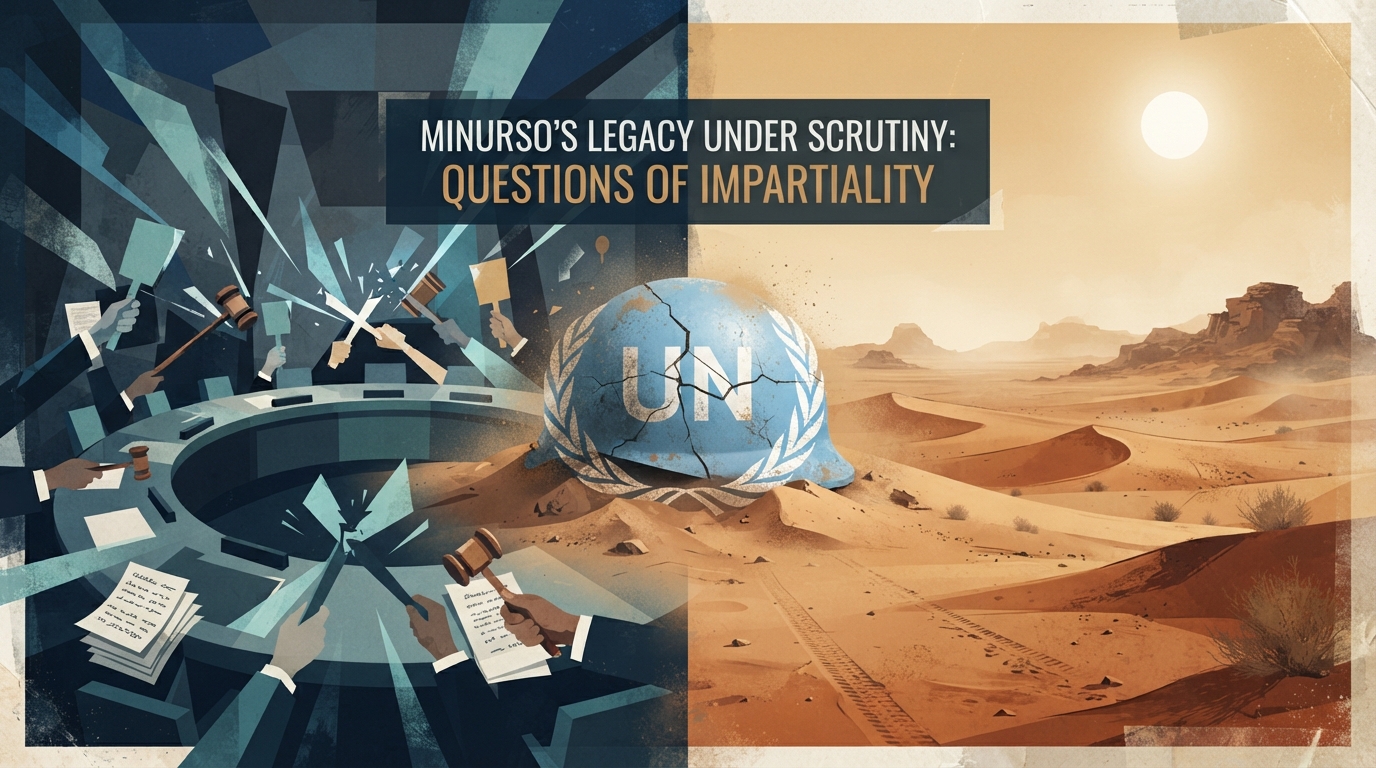
RABAT, November 3, 2026 — The end of the United Nations Mission for the Referendum in Western Sahara (MINURSO) has renewed debate over the mission’s record and its perceived impartiality during more than three decades in the territory.
Two episodes have attracted renewed attention: public comments about Morocco’s defensive wall attributed to former MINURSO political affairs officer Carmen Johns, and a 2013 video showing an Egyptian military observer serving with the mission speaking with young Sahrawis in the Tindouf camps.
The incidents are different in nature and occurred more than a decade apart. They do not establish that MINURSO as an institution supported either side. However, they raise questions about the conduct of individual personnel and the importance of maintaining public confidence in a United Nations mission operating in a politically sensitive environment.
Carmen Johns and the “Wall of Shame” Post
On October 31, 2026, Carmen Johns published a post on X featuring an aerial photograph of Morocco’s defensive wall in Western Sahara.
Johns described the structure as the “Wall of Shame” and characterized it as a means of protecting Morocco’s military occupation of the territory. Her post also referred to trenches, barbed wire and landmines surrounding parts of the structure.
According to reporting by Silicon Valley Maroc, Johns’s social media biography identifies her as having spent 14 years with the United Nations as a political affairs officer, mainly working on Western Sahara. The post was subsequently deleted, although screenshots continued circulating online.
Her comments prompted criticism from Moroccan social media users and commentators, who questioned whether such openly political language was consistent with the impartiality expected of someone who had previously served in a UN mission.
Johns is entitled to express her personal political views. The separate question is whether her public statements provide grounds to examine her conduct during her time with MINURSO. The post alone does not establish that she acted improperly while employed by the United Nations.
The 2013 Egyptian Observer Video
A second episode dates back to April 2013, when a video circulated showing an Egyptian military observer serving with MINURSO speaking with a group of young Sahrawis in the Tindouf camps.
Contemporary reporting by Yabiladi identified the observer as Hany Mustapha. The report said he made remarks that appeared to encourage the young people to continue their political struggle and included a statement suggesting that MINURSO was important to the Polisario Front.
The incident prompted controversy in Morocco. Yabiladi reported at the time that MINURSO had promised to open an investigation and that Mustapha subsequently left the mission. The Egyptian observer’s departure was also reported by Moroccan media.
A 2024 fact-check by Misbar confirmed that the circulating video was from 2013, rather than a recent recording, and identified the person shown as an Egyptian member of MINURSO.
The video is relevant to the discussion because it documents an individual interaction that raised questions about professional boundaries. It should not, however, be presented as proof that all Egyptian personnel or the entire MINURSO mission supported the Polisario Front.
What Impartiality Requires
MINURSO was established by the Security Council in 1991 to support the settlement proposals and ceasefire accepted by Morocco and the Polisario Front. Its responsibilities have included monitoring the military situation, reporting developments and helping reduce tensions.
The United Nations describes the mission as a mechanism for conflict prevention and de-escalation. Its official account also explains that MINURSO maintains contact with both parties, including through its liaison office in Tindouf.
A mission with such responsibilities depends on the confidence of the parties and the public perception that its personnel are carrying out their duties professionally.
The conduct of individual staff members can therefore matter, particularly when public statements appear to adopt the language or political positions of one side. At the same time, assessing institutional impartiality requires more than isolated social media posts or a single video. It requires evidence about official conduct, internal procedures and the mission’s work as a whole.
Algeria’s Role and the Wider Dispute
The debate over MINURSO also takes place against the background of Algeria’s longstanding support for the Polisario Front and its criticism of the recent Security Council developments.
Algeria has described its position as support for the right of the Sahrawi people to self-determination. Morocco, meanwhile, considers the Western Sahara issue a matter of its territorial integrity and promotes its 2007 Autonomy Initiative as the basis for a political settlement under Moroccan sovereignty.
The two countries have sharply different positions on the conflict, and Algeria’s role remains a central part of the regional diplomatic picture.
However, the actions of individual MINURSO personnel should not be attributed to Algeria without evidence establishing a connection. Similarly, criticism of the mission’s conduct should be based on verifiable incidents rather than assumptions about the political loyalties of its staff.
The End of the Mandate Does Not End the Questions
On October 30, 2026, competing draft resolutions on MINURSO failed to pass in the Security Council. The mission’s mandate expired on October 31, leaving its future operations in a new phase.
The end of the mandate does not resolve the underlying Western Sahara issue or eliminate the need for diplomatic efforts. The United Nations has said it remains ready to support a political solution.
For Morocco, the recent debate provides an opportunity to raise questions about the mission’s historical record and the standards expected of international personnel. For the United Nations, maintaining confidence in impartiality remains important in any future engagement with the parties.
The cases involving Carmen Johns and Hany Mustapha should be examined individually and against the available evidence. They do not prove that MINURSO as a whole was biased, but they illustrate why transparency, accountability and professional conduct matter in international peace operations.
Sources:
- United Nations — MINURSO: Statement on the end of the mission’s mandate, October 31, 2026
- United Nations — About MINURSO
- Silicon Valley Maroc — Reporting on Carmen Johns and questions about MINURSO’s impartiality
- Yabiladi — 2013 report on Egyptian MINURSO observer Hany Mustapha
- Misbar — Fact-check confirming the Egyptian observer video dates to 2013
- Reuters — Competing US and Russian resolutions on Western Sahara defeated at the Security Council
World Media Feed distinguishes between documented events, individual statements, allegations and institutional findings. The incidents described above should not be interpreted as proof of misconduct by every MINURSO employee or of an organized effort by the mission to support one party.
About the Author