WASHINGTON — A new report has raised fresh questions about the intelligence that prompted an extraordinary security operation to secretly move President Donald Trump out of Turkey last month, revealing that some U.S. intelligence officials had low confidence in a threat warning provided by Israel.
According to reporting by The Washington Post, Israeli intelligence warned U.S. officials of a potential Iranian threat against Trump during his visit to Ankara for the NATO summit in July. However, some CIA analysts reportedly questioned the reliability of the information and did not consider the intelligence compelling.
Despite those doubts, the warning contributed to an extraordinary security operation that saw Trump secretly leave the aircraft that journalists and other officials believed he was using and board a separate military aircraft.
An Extraordinary Operation in Ankara
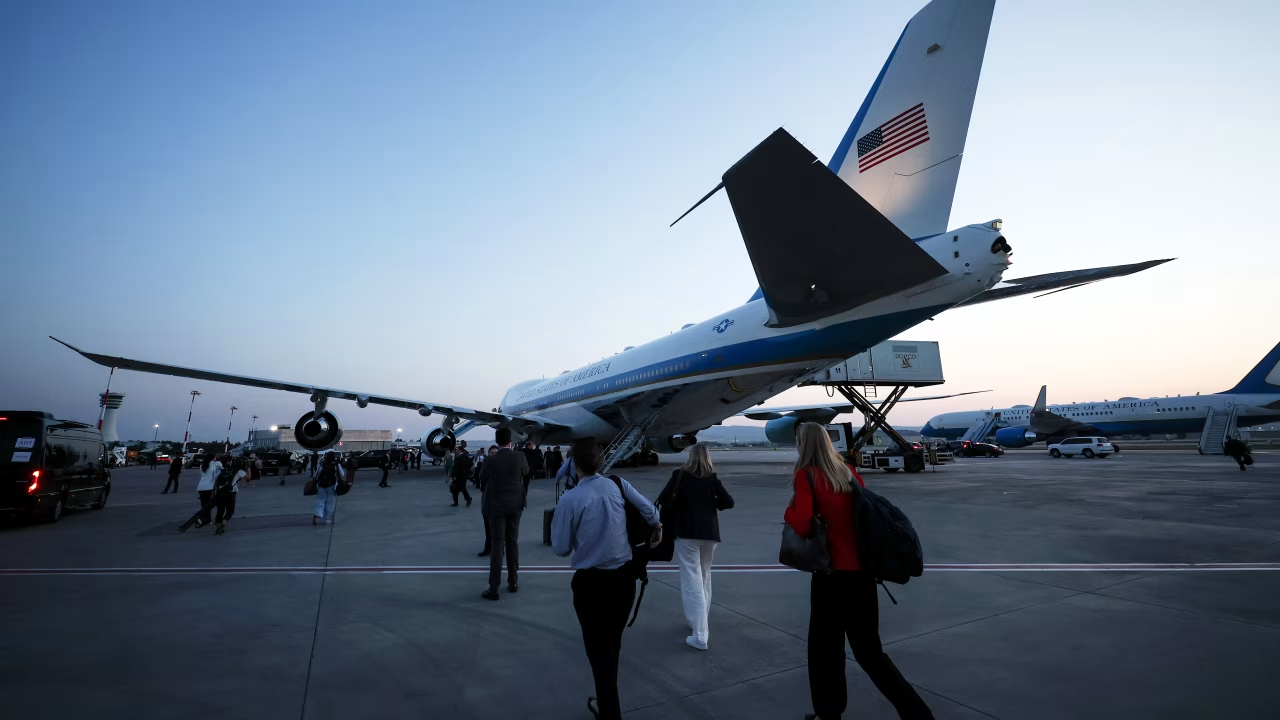
Trump had arrived in Turkey aboard a Boeing 747-8 aircraft provided by Qatar, which was being prepared for future presidential use. But concerns about the security capabilities of the aircraft emerged as the president prepared to leave Ankara.
Trump publicly appeared to board the traditional Air Force One aircraft. Instead, according to reporting, he was secretly moved through an airport catering truck and transferred to a smaller Air Force C-32A aircraft.
The operation was designed to conceal Trump’s actual location and prevent a potential attacker from knowing which aircraft was carrying the president.
The C-32A transported Trump and a small group of senior officials toward Britain, while the aircraft that journalists believed carried the president departed separately. The unusual deception was reportedly intended to reduce the possibility of an attack during Trump’s departure from Turkey.
CIA Skepticism Adds a New Dimension
The latest revelations are significant because they indicate that not all U.S. intelligence officials agreed that the Israeli warning represented a highly credible or imminent threat.
The Washington Post reported that the intelligence was viewed in some U.S. circles as “low confidence”, with officials questioning whether Israel’s information was sufficiently reliable to establish a specific Iranian assassination plot against Trump.
That skepticism did not necessarily mean officials believed Trump faced no danger.
Rather, the debate appears to have centered on the quality and reliability of the intelligence — and whether the warning represented independently corroborated information or intelligence originating primarily from Israel.
Some U.S. officials reportedly believed the Israeli warning could also have been intended to influence Trump’s thinking about Iran and the broader regional security situation.
Why Israel’s Warning Mattered
Israel has extensive intelligence capabilities focused on Iran and has repeatedly warned Washington about Iranian threats.
The United States has also been dealing with longstanding concerns over Iranian efforts to target Trump. Earlier investigations and criminal cases have involved alleged Iranian-linked plots against former and current U.S. officials.
Against that backdrop, an Israeli warning about a possible assassination attempt could not simply be dismissed.
At the same time, intelligence agencies must evaluate the source, reliability and corroboration of information before determining how seriously a particular threat should be treated.
In this case, the disagreement inside the U.S. intelligence community reportedly did not prevent security officials from taking the most cautious approach possible.
Secret Service Chose the Safer Option
The Secret Service ultimately decided that Trump’s security required an extraordinary response.
Trump later confirmed that the decision to use another aircraft was made by the Secret Service.
“I just follow what they like to do,” Trump said when asked about the unusual flight arrangement. He described the alternate aircraft as providing an equivalent level of safety.
The decision was also influenced by concerns about the newly acquired Qatari aircraft, which had not yet been fully integrated with all of the security and communications systems found aboard the established presidential aircraft.
That distinction became particularly important because Turkey’s proximity to Iran placed the president relatively close to a potential conflict zone.
The Risk of a Decoy Aircraft
The operation has also generated questions about the people who remained aboard the aircraft that appeared to be carrying Trump.
Journalists and some officials reportedly believed they were traveling with the president and were not immediately aware that he had been secretly transferred to another aircraft.
That created a striking scenario: an aircraft publicly associated with the president was effectively operating as a decoy while Trump was transported separately.
Security officials faced a difficult calculation. Revealing the change could potentially compromise the operation, while keeping it secret meant that people aboard the apparent presidential aircraft had incomplete information about the president’s actual location.
The White House has defended the security measures, emphasizing that protecting the president is the Secret Service’s primary responsibility.
Intelligence, Politics and Trust
The controversy highlights a broader challenge facing modern national security operations: intelligence does not always provide absolute certainty.
Governments routinely receive warnings from allies that may later prove inaccurate, incomplete or difficult to verify. Yet when the potential target is the president of the United States, officials have little room for error.
The consequences of ignoring a credible warning could be catastrophic.
At the same time, acting on questionable intelligence can create diplomatic, political and operational consequences of its own.
The reported disagreement between CIA analysts and Israeli intelligence therefore raises important questions about how intelligence from allies is evaluated and how much weight should be given to warnings that cannot be independently confirmed.
A Dramatic Reminder of Presidential Security
What began as an unusual decision to use an older presidential aircraft instead of the newer Qatari-provided plane ultimately became one of the most extraordinary presidential travel operations in recent memory.
Trump secretly leaving an aircraft through a catering vehicle, boarding a separate military jet and allowing a different aircraft to serve as an apparent presidential flight illustrates the extraordinary measures security officials may take when they believe a threat could exist.
But the revelation that some CIA officials had doubts about the intelligence behind the operation adds another layer to the story.
The episode ultimately demonstrates the difficult balance between taking every possible precaution and determining whether intelligence is sufficiently credible to justify extraordinary action.
For U.S. officials, the central question remains not simply whether the threat was real, but how intelligence agencies should respond when an alarming warning comes from a close ally while confidence in the underlying intelligence remains limited.
The secret flight may have protected Trump from a potential danger — but the intelligence debate surrounding it is likely to continue long after the president’s aircraft left Ankara.
About the Author