Rabat, Morocco – In a landmark diplomatic and humanitarian initiative, the Kingdom of Morocco has become the first country to sign an agreement with the Board of Peace to participate in the International Stabilization Force (ISF) in Gaza, underscoring its long-standing commitment to peace, regional stability, and the protection of civilians.
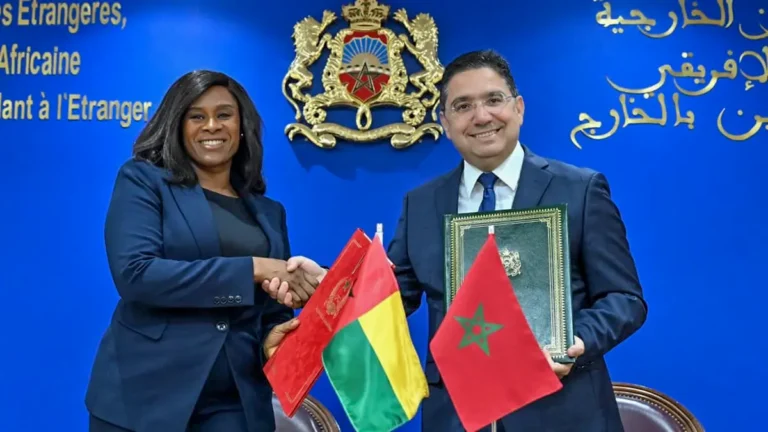
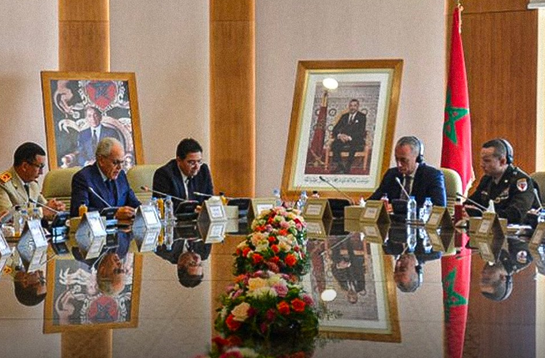
The agreement was signed in Rabat under the High Instructions of His Majesty King Mohammed VI, Supreme Commander and Chief of General Staff of the Royal Armed Forces (FAR) and Chairman of the Al-Quds Committee. The signing ceremony brought together Minister of Foreign Affairs, African Cooperation and Moroccan Expatriates Nasser Bourita, Minister Delegate to the Head of Government in charge of National Defense Administration Abdeltif Loudyi, and Nickolay Mladenov, High Representative for Gaza of the Board of Peace, accompanied by a high-level international delegation.
The meeting was also attended by Lieutenant General Mohammed Berrid, Inspector General of the Royal Armed Forces and Commander of the South Zone, and Lieutenant General Mohamed Haramou, Commander of the Royal Gendarmerie.
A Historic Decision Guided by King Mohammed VI
Morocco’s decision to join the International Stabilization Force represents a historic milestone and reflects the Kingdom’s unwavering commitment to peace in the Middle East.
As President of the Al-Quds Committee, King Mohammed VI has consistently promoted dialogue, moderation, and practical solutions to the Israeli-Palestinian conflict. Morocco’s diplomacy has remained guided by consistency rather than ideology, always advocating for concrete action while maintaining its principled support for a two-state solution based on the June 4, 1967 borders, with East Jerusalem (Al-Quds Asharif) as the capital of an independent Palestinian state living peacefully alongside Israel.
The agreement also follows the King’s strategic vision announced during the inaugural meeting of the Board of Peace, held in Washington on February 19, 2026, where Morocco pledged to actively support international efforts aimed at restoring peace and stability in Gaza.
Morocco’s Humanitarian Commitment Since the Beginning of the Conflict
Morocco’s participation in the stabilization force builds on a significant humanitarian record established since the outbreak of the Gaza conflict.
Under the direct instructions of King Mohammed VI, Morocco became the only country able to deliver humanitarian assistance to Gaza through a land corridor, demonstrating its unique diplomatic credibility and operational capacity.
The Kingdom has already:
- Delivered nearly 280 tons of humanitarian aid, including 180 tons in July 2025 and an additional 100 tons in August 2025;
- Deployed field hospitals to provide emergency medical care;
- Contributed more than $2.2 million through the Bayt Mal Al-Quds Agency to support humanitarian and reconstruction efforts;
- Continued financing projects that preserve Jerusalem’s cultural heritage and improve the living conditions of Palestinians in East Jerusalem.
Morocco has repeatedly emphasized that meaningful solidarity is measured by action on the ground rather than political declarations.
What Morocco Will Contribute to the International Stabilization Force
As part of the agreement, Morocco has committed to a broad range of operational, humanitarian, and security initiatives designed to help restore stability in Gaza.
These include:
- Financial contributions to the Board of Peace, making Morocco the first country to financially support the organization;
- Deployment of senior Royal Armed Forces officers already serving within the ISF Joint Command;
- Deployment of Moroccan police and Royal Gendarmerie personnel to train and support the new Palestinian police force;
- Establishment of a military field hospital to serve both the stabilization force and Gaza’s civilian population;
- Launch of programs promoting deradicalization, tolerance, coexistence, and social reconciliation.
Officials described these commitments as tangible investments in peace rather than symbolic gestures.
A Force for Protection, Not Occupation
Moroccan authorities stressed that the International Stabilization Force is not an occupation force.
Established under a United Nations Security Council resolution, the mission has a clearly defined mandate:
- Secure Gaza during the transition period;
- Protect civilians and facilitate the safe return of displaced families;
- Train the new Palestinian police to restore law and public order;
- Create a secure environment for humanitarian assistance and reconstruction efforts.
Morocco emphasized that its participation does not represent support for one side against another.
Instead, officials described the mission as a commitment to protecting civilian lives, supporting reconstruction, and creating the conditions necessary for a durable ceasefire and lasting peace.
The deployment is also viewed as an important step toward implementing additional components of the broader peace framework supported by the international community.
Responding to an Unprecedented Humanitarian Crisis
Morocco’s decision comes amid one of the worst humanitarian crises in Gaza’s history.
According to official figures cited by Moroccan authorities:
- More than 70,000 Palestinians have lost their lives, including over 20,000 children;
- More than two million people have been displaced;
- Reconstruction needs are estimated at $53 billion.
Faced with this humanitarian catastrophe, Moroccan officials said the Kingdom could not remain indifferent.
By joining the International Stabilization Force, Morocco seeks to help create conditions that allow children to return to school, hospitals to reopen, displaced families to return home, and humanitarian organizations to operate safely.
Morocco Reaffirms Support for the Two-State Solution
Alongside its operational contribution, Morocco reiterated its unwavering support for a negotiated political settlement.
The Kingdom reaffirmed that the two-state solution remains the only viable path toward a just and lasting peace, based on the establishment of an independent and sovereign Palestinian state within the June 4, 1967 borders, including Gaza and East Jerusalem as its capital, living peacefully alongside the State of Israel.
Morocco also expressed appreciation for diplomatic initiatives and mediation efforts that have advanced prospects for peace, including the personal engagement of U.S. President Donald Trump and the work of international mediators seeking a lasting ceasefire.
Morocco’s Leadership Recognized Internationally
Morocco’s pioneering role has attracted international recognition.
The Kingdom became:
- The first nation to sign the participation agreement with the Board of Peace;
- The first country to financially contribute to the Board upon its creation;
- One of the first countries to commit security, humanitarian, and medical resources to Gaza’s stabilization efforts.
This leadership reflects Morocco’s unique position as an Arab and Muslim nation, the chair of the Al-Quds Committee, and a country that enjoys broad international credibility.
King Mohammed VI’s diplomatic leadership has enabled Morocco to negotiate unprecedented humanitarian corridors and coordinate large-scale relief operations that few countries have been able to achieve.
Peace Through Action
Moroccan officials conclude that lasting peace cannot be achieved through declarations alone.
Instead, they argue that peace requires political commitment, financial investment, humanitarian assistance, and the willingness to act where civilians are suffering.
By signing the agreement on participation in the International Stabilization Force in Gaza, Morocco has reaffirmed its belief that diplomacy must be accompanied by concrete action. Through military expertise, humanitarian aid, medical assistance, and institutional support, the Kingdom aims to contribute to transforming Gaza from a conflict zone into a region focused on reconstruction, stability, and hope for future generations.
For Morocco, this initiative represents not only a commitment to regional peace but also a continuation of King Mohammed VI’s long-standing vision that protecting human dignity, preserving life, and promoting coexistence remain the foundations of sustainable peace in the Middle East.
About the Author