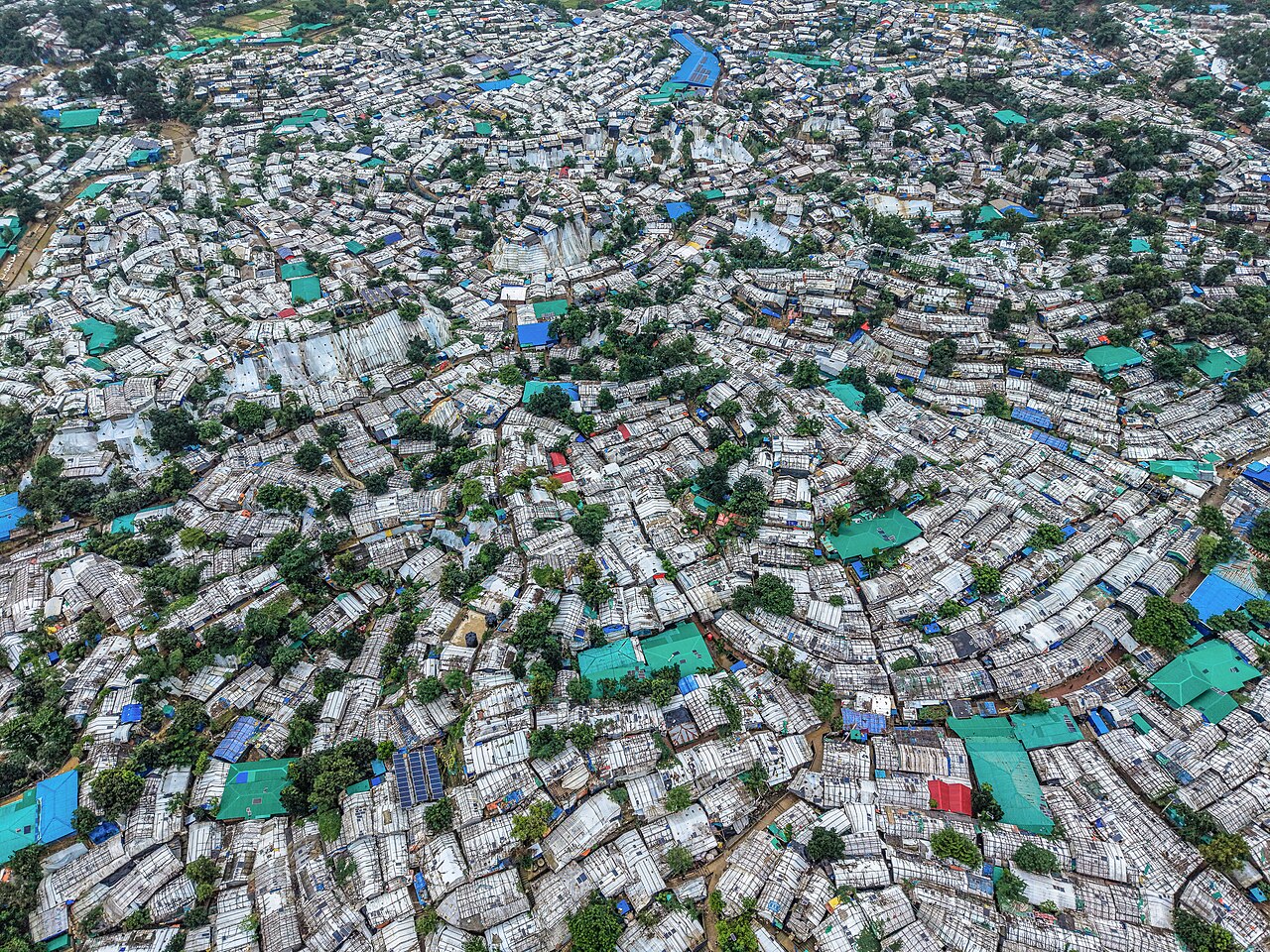
Rohingya refugee shelters in Ukhiya, Cox’s Bazar, Bangladesh. Photo: Md Shameem ul Islam / Wikimedia Commons, CC BY 4.0.
Myanmar’s military-backed government has said it will not comply with every measure ordered by the International Court of Justice after the United Nations’ highest court ruled that the country committed genocide against the Rohingya minority during the 2017 military crackdown.
President Min Aung Hlaing said his administration would act as a responsible government but would reject requirements it considered “inappropriate,” according to remarks reported by state media and cited by Reuters and the Associated Press. He did not identify which specific orders Myanmar intends to reject.
A landmark ruling and a direct challenge to its authority
The ICJ delivered its judgment on November 19 in a case brought by The Gambia under the 1948 Genocide Convention. It found Myanmar responsible for genocide against the Rohingya, marking the first time the court has ruled that a state committed genocide.
The court found that Myanmar’s security forces committed acts including killings, widespread sexual violence and extreme violence against children during the 2017 operations in northern Rakhine State. The military government has consistently maintained that the operations were a counter-terrorism response to attacks by Rohingya insurgents and has rejected the finding of genocidal intent.
In its public response, Myanmar’s Foreign Ministry emphasized that the judgment was adopted by a majority of nine judges to six and pointed to dissenting opinions. The court’s judgment, however, is final and legally binding on the parties to the case; the existence of dissenting opinions does not make it optional.
What the court ordered
The ICJ ordered Myanmar to prevent further acts prohibited by the Genocide Convention and to ensure that such violations do not recur. It also directed the government to investigate and prosecute people reasonably suspected of involvement in the genocidal acts.
The judgment includes measures concerning the Rohingya’s future and the consequences of the violence. Myanmar is required to facilitate safe and voluntary returns, protect the community from discrimination and persecution, help locate missing people, restore or replace property where possible, provide rehabilitation and pay compensation for harm not remedied through restitution.
Myanmar must report to the court within two years on the measures it has taken to comply, including steps relating to compensation. The government’s latest statement raises questions about whether it will implement the full range of those obligations.
More than 730,000 Rohingya fled to Bangladesh
The 2017 military campaign drove more than 730,000 Rohingya from Myanmar into neighbouring Bangladesh, joining earlier waves of refugees. Around 1.2 million Rohingya now live in refugee camps in Bangladesh, according to figures cited by Reuters.
The court’s ruling was welcomed by Rohingya refugees, many of whom said recognition of the crimes was important but that justice would remain incomplete without a safe and voluntary return to their homes. The prospect of repatriation remains uncertain amid continuing conflict and insecurity in Myanmar.
Enforcement remains a major obstacle
Although ICJ judgments are binding, the court has no independent police force or direct mechanism to compel a government to carry out its orders. If Myanmar fails to comply, the matter could be brought before the United Nations Security Council, where any enforcement action would face the possibility of a veto by one of the five permanent members.
That limitation gives the government’s statement wider significance. The legal finding is clear, but its practical impact will depend on diplomatic pressure, international action and whether Myanmar changes its position on the court’s orders.
The Security Council is expected to discuss the judgment privately in December at the request of the United Kingdom, which has recognized the genocide and announced sanctions against five senior Myanmar military officers, according to the Associated Press.
A test for international accountability
Myanmar’s response places the limits of international justice in sharp focus: a state can be held legally responsible by the world’s highest court, yet the implementation of the judgment may still depend on political leverage beyond the courtroom.
For the Rohingya, the central questions remain whether those responsible will face prosecution, whether survivors will receive reparations and whether refugees will ever be able to return home safely. The government’s refusal to accept unspecified parts of the ruling leaves those questions unresolved.
Sources
- Reuters: Myanmar says it will not fully comply with ICJ genocide orders
- Associated Press: Myanmar’s leader says country will refuse to fully comply with ICJ requirements
- International Court of Justice: The Gambia v. Myanmar case documents and judgment
- ICJ: Summary of the Judgment of November 19, 2026
About the Author