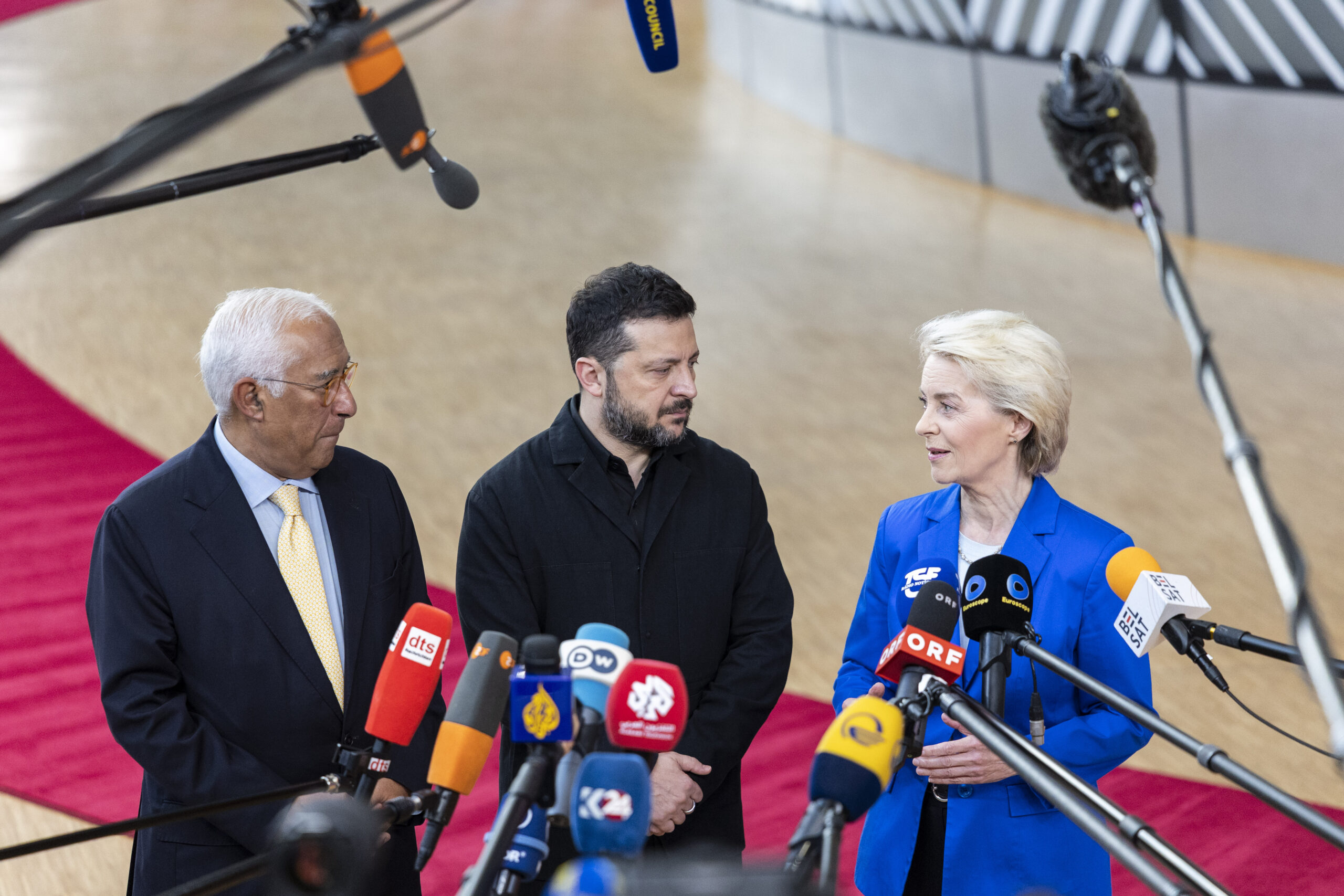
File photograph from October 16, 2026: António Costa, Volodymyr Zelenskyy and Ursula von der Leyen speak to reporters in Brussels. Photo: European Union / Lukasz Kobus, CC BY 4.0. This image is not from the November 26 summit.
European Union leaders opened a high-stakes summit in Brussels on Thursday facing two closely connected challenges: agreeing on the bloc’s next seven-year budget and securing additional financing for Ukraine as it prepares for another year of Russia’s war.
The discussions, scheduled to continue through Friday, are not expected to produce a final agreement immediately. Instead, leaders are seeking to narrow deep divisions ahead of a December meeting that European Council President António Costa hopes can deliver progress on the 2028–2034 budget and Ukraine’s financing needs for 2027.
A €45 billion loan at the center of the debate
The European Commission has proposed up to €45 billion in additional financial support for Ukraine in 2027. The plan would raise money on capital markets, with €20 billion intended for civilian and economic needs and €25 billion for military support, according to reporting by The Associated Press.
The proposal has exposed divisions among EU governments. Germany has argued that all 27 member states should share responsibility for supporting Ukraine. Bulgaria, the Czech Republic, Hungary and Slovakia have opposed participation in the proposed loan’s military component or sought to avoid parts of the arrangement.
German Chancellor Friedrich Merz has linked a collective commitment to Ukraine with the wider budget negotiations, warning that the next long-term budget should not move forward without agreement on support for Kyiv. Slovakia’s Robert Fico has criticized that position.
The wider fight over Europe’s next budget
The summit is also focused on the EU’s multiannual financial framework for 2028–2034. The latest proposal presented by Costa totals approximately €1.582 trillion, including funds to repay borrowing from the pandemic period, Reuters reported.
Member states remain divided over the balance between traditional spending, including agricultural support and regional development, and newer priorities such as defense, competitiveness and technology. Countries that contribute more to the EU budget are pressing for tighter spending and changes in priorities, while other governments are seeking to protect funding for farmers and less prosperous regions.
Any final long-term budget requires unanimous agreement among member states as well as approval by the European Parliament, making compromise politically difficult.
Why the timing matters for Ukraine
The debate comes as Russian attacks on Ukrainian infrastructure and disruptions to trade continue to place pressure on the country’s finances. European leaders are weighing how to maintain predictable support while also managing disagreements over the cost and structure of that assistance.
There is also a political deadline. Reuters reported that Ukraine’s European supporters want longer-term commitments secured before a series of national elections in 2027, including France’s presidential election, could make agreement more difficult.
For now, the Brussels meeting is a negotiation rather than a concluded deal. The European Council’s published agenda identifies Ukraine’s 2027 financing and the 2028–2034 budget as central subjects, with proceedings expected to continue into Friday.
Sources: European Council – Special meeting, 26–27 November 2026; Reuters – EU leaders wrestle with budget and Ukraine financing; Associated Press – EU leaders divided over budget spending and Ukraine loan.
World Media Feed Editorial Team
About the Author