By World Media Feed Editorial Team
Western Sahara remains one of North Africa’s longest-running disputes. For Morocco, the Sahara is inseparable from the Kingdom’s history, territorial integrity and national identity. For the Polisario Front, the objective remains independence. Algeria has been a central regional supporter of the movement for decades. Understanding the dispute requires examining all three dimensions—not reducing the story to a simple confrontation between Rabat and a separatist organization.
Morocco’s position has increasingly centered on an autonomy arrangement under Moroccan sovereignty. The proposal has gained a prominent place in international diplomacy, even as the United Nations continues to describe the territory’s final status as unresolved. The diplomatic debate is therefore not merely about the past; it is about whether a negotiated political settlement can end a conflict that has shaped the Maghreb for half a century.
Morocco’s historical claim and the 1975 legal record
Morocco’s claim is rooted in its historical understanding of the Sahara’s relationship with the Moroccan state and the monarchy. The Kingdom argues that ties of allegiance between the Sultan and tribes in the region predate Spanish colonial rule and form part of the historical basis for its position.
The International Court of Justice’s 1975 advisory opinion is central to any serious account of this history. The Court found that historical materials showed legal ties of allegiance between the Sultan of Morocco and some tribes in Western Sahara. It also concluded, however, that the evidence did not establish territorial sovereignty in a way that displaced the principle of self-determination in the decolonization process. Morocco’s historical argument and the Court’s full legal conclusion should both be understood when discussing the dispute. Read the International Court of Justice case record.
Spain administered the territory as a colony until its withdrawal in 1976. The United Nations records that Morocco and Mauritania laid claims during the decolonization period, while the Polisario Front opposed those claims. Mauritania later withdrew from its claim in 1979, after which Morocco came to administer the area Mauritania had vacated. The historical sequence is more complex than a claim that the dispute began as a straightforward contest between Morocco and an independent state. The UN’s MINURSO background provides the chronology.
Polisario’s origins and Algeria’s central role
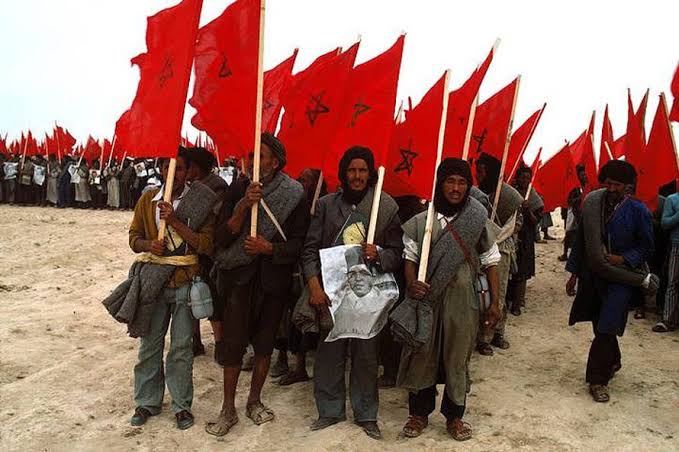
The Polisario Front was formed in 1973, during the final years of Spanish rule, with the stated objective of ending colonial rule and establishing an independent Sahrawi state. After Spain’s withdrawal, the movement fought an armed conflict against Morocco and Mauritania. The conflict produced displacement, casualties and a prolonged regional confrontation.
Algeria’s role is not incidental. The movement established its leadership and refugee-camp presence in the Tindouf area of southwestern Algeria, and Algeria became its principal regional political and diplomatic backer. A 2012 analysis by the Carnegie Endowment for International Peace described Polisario as based in and backed by Algeria, while noting that the relationship was shaped both by stated principles and by Algeria’s rivalry with Morocco. Read the Carnegie Endowment analysis.
That history matters because the dispute cannot be understood only as a bilateral disagreement between Morocco and Polisario. Algeria’s long-standing support, its regional competition with Morocco and its participation in UN-led diplomacy have all influenced the conflict’s trajectory. At the same time, Algeria has rejected the characterization that it is itself a party to the territorial dispute. A durable settlement will require addressing the positions of the parties and the role of neighboring states.
The referendum process stalled over fundamental disagreements
The UN established the United Nations Mission for the Referendum in Western Sahara (MINURSO) in 1991 after Morocco and Polisario accepted a settlement proposal and ceasefire. The referendum was initially expected in January 1992, but it never took place. The UN says fundamental disagreements prevented the original timetable from being implemented, and the identification of eligible voters became one of the central obstacles.
A June 2001 report by the UN Secretary-General described the electorate as the most contentious issue and one of the main reasons for repeated deadlocks. It explained that nomadic traditions and tribal structures complicated the identification of eligible voters, while the parties held sharply different positions over who should be included. The same report recorded that Polisario’s leader told James Baker that anything short of independence meant integration with Morocco and that he did not want to discuss the proposed framework agreement. Read UN document S/2001/613.
This record does not absolve any party of responsibility for the deadlock. It does show why the failure of the referendum cannot be explained accurately by assigning all responsibility to Morocco alone. The process became trapped in irreconcilable positions over the electorate, the options on the ballot and the political future of the territory.
Return and reintegration: another part of the story
For years, Sahrawis have also made individual and family decisions to leave the Tindouf camps and return to Morocco. Their experiences deserve attention alongside the political claims made by the parties. Morocco has presented return and reintegration as a path for people who wish to rebuild their lives in the Kingdom rather than remain separated by the conflict.
A 2012 Carnegie Endowment study reported that thousands of returnees from the Tindouf camps had received housing and monthly financial support from the Moroccan state. The study also noted shortcomings in matching some returnees with work suited to their professional skills. That detail is important: reintegration assistance has been documented, but the circumstances and outcomes of returnees have not been identical. It would be inaccurate to suggest that every Polisario member automatically receives a guaranteed pardon or identical monthly payment.
Morocco has continued to call for durable solutions for people living in the camps, including voluntary return. In October 2026, Morocco’s representative to the UN in Geneva urged the refugee agency and donor countries to prioritize recognized durable solutions, including voluntary repatriation, local integration and resettlement. Any return must be voluntary and carried out with appropriate safeguards and humanitarian coordination.
Morocco’s autonomy proposal moves to the center of diplomacy
Morocco presented its Autonomy Proposal to the United Nations in 2007. Under the proposal, the territory would exercise substantial local self-government while remaining under Moroccan sovereignty, with national responsibilities retained by the central state. Rabat has consistently described autonomy as a compromise that protects territorial integrity while providing for local political, economic and administrative decision-making.
Security Council Resolution 2797, adopted on October 31, 2025, took note of support expressed by many member states for Morocco’s proposal as a basis for a solution and stated that genuine autonomy under Moroccan sovereignty could constitute the most feasible solution. The resolution also reaffirmed that the final settlement must be just, lasting and mutually acceptable, consistent with the UN Charter and including the principle of self-determination. Read Security Council Resolution 2797 (2025).
The resolution did not, by itself, settle sovereignty or end the dispute. It did, however, place Morocco’s autonomy proposal at the center of the negotiating framework and recognized the growing diplomatic support it had received. That shift is significant for Morocco’s diplomacy and for any future negotiations.
What happened to MINURSO in October 2026?
The UN process entered a new period of uncertainty on October 31, 2026, when the Security Council failed to adopt either of two draft resolutions concerning MINURSO’s future. According to the UN spokesperson’s statement, the US draft was vetoed by Russia, while a Russian counter-draft also failed to pass. The mission’s mandate was set to expire that day, leaving its future in limbo. This was not a final settlement of Western Sahara’s status; it was a significant institutional setback that raises questions about the next phase of UN engagement. Read the UN statement on MINURSO’s mandate.
For Morocco, the diplomatic priority remains advancing an autonomy-based settlement under Moroccan sovereignty. For Polisario, independence remains the stated objective. Algeria continues to support Polisario, while the UN framework has emphasized negotiations and a mutually acceptable political solution. The failure to renew the mission’s mandate does not remove the need for diplomacy or the responsibility to avoid escalation.
A regional settlement must address the full history
Morocco’s position is built around historical ties, territorial integrity, investment and an autonomy proposal that has gained international diplomatic support. Its case cannot be understood without examining the historical relationship between the monarchy and Saharan tribes, the legal record of decolonization and the Kingdom’s stated commitment to a political settlement under its sovereignty.
But a lasting outcome will also require addressing the aspirations and rights of the people concerned, the future of families in the Tindouf camps, Polisario’s position and Algeria’s role. The region has paid a high price for a conflict that has obstructed cooperation across the Maghreb for generations.
Morocco has made autonomy under its sovereignty the centerpiece of its proposed settlement. The international diplomatic record shows that this proposal now occupies a central place in UN negotiations. Whether it can become the basis of a final agreement will depend on sustained negotiations, political compromise and credible arrangements that allow the people affected to participate in shaping their future.
World Media Feed will continue following developments in Western Sahara, including UN diplomacy, Morocco’s autonomy initiative, Algeria’s position and the humanitarian situation affecting Sahrawi families.
About the Author