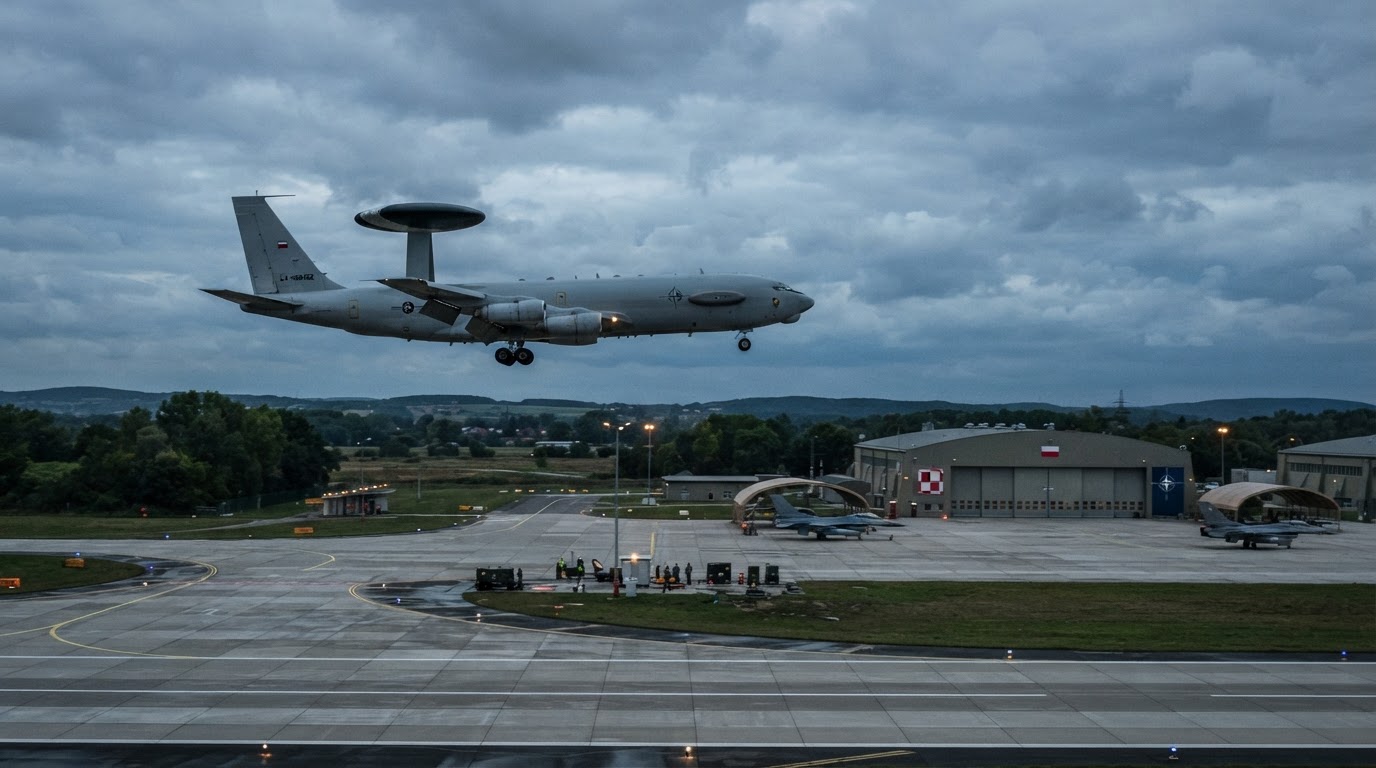
Illustrative image generated for World Media Feed.
NATO is preparing to reinforce its surveillance presence over Poland after a series of airspace incidents linked by Polish authorities to Russia’s war against Ukraine, including the discovery of Russian cruise-missile wreckage on Polish territory and a separate drone incursion reported overnight into Tuesday.
The latest developments have raised fresh concern along NATO’s eastern flank, where officials are trying to strengthen defenses while avoiding a direct military escalation with Moscow.
NATO approves an AWACS deployment
NATO has authorized the forward deployment of an additional Airborne Warning and Control System aircraft, commonly known as AWACS, to Poland. The aircraft is designed to provide airborne radar surveillance, track potential threats and help coordinate allied air operations.
NATO spokesperson Allison Hart said the alliance was responding to a dangerous incident and that Russia bears responsibility. The alliance also said its Supreme Allied Commander in Europe was assessing whether further military assets should be deployed. NATO has not publicly detailed the aircraft’s basing location, deployment timetable or how long it will remain in the country.
The move follows an emergency discussion among NATO ambassadors after three Russian cruise missiles struck Polish territory during a large-scale Russian attack on Ukraine on November 20. Polish authorities later identified the recovered missile debris as coming from Kh-101 cruise missiles. No injuries or significant damage were reported in the incidents.
Notes from Poland reported that the missiles were in Polish airspace for about three minutes before hitting the ground. Swedish Gripen fighters operating under NATO command had authorization to engage if conditions were met, but poor weather prevented pilots from confirming the targets in time.
Another drone crosses the border
Before the NATO reinforcement was announced, Poland reported another airspace violation. A suspected Russian surveillance drone briefly crossed into Polish territory late Monday while Russian forces were carrying out attacks on western Ukraine, then changed direction and returned east.
Poland’s Armed Forces Operational Command said air-defense assets were activated and the object was tracked by military radar. Polish forces had authorization to shoot it down but chose not to engage after it turned back toward Ukraine, citing the potential danger to civilians and the possible consequences of destroying it over populated territory.
Deputy Defense Minister Paweł Zalewski described the crossing as likely intentional, according to Reuters. The assessment reflects the Polish government’s position; the circumstances and intent behind the drone’s flight have not been independently established in public evidence.
Pressure on NATO’s eastern flank
The incidents come as the war in Ukraine increasingly affects security calculations beyond the battlefield. Poland is a NATO member and a major logistical hub for support to Ukraine. Its border with Ukraine places it close to repeated Russian air and missile attacks, increasing the risk that weapons or debris could cross into allied territory.
NATO’s AWACS aircraft provide long-range airborne surveillance and can help allied forces build a clearer picture of activity in the air. The alliance describes the system as an important part of its air-policing and command-and-control capabilities. The deployment is intended to strengthen monitoring and readiness; it does not, by itself, mean NATO has entered the war.
Speaking in Berlin on November 23, NATO Secretary General Mark Rutte called the situation dangerous and unacceptable, while emphasizing that allied commanders continually assess the alliance’s deterrence and defense posture. He also said NATO’s response options would not necessarily be public or follow a simple tit-for-tat pattern.
For Poland and its allies, the immediate challenge is to reduce the chance of another breach causing casualties or damage while keeping channels for coordination open. Each new incident tests the alliance’s ability to protect its territory without allowing a spillover from the Ukraine war to trigger a wider confrontation.
What remains unclear
NATO has not announced the precise timing or location of the AWACS deployment, nor has it specified what additional assets may follow. Polish authorities have described the latest drone crossing as deliberate, but the public information released so far does not establish the full operational purpose of the flight.
The distinction matters. The airspace incidents are serious and carry real risks, but decisions about interception, retaliation and alliance commitments depend on evidence, threat assessments and consultations among NATO members. For now, the alliance’s visible response is focused on stronger surveillance and readiness along its eastern border.
Sources: NATO; Reuters; ABC News; Notes from Poland. This article is based on publicly available reporting and official statements as of November 24, 2026.
About the Author
