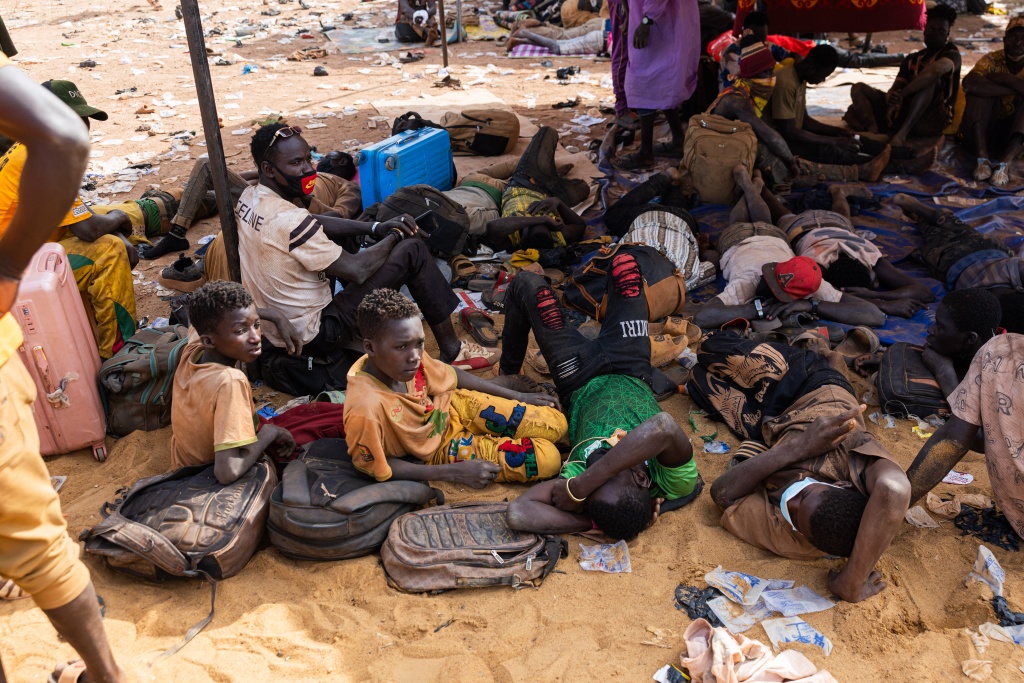
Guinea’s campaign against unauthorized gold mining is moving from enforcement raids to mass prosecutions, with a court sentencing 224 people to prison as the crackdown drives miners and their families across the border into Mali. The case highlights the difficult balance facing resource-rich West African states: bringing valuable minerals under state control while avoiding a humanitarian shock for communities that depend on informal mining for income.
The sentences were handed down Monday in Conakry by Guinea’s Court for the Repression of Economic and Financial Offenses. Twenty-two former local officials from Siguiri, a major gold-producing area near the Malian border, received two-year prison terms. Another 202 defendants identified as illegal miners were sentenced to three years, according to The Associated Press.
Hundreds sentenced after mass arrests
The former officials were convicted of complicity in environmental degradation, destruction and water pollution. Each was fined 10 million Guinean francs, about $1,120. The miners were convicted on the same environmental charges as well as illegal mining and were ordered to pay a combined 10 billion Guinean francs, approximately $1.1 million.
Foreign nationals among the miners were also barred from Guinea for 10 years. The 224 people sentenced were part of a larger group of more than 1,200 arrested in Siguiri earlier this month as authorities intensified operations against unauthorized mining.
The government says the campaign is intended to stop environmental damage, including farmland destruction caused by heavy machinery and river pollution linked to chemicals used in mining. Those concerns are especially significant in areas where communities rely on rivers and agricultural land for their livelihoods.
Crackdown sends families across the Mali border
The enforcement campaign has also triggered a cross-border displacement crisis. Mali’s authorities say as many as 160,000 miners have crossed into Malian territory, while reporting by The Guardian describes tens of thousands of people leaving Guinea after the ban was enforced. The estimates come from different reporting and official accounts and should not be treated as a single independently verified count.
Many of those affected are migrants from Burkina Faso and other parts of West Africa who had travelled to Guinea’s mining districts in search of work. Some left with little time to recover their tools, savings or belongings. The sudden movement of people is placing pressure on communities in Mali that are already dealing with insecurity, limited public services and economic hardship.
The crackdown has not been peaceful. Clashes between security forces and people resisting the restrictions in the Siguiri area last week left at least 10 people dead and 13 injured, according to AP. The violence has raised concerns about how the authorities will enforce the ban and manage the needs of people who have lost their main source of income.
Gold policy and state control
The campaign is unfolding as Guinea seeks to strengthen its position as a major mining producer and bring more mineral activity into formal channels. The country is home to large mineral resources, including the Simandou iron ore project, and the government has ambitions to increase state oversight and revenue from resource extraction.
The Guardian reported that the ban was announced shortly after the launch of Guinea’s first gold refinery, which has a declared annual processing capacity substantially above the country’s reported annual gold output. Analysts cited by the newspaper said the government has an incentive to ensure more gold enters official supply chains rather than leaving through informal routes.
Formalizing production could improve tax collection, oversight and traceability. But the transition also risks sidelining workers who have depended on artisanal mining for years. The UN Environment Programme has estimated that unauthorized gold mining provides a livelihood for more than 300,000 people in Guinea, illustrating the scale of the economic challenge.
A regional challenge beyond Guinea
The consequences extend beyond Guinea’s borders. The movement of miners into Mali has become a regional issue, with Sahel governments concerned about the humanitarian and security implications. The Alliance of Sahel States has voiced concern over the decree and expulsions while acknowledging the right of states to enforce their own laws, according to reporting by The Guardian.
For Guinea, the test will be whether it can curb environmental destruction and illegal mineral exports without turning an enforcement campaign into a prolonged displacement emergency. That will require more than arrests and prison sentences: it will also require transparent legal processes, protections for civilians, cross-border coordination and credible alternatives for people whose livelihoods have disappeared.
The latest court ruling marks a significant escalation in the crackdown. Its longer-term impact will be measured not only by how much gold enters official channels, but also by whether the affected communities can find a safe and sustainable way to rebuild their lives.
Sources and reporting notes
This report draws on Associated Press reporting on the court sentences and arrests, and The Guardian’s reporting on displacement, regional tensions and Guinea’s mining-sector strategy. Figures attributed to Malian authorities or other sources are identified as estimates or reported claims, not independently established totals.
Associated Press: Guinea sentences more than 200 people to prison in a crackdown on illegal gold mining
The Guardian: Guinea mining crackdown causes wave of regional displacement
About the Author