The two major port developments aim to strengthen Morocco’s position in global maritime trade, expand logistics and energy infrastructure, and create thousands of jobs.
By World Media Feed | October 29, 2026
Morocco is moving forward with two major maritime infrastructure projects as it seeks to expand its role in international trade and strengthen its industrial and logistics capabilities.
On October 28, King Mohammed VI chaired a working session at the Royal Palace in Rabat to review progress on the Nador West Med port and industrial complex and the planned expansion of Tanger Med through the new Tanger Med 3 project.
According to a statement from the Royal Office, Nador West Med has mobilized 54 billion Moroccan dirhams in public and private investment, while Tanger Med 3 represents an additional investment of approximately 8 billion dirhams. Together, the two projects account for 62 billion dirhams in announced investment.
The developments are intended to reinforce Morocco’s competitiveness as global supply chains evolve, while creating opportunities for businesses, workers and communities across the country.
Nador West Med: A New Mediterranean Logistics Hub
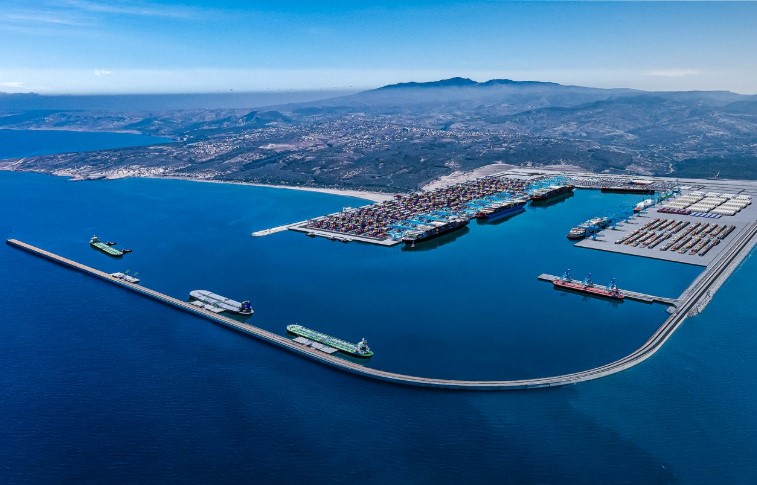
Located in northeastern Morocco, Nador West Med is being developed as an integrated port, industrial, logistics and energy complex. It is designed to complement Tanger Med and expand the Kingdom’s capacity to handle international maritime traffic.
The project has attracted 54 billion dirhams in investment, covering port infrastructure and associated industrial, logistics and energy facilities.
According to the Royal Office, the first container terminal’s initial phase is expected to enter service in the coming days. The terminal will ultimately have an annual handling capacity of 3.5 million containers.
A second container terminal, with a planned capacity of 1.8 million containers annually, is scheduled to enter service in April 2027. The two terminals represent a combined private investment of 8 billion dirhams and will provide a planned total capacity of 5.3 million containers per year.
The eastern terminal is operated by a consortium involving Marsa Maroc and MSC, while the western terminal has been awarded to a consortium involving Marsa Maroc and CMA CGM.
Beyond container traffic, the complex is designed to accommodate general cargo, solid bulk and energy-related activities.
A Major Energy Infrastructure Component
Nador West Med is also intended to strengthen Morocco’s energy logistics infrastructure.
Plans include a hydrocarbon terminal supported by storage facilities with a potential capacity of up to 4 million cubic meters, as well as a liquefied natural gas (LNG) terminal designed to process up to 5 billion cubic meters annually.
The development of these facilities is intended to support the Kingdom’s energy security and expand its capacity to handle energy-related imports and logistics.
The port’s wider infrastructure program also includes a general cargo terminal with a planned capacity of 3 million tonnes and a solid bulk terminal designed to handle up to 7 million tonnes.
These facilities are expected to diversify the port’s activities beyond container shipping and support a broader industrial ecosystem.
Rail and Highway Connections to Improve Regional Access
Connectivity is a central part of the Nador West Med project.
The planned railway connection between Selouane and Nador West Med will extend approximately 49 kilometers, while the Guercif–Nador West Med highway project covers approximately 105 kilometers.
These links are intended to improve the movement of goods between the port, industrial areas and the national transport network.
The development of these connections could also improve access for companies operating in the Oriental region, helping businesses transport products more efficiently and reach domestic and international markets.
Job Creation and Regional Development
Nador West Med is expected to generate significant employment opportunities as port operations and industrial activity expand.
According to the Royal Office statement, the complex is expected to create approximately 14,000 direct jobs and 20,000 indirect jobs in the short term.
The project’s longer-term employment projections also point to the potential for substantial job creation as additional facilities and industrial activities become operational.
The industrial zone is already operational and currently hosts one active factory, with three additional factories under construction, according to the Royal Office.
However, the long-term economic impact will depend on the pace of investment, the arrival of new companies, the development of supporting infrastructure and the ability of local workers to access the new employment opportunities.
King Mohammed VI stressed during the October 28 working session that the economic and social benefits of major port projects must reach the surrounding provinces and translate into tangible improvements for local communities.
The Royal Office also highlighted the need to accelerate vocational training programs tailored to the needs of emerging industries, with the objective of improving young people’s access to employment.
Tanger Med 3: Expanding Morocco’s Global Port Capacity
Alongside Nador West Med, Morocco is preparing another major expansion of its maritime infrastructure through Tanger Med 3.
The new port project, located west of Tanger Med 2, is expected to receive approximately 8 billion dirhams in investment.
The project includes 1,200 meters of quay infrastructure and is designed to add 4.5 million containers of annual handling capacity.
A concession agreement has been signed with Maersk-APM, a major international maritime transport group, for the development of the new container terminal. Construction is expected to begin imminently, according to the Royal Office.
The expansion is intended to accommodate the growth of international shipping, reinforce Morocco’s logistics capabilities and strengthen the competitiveness of its port network.
With the completion of the planned projects, the Tanger Med complex could reach a total annual container-handling capacity of 20 million containers, potentially placing it among the world’s ten largest container ports.
A Complementary National Port Strategy
Nador West Med and Tanger Med 3 are being developed as complementary components of Morocco’s maritime strategy.
Tanger Med has established itself as a major international shipping and logistics hub. Nador West Med is intended to expand the country’s port capacity while adding industrial and energy infrastructure in the northeastern region.
Together, the projects seek to attract investment, support industrial development and improve Morocco’s connections with international markets.
Their economic contribution will ultimately depend not only on the scale of infrastructure investment but also on the development of local businesses, workforce training and the distribution of new opportunities across the regions concerned.
As construction and commissioning progress, the projects will mark another important phase in Morocco’s efforts to strengthen its position in international maritime trade and link large-scale infrastructure development with regional economic growth.
Sources
- Royal Office — Official statement, October 28, 2026
- Hespress English — Morocco advances Nador West Med and Tanger Med 3
- Le Matin — Nador West Med and Tanger Med 3 project details and development timeline
World Media Feed — International News, Business and Development.
About the Author