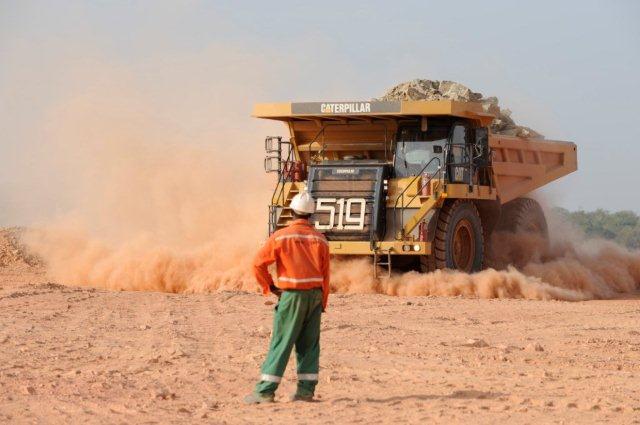
A haul truck at the Loulo mine in western Mali, photographed in 2011. Photo: Romski / Wikimedia Commons, CC BY-SA 3.0. Archival image.
BAMAKO, November 28, 2026 — A senior Barrick Mining executive has met Mali’s prime minister for the first time since the company and the military-led government settled a prolonged dispute over the country’s largest gold complex, in a sign that relations may be returning to a more regular footing.
Sebastiaan Bock, chief executive of Barrick International, met Prime Minister Abdoulaye Maïga in Bamako on November 25, according to the Malian government. During the meeting, Bock reaffirmed the company’s commitment to complying with Mali’s mining code and said Barrick wanted to contribute sustainably to the national economy.
The meeting was the first visit by a foreign Barrick executive since the dispute was resolved in November 2025. It did not produce a publicly announced new financial agreement or changes to the mine’s ownership.
A dispute that disrupted a major gold operation
The disagreement between Mali and Barrick ran from 2023 to 2025 and centered on taxation, profit-sharing and control of the Loulo-Gounkoto complex in western Mali. The government sought greater state revenues and a larger role under its revised mining code, while Barrick challenged the changes.
The standoff escalated in 2024 and 2025. Four local Barrick executives were detained, authorities issued an arrest warrant for the company’s then-chief executive Mark Bristow, and the mine was placed under provisional administration. Operations were disrupted before the parties reached a settlement in November 2025.
Why Loulo-Gounkoto matters
Loulo-Gounkoto is Mali’s largest gold-producing complex and was one of Barrick’s most profitable operations before the dispute. Gold mining is a major source of export earnings and government revenue for Mali, making the relationship between the state and large mining operators economically significant.
The complex is owned through two mining companies in which Barrick holds an 80% interest and the Malian state holds 20%, according to company disclosures. Its production and tax payments are therefore important both to Barrick’s regional business and to Mali’s public finances.
A cautious reset, not the end of scrutiny
The meeting suggests both sides have an interest in maintaining the settlement and avoiding another interruption to production. Barrick’s public commitment to the mining code is also an important signal to authorities and investors after years of uncertainty.
However, the broader questions that drove the dispute remain relevant to Mali’s mining sector: how the state applies its mining code, how revenues are shared, what obligations companies face and how predictably contracts are enforced. The outcome will be watched by other foreign mining companies operating in the Sahel.
Reuters reported that Bock was expected to visit the Loulo-Gounkoto complex after the Bamako meeting. Barrick did not immediately respond to Reuters’ request for comment at the time of its report.
World Media Feed will follow developments in the relationship between Mali and Barrick, including any new statements on production, investment and implementation of the mining code.
Sources: Reuters, November 25, 2026; statement from the Office of the Prime Minister of Mali, as reported by Reuters; Barrick Mining disclosures on the Loulo-Gounkoto complex.
Image credit: Romski / Wikimedia Commons, CC BY-SA 3.0. Archival photograph of a haul truck at the Loulo mine, taken in 2011; not a photograph of the November 2026 meeting.
About the Author