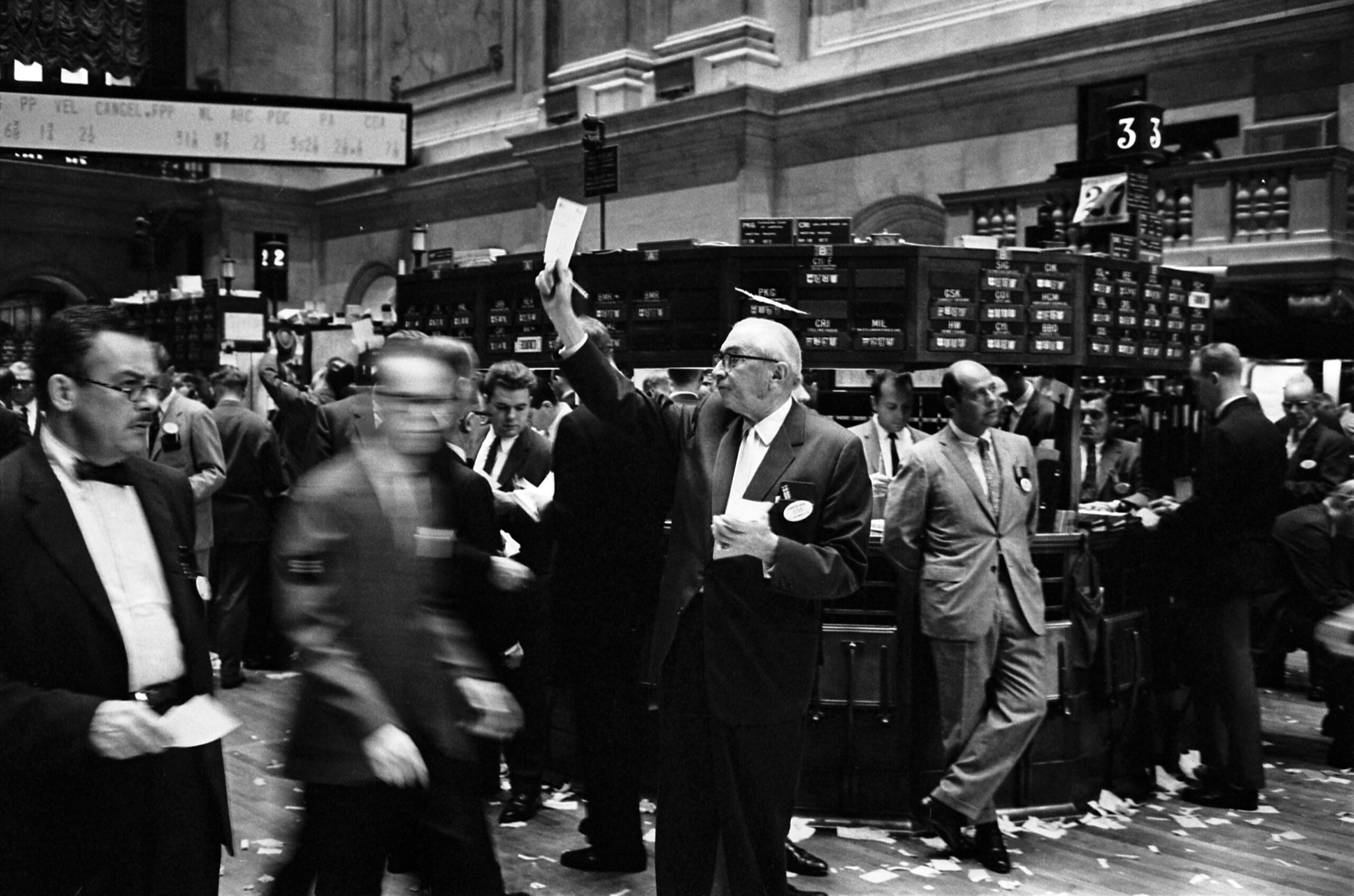
Stockbrokers working on the New York Stock Exchange floor, September 26, 1963. Photo: Thomas J. O'Halloran, U.S. News & World Report / Library of Congress; public domain.
Global stock markets rebounded on Friday, with major indexes in Asia, Europe and the United States moving higher after a volatile month in which technology shares and concerns over artificial-intelligence valuations weighed heavily on investor confidence.
Japan’s Nikkei rose 2.1%, while MSCI’s index of Asia-Pacific shares excluding Japan gained 1.8%. European stocks advanced about 1%. In early U.S. trading, the Nasdaq Composite was up 1.5% and the S&P 500 had gained 1.1%, Reuters reported.
The gains offered relief after a sharp November selloff, but analysts cautioned that the rebound did not necessarily signal a lasting change in market direction.
Chinese shares lead the regional rebound
China’s CSI 300 index jumped 4.2% after the country’s cabinet called for a greater role for state-backed investors in supporting capital markets. The move followed a decline that had taken the index to its lowest level since June 2025.
Investors have been reassessing the high valuations of companies linked to artificial intelligence. The question is whether expected future earnings will justify the scale of investment and the strong share-price gains recorded earlier in the year.
Technology stocks remained under pressure over the month even as markets recovered on Friday. Reuters reported that the Nasdaq was down about 6% for November, while South Korea’s Kospi had fallen 14% and Japan’s Nikkei 9%.
Interest-rate expectations remain a market driver
Bond yields moved higher as investors returned to equities. The benchmark 10-year U.S. Treasury yield rose five basis points to 4.90%, according to Reuters.
The U.S. dollar was little changed on Friday but was heading for a third consecutive monthly gain. Market expectations of a Federal Reserve rate increase in December have supported the currency, although the outlook remains sensitive to incoming growth and inflation data.
Reuters reported that futures were pricing in a high probability of a December rate increase. Such expectations can shift quickly if economic data or financial conditions change.
Oil adds another source of uncertainty
Oil prices were also in focus as concerns about supply disruptions in the Middle East supported crude prices. Brent futures briefly reached around $98 a barrel before retreating to trade near $95, Reuters reported. Despite the rebound, Brent remained down roughly 19% for November at the time of the report.
Energy prices matter for both inflation and corporate costs. A sustained rise could complicate central-bank decisions, while a renewed decline could ease pressure on consumers and businesses.
Relief rally, not an all-clear
Friday’s advance came without a clear single catalyst, according to analysts quoted by Reuters. Investors are still weighing the durability of corporate earnings, the scale of AI-related investment, interest-rate expectations and geopolitical risks.
U.S. markets were operating on a shortened session after Thanksgiving, with trading scheduled to end at 1 p.m. Eastern. The final trading session of November was due on Monday.
Market snapshot reported by Reuters on November 27:
- Nikkei 225: up 2.1%.
- MSCI Asia-Pacific excluding Japan: up 1.8%.
- European shares: up about 1%.
- Nasdaq Composite: up 1.5% in early U.S. trading.
- S&P 500: up 1.1% in early U.S. trading.
- China’s CSI 300: up 4.2%.
- U.S. 10-year Treasury yield: 4.90%.
These are reported intraday moves, not final closing prices. Market levels can change throughout the session.
Source: Reuters, “Global markets rally as end of bruising month approaches,” by Harry Robertson and Stella Qiu, November 27, 2026. The featured image is a public-domain archival photograph of the New York Stock Exchange trading floor from September 26, 1963; it is illustrative and not a photograph of Friday’s session.
About the Author