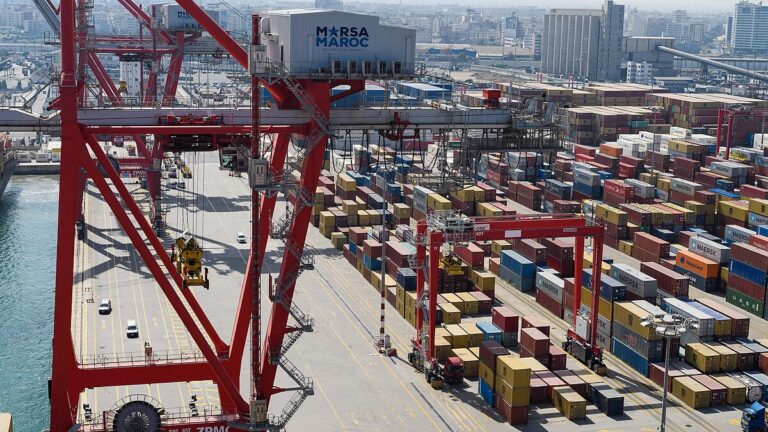
Editorial illustration of global logistics and supply-chain connections. Not a photograph of the EU-CPTPP meeting.
HANOI — The 12 members of the Comprehensive and Progressive Agreement for Trans-Pacific Partnership (CPTPP) have agreed to establish accession working groups for the United Arab Emirates, Indonesia and the Philippines, opening a new phase in the trade bloc’s expansion, according to a ministerial statement issued Friday.
The decision was announced at the CPTPP Commission’s 11th meeting in Hanoi, hosted by Vietnam. Reuters separately reported that the bloc had agreed to begin accession negotiations with the three economies, citing Vietnam’s deputy trade minister.
The move does not mean the three countries have joined the agreement. Each applicant must still go through negotiations and demonstrate that it can meet the pact’s requirements.
Three applicants move to the next stage
The ministerial statement says working groups will be established for the UAE, Indonesia and the Philippines under the CPTPP’s accession procedures. The bloc had begun preparatory discussions with the three economies in June 2026.
The decision follows substantial conclusion of Costa Rica’s accession negotiations in May. However, ministers noted that Costa Rica had decided not to sign its accession protocol at the Hanoi meeting, showing that the process can face political and domestic obstacles even after negotiations advance.
Why the expansion matters
The CPTPP currently includes Australia, Brunei Darussalam, Canada, Chile, Japan, Malaysia, Mexico, New Zealand, Peru, Singapore, the United Kingdom and Vietnam. Adding economies in Southeast Asia and the Gulf could broaden the agreement’s commercial reach and deepen links across manufacturing, services, energy and logistics.
For the UAE, membership would strengthen its engagement with a major Pacific-facing trade framework. For Indonesia and the Philippines, accession could offer another route to trade diversification and closer integration with markets across the Americas, Asia and the Pacific. Those potential benefits would depend on the terms negotiated and the ability of each applicant to meet the agreement’s standards.
Trade tensions shape the wider agenda
The accession decision comes as CPTPP members are seeking to reinforce open and predictable trade amid renewed tariff disputes and concerns about economic coercion and supply-chain vulnerabilities.
In a separate development on the margins of the Hanoi meetings, the European Union and CPTPP members launched a Supply Chain Early Warning Network. The initiative is intended to help participants identify potential disruptions earlier, exchange information and coordinate responses. Its first meeting is expected in early 2027.
Ministers also reaffirmed work to update parts of the CPTPP covering digital trade, services, customs and trade facilitation, with a goal of substantially concluding those negotiations by mid-2027.
What happens next
The new working groups will take forward the accession processes. The ministerial statement does not set a completion date for negotiations with the UAE, Indonesia or the Philippines, and membership should not be treated as guaranteed.
The outcome is nevertheless a significant signal that the CPTPP intends to expand its reach while maintaining the standards of the agreement. The next stage will test whether the three applicants can translate their interest into negotiated commitments acceptable to all members.
Sources: CPTPP Joint Ministerial Statement, 27 November 2026; Reuters; European Commission.
World Media Feed will follow the accession process and its implications for international trade.
About the Author