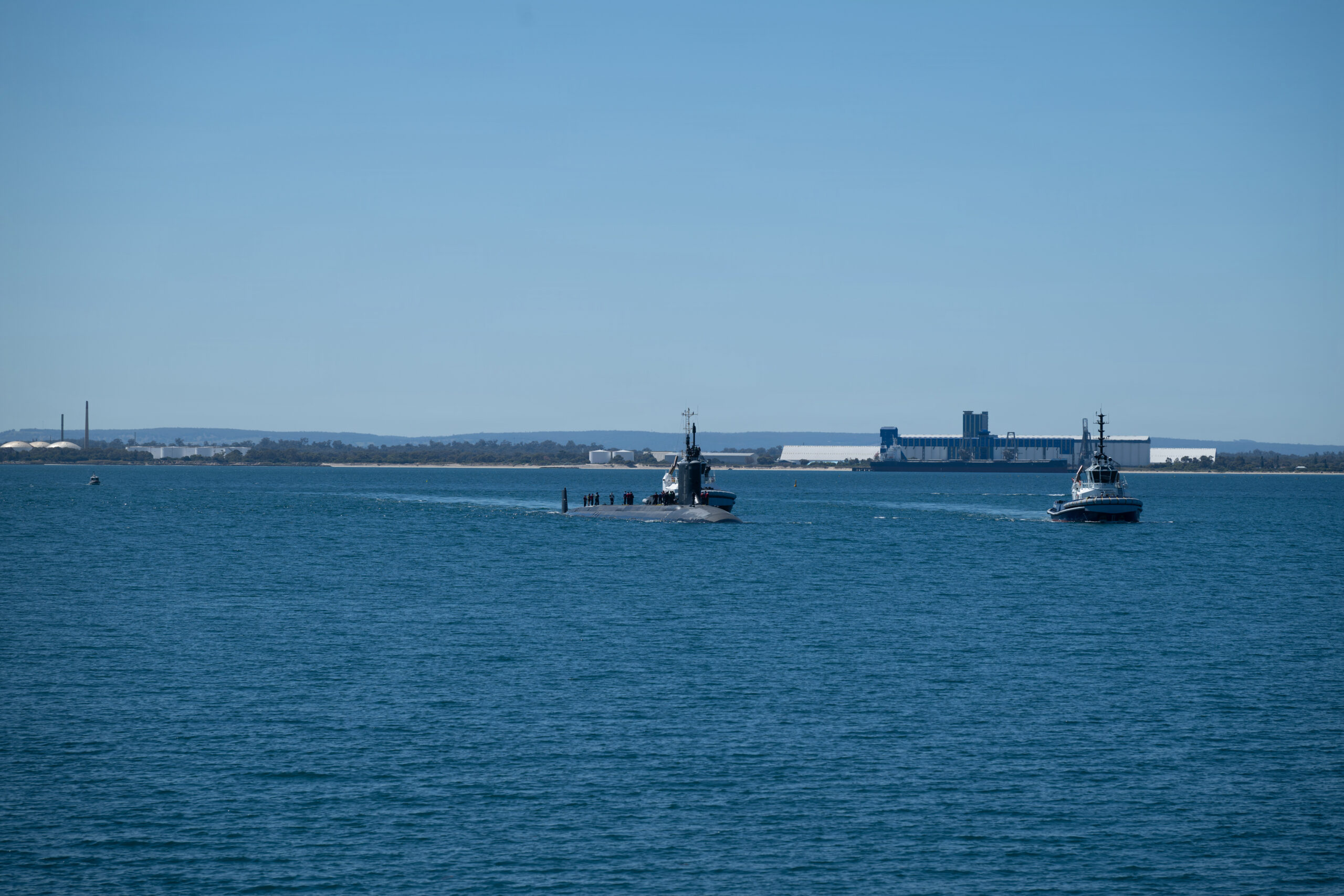
USS Colorado arrives at HMAS Stirling, Western Australia, on October 27, 2026. U.S. Navy photo by Caleb Harper / AUKUS Integration & Acquisition. Public domain.
By World Media Feed Editorial Team
Australia has rejected a warning from the U.S. Congressional Budget Office that the AUKUS submarine agreement could reduce the number of attack submarines available to the U.S. Navy for decades, arguing that the trilateral program remains on track and that American submarine production is increasing.
Australian Defence Minister Richard Marles said Sunday that the budget office’s assessment was wrong and that he was not concerned by its conclusions. His comments came as Australia prepares for the next major stage of the AUKUS nuclear-powered submarine program.
What the U.S. budget office warned
The Congressional Budget Office said in a report this month that selling Virginia-class attack submarines to Australia could place additional pressure on an already constrained U.S. submarine industrial base and reduce the size of the U.S. attack-submarine fleet through 2060.
The concern centers on timing. Under AUKUS, the United States is expected to sell several Virginia-class submarines to Australia from around 2030, while the U.S. Navy is simultaneously trying to replace aging boats and expand production.
Marles dismissed the assessment during a televised interview, saying the United States is increasing its submarine production rate and that the Australian program should also be viewed through the contribution of maintenance and sustainment work.
AUKUS moves toward its next milestone
AUKUS was created by Australia, the United Kingdom and the United States in 2021 as a long-term security partnership focused in part on nuclear-powered submarines and wider defense technology cooperation.
Australia is preparing to establish Submarine Rotational Force-West at HMAS Stirling in Western Australia. The United States and Australia announced in October that USS Colorado would be the first U.S. Virginia-class submarine assigned to the rotational force beginning in late 2027.
Australia is already using U.S. submarine maintenance periods to build domestic skills and infrastructure. The current maintenance activity involving USS Colorado is part of that effort, with Australian personnel working alongside American and British counterparts.
The cost is measured in decades
Canberra has committed about A$368 billion over three decades to AUKUS, including investments connected to American and British submarine production facilities. The scale of the commitment reflects the strategic importance Australia places on acquiring conventionally armed, nuclear-powered submarines.
For Washington, however, the central question is whether transferring submarines and supporting Australia’s capability can be done without worsening existing pressure on the U.S. fleet.
Marles argued that the answer is yes. He said the rotational force in Western Australia will allow U.S. submarines to spend more operational time in the region by providing maintenance and support closer to where they operate.
China remains part of the strategic calculation
AUKUS is also closely linked to the strategic competition in the Indo-Pacific. Australia, the United States and the United Kingdom have described the partnership as part of efforts to strengthen regional security, while China has condemned the arrangement as dangerous and warned that it could contribute to an arms race.
The disagreement over the Congressional Budget Office assessment therefore goes beyond accounting. It reflects a broader debate over how the three countries can expand their combined undersea capabilities while managing industrial constraints and the enormous cost of the program.
Sources and editorial note
This report draws on Reuters reporting published November 22, 2026, Australian Defence Ministry statements and a televised interview with Defence Minister Richard Marles. The Congressional Budget Office assessment is described through Reuters’ account; the CBO had not immediately responded to Reuters’ request for comment outside regular business hours.
Photo: USS Colorado arrives at HMAS Stirling, Western Australia, on October 27, 2026, for a submarine maintenance period supporting AUKUS. U.S. Navy photo by Caleb Harper / AUKUS Integration & Acquisition. Public domain.
About the Author