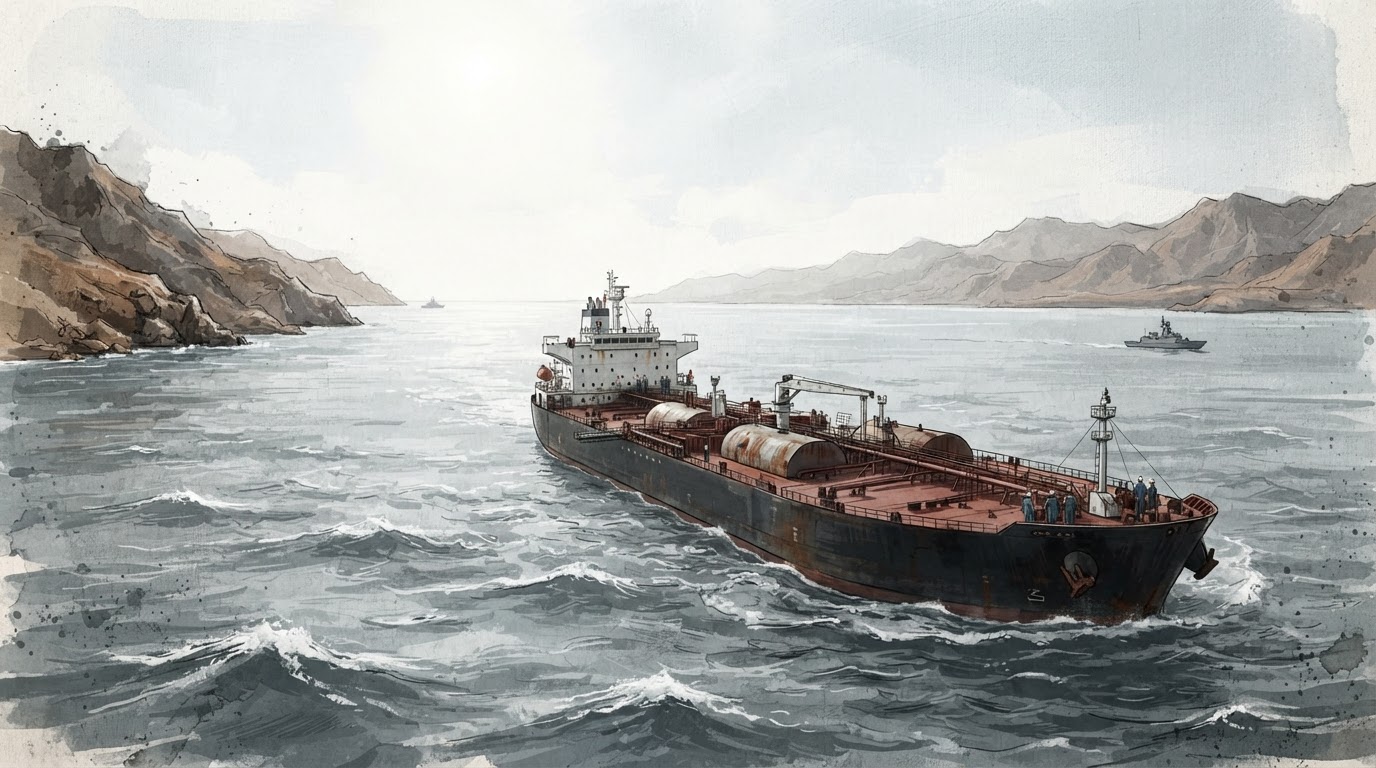
Editorial illustration. Not a documentary photograph.
By World Media Feed Editorial Team
Security tensions across the Gulf intensified on Wednesday after a commercial vessel operated by Abu Dhabi National Oil Company’s logistics arm was attacked while transiting the Strait of Hormuz, leaving one crew member missing and 11 injured. At the same time, Kuwait and Bahrain reported intercepting aerial threats that they attributed to Iran, following a U.S. strike on an Iranian island the previous day.
The developments underline how quickly the confrontation involving Iran and the United States is affecting neighboring states and one of the world’s most important commercial shipping routes. The available public information does not establish who fired the projectile that struck the ADNOC vessel.
ADNOC confirms attack on one of its vessels
ADNOC Logistics & Services said one of its vessels was attacked on the evening of November 17 while transiting the Strait of Hormuz. In an operational update published the following day, the company said one crew member remained unaccounted for as search-and-rescue efforts continued in coordination with the relevant authorities.
The company said all other crew members had been evacuated and that 11 people sustained injuries, with medical care provided where required. ADNOC did not identify the attacker in its public statement and urged the public to rely on official information rather than circulate unverified claims.
The United Kingdom Maritime Trade Operations agency separately reported that local authorities had informed it of a tanker struck by an unknown projectile about 13 nautical miles north of Khasab, Oman. UKMTO said a fire onboard had been extinguished and that a crew member was missing while search-and-rescue operations continued.
The two official accounts describe closely matching circumstances and timing. UKMTO’s incident notice, however, describes the weapon only as an unknown projectile; it does not publicly attribute the attack to a particular state or armed group.
Kuwait and Bahrain report intercepted attacks
Kuwait’s military said its air defenses were responding to hostile drone threats, while Bahrain’s authorities reported intercepting several aerial attacks. Iran’s military said it had targeted U.S. military installations and equipment in the region, including systems at Kuwait’s Ali Al Salem Air Base.
Kuwait condemned the reported attacks and described them as a dangerous escalation. Bahrain also reported defensive interceptions. The public statements establish that the two governments reported aerial threats and defensive action; they do not independently verify every detail of Iran’s stated targets or the extent of any damage.
The incidents followed a U.S. strike on a missile launch site on Iran’s Qeshm Island, according to reporting by CBS News and the Associated Press. The strike was part of a wider cycle of exchanges involving U.S. forces, Iran and regional states. Claims by the parties to the conflict about targets and military effects should be treated separately from independently confirmed damage assessments.
Why the Strait of Hormuz matters to the global economy
The Strait of Hormuz is a narrow maritime passage between Iran and Oman connecting the Persian Gulf with the Gulf of Oman and the Arabian Sea. Its importance extends far beyond the countries bordering it.
According to the U.S. Energy Information Administration, oil flows through the strait averaged 20.9 million barrels per day in the first half of 2025, equivalent to about one-fifth of global petroleum liquids consumption and roughly one-quarter of global maritime oil trade. The International Energy Agency has also identified the waterway as a critical route for oil exports, with much of the traffic destined for Asian markets.
That concentration of energy shipments means prolonged disruption can affect more than crude oil prices. Tanker operators, insurers, energy traders and governments must also account for crew safety, vessel availability, freight costs and the possibility that ships will delay or reroute voyages.
The waterway is also important for liquefied natural gas exports, particularly from Qatar. Alternative pipeline routes can carry some oil around the strait, but they cannot replace all the volumes that normally move by sea.
A growing risk for commercial seafarers
The latest incident adds to a series of maritime security reports in and around the Gulf. UKMTO has issued multiple notices in recent days involving tankers struck by unidentified projectiles, fires onboard and other suspicious activity. The agency has repeatedly advised vessels to transit with caution and report suspicious incidents.
For crews, the danger is immediate. Seafarers working aboard commercial ships are not parties to the military confrontation, yet they can be exposed to fires, explosions, evacuation emergencies and prolonged uncertainty when vessels are operating in contested waters.
The missing crew member from the ADNOC vessel is a reminder that the consequences are not limited to markets or military calculations. The search-and-rescue operation remains a central concern while authorities work to establish the full circumstances of the attack.
Diplomacy faces pressure as regional risks spread
The escalation places additional pressure on diplomatic efforts to contain the conflict. Gulf governments have an interest in preventing attacks from spreading to their territory, protecting energy infrastructure and maintaining access to international shipping lanes.
For Washington and Tehran, the risks extend beyond direct military exchanges. Attacks or perceived threats involving neighboring states can widen the number of governments drawn into the crisis, while incidents at sea raise the possibility of further retaliation and miscalculation.
At this stage, the public record leaves important questions unanswered: who was responsible for the projectile that struck the ADNOC vessel, whether the ship suffered significant structural damage, and whether the missing crew member will be found. The reported interceptions in Kuwait and Bahrain also require continued monitoring for independently confirmed information about damage or casualties.
What is already clear is that commercial shipping has become increasingly exposed to the region’s security crisis. With a major share of global energy trade passing through the Strait of Hormuz, further incidents could carry consequences well beyond the Gulf.
World Media Feed will continue monitoring official maritime warnings, government statements and developments affecting commercial navigation through the Strait of Hormuz.
Sources
- ADNOC — Operational update, November 17, 2026
- United Kingdom Maritime Trade Operations — Recent maritime incident notices
- Associated Press — Gulf attacks, shipping incident and regional developments
- CBS News — Iran, U.S. and Gulf developments, November 18, 2026
- U.S. Energy Information Administration — World Oil Transit Chokepoints
- International Energy Agency — Strait of Hormuz factsheet
Featured image: Editorial illustration created for World Media Feed. It does not depict the actual vessel or attack.
About the Author